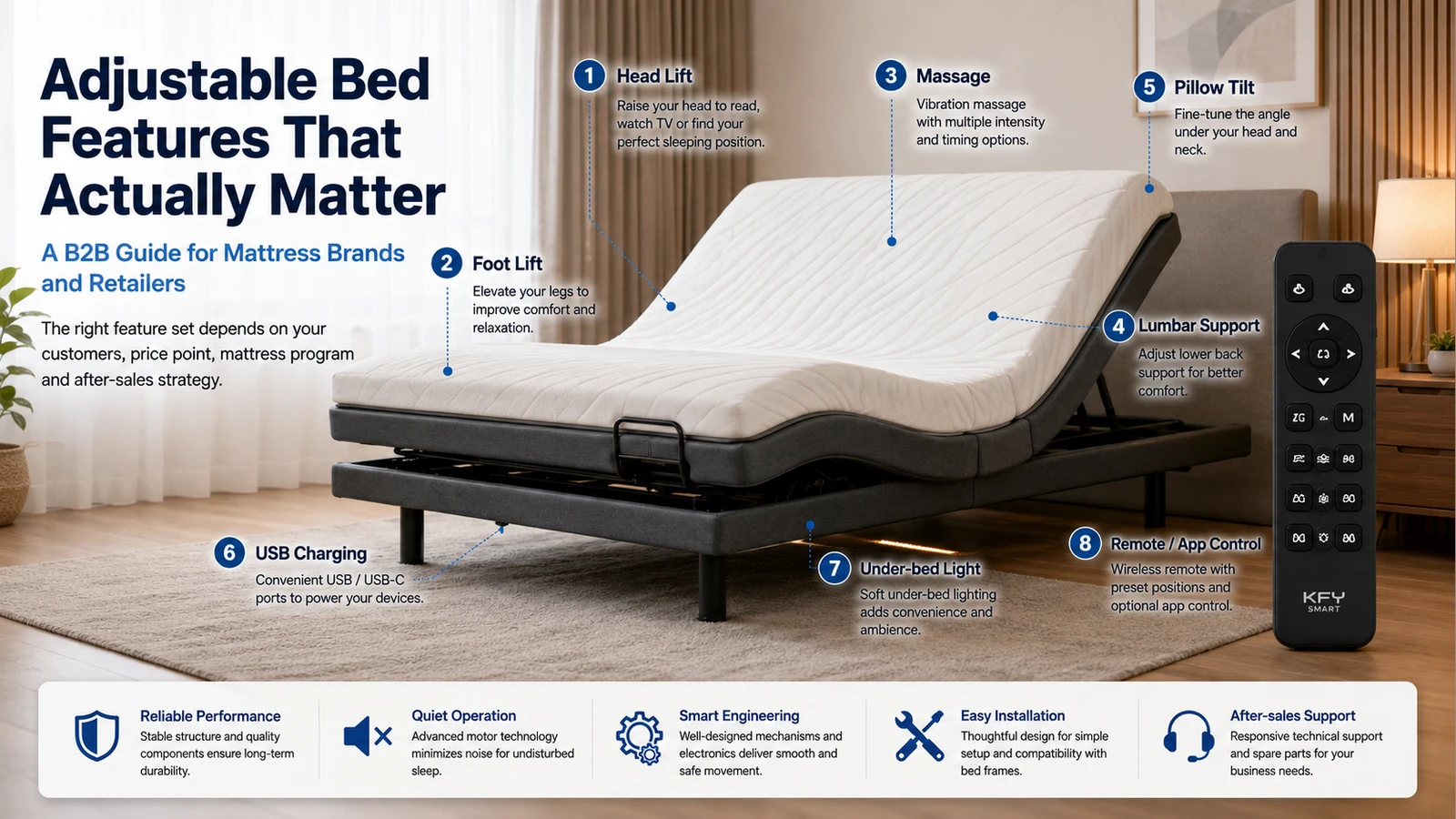
An adjustable bed can be built around simple head and foot movement, or it can combine several positioning, comfort and connected functions. The difficult part for a mattress brand or furniture retailer is not finding a longer list of features. It is deciding which features solve a customer problem, which ones can be demonstrated on the intended product, and which ones the brand can support after the sale.
Two adjustable bases can carry the same feature name and still behave differently. A programmable position, for example, depends on the actual control system. A lumbar function depends on the support mechanism and the mattress used above it. A smartphone app may control movement without collecting any sleep data at all.
What Are the Core Features of an Adjustable Bed?
The first decision is which movements the product must perform. A simple head-adjustable platform can serve a different commercial purpose from a base with both head and foot adjustment. For a full-featured mainstream program, the following questions provide a useful starting point.
| Core decision | What the buyer should review |
|---|---|
| Head and foot movement | Required axes, approved range and behaviour with the intended mattress |
| Flat position | How the user returns to flat under normal power and the documented limits |
| Control | Button logic, usability, supported commands and replacement compatibility |
| Movement quality | Smoothness, stability, operating noise and agreed test conditions |
| Physical fit | Support structure, mattress flexibility, retention and installation requirements |
These are proposed buying criteria, not universal performance specifications. A motor's catalogue rating alone does not describe the movement quality of a complete bed. The frame geometry, linkage, support surface, mattress and control behaviour all influence the finished experience. Review the intended mattress-and-base combination rather than approving the base in isolation.
The Purple adjustable-base range illustrates why product levels should not be treated as interchangeable: its published comparison distinguishes an entry head-elevation model from models with additional motion and control features. These are Purple's own model descriptions, not independent performance tests or specifications for KFY SMART.
Are Preset Positions Worth Adding?
A preset can make repeated positioning easier. The customer should be able to understand what the button does without learning the underlying actuator arrangement. A buyer, however, should know whether the position is fixed, programmable or resettable, and how the control behaves when the command is interrupted.
For an OEM sample, demonstrate the actual preset and the return-to-flat command using the intended mattress. Where a split configuration is offered, confirm independent and synchronized operation separately. Record the approved button mapping with the sample revision.
What Is a Zero-Gravity Adjustable Bed?
Zero Gravity generally describes a preset that moves the head and foot sections into a reclined posture. The term does not establish a universal angle, a medical result or the same position across different products. It is a feature of the motion system rather than a distinct mattress material.
For a retail program, describe the supported posture and show it on the approved configuration. If the feature is optional, identify the exact SKU on which it is available. Check the E1–E4 adjustable base range before specifying a private-label feature list.
Zero Gravity, Zero Clearance and Wall Hugger: Different Decisions
Zero Gravity is a positioning decision. Zero Clearance concerns whether a particular supported installation is permitted. Wall Hugger concerns how the platform moves relative to its surroundings during articulation. A product can support one capability without supporting the others.
For furniture integration, use the separate zero-clearance installation guide and wall-hugger movement guide. Do not use a comfortable-looking reclined image as proof of either installation or wall-saving capability.
Massage: Useful Upgrade or Marketing Feature?
Massage in many adjustable bases refers to vibration generated by dedicated components. It can provide a distinct showroom experience, but buyers need to understand the actual sensation with the intended mattress, where the components are located and what the handset can control. A thick or differently constructed mattress may change how vibration feels to a user; demonstrate the proposed combination rather than assuming a particular result.
Specify the supported zones, control settings and operating conditions, where applicable. Confirm whether the massage components are independently serviceable and whether the function is included or optional in the quotation. A vibration demonstration is not evidence of a therapeutic massage effect.
What Do Lumbar Support and Pillow Tilt Add?
Lumbar Support
An adjustable lumbar mechanism changes support in a localized area of the platform. Unlike a broad head-lift movement, it may introduce an additional mechanical interface that needs to work with the mattress above it. The buyer should review the exact support mechanism, approved range, interaction with other movements and service access.
Compare the supported posture with the lumbar feature off and on. Do not promise pain relief or a specific pressure-distribution outcome simply because a lumbar mechanism exists.
Pillow Tilt or Head Tilt
Pillow tilt can refer to additional articulation near the upper part of the bed. The actual structure and range depend on the platform. Check whether it is an independently controlled movement, how it interacts with the main head section and whether the intended mattress accommodates it. Review the mattress retention system as part of the complete assembly.
Massage vs. Lumbar Support vs. Pillow Tilt: Which Should a Buyer Choose?
These are different functions, not three names for the same premium feature.
| Function | Product role | Key evidence before approval |
|---|---|---|
| Massage | A selectable vibration experience | Demonstration through the specified mattress; agreed controls and service scope |
| Lumbar support | Localized adjustable support, where provided | Mechanism and mattress interaction; approved motion and service plan |
| Pillow tilt | Additional upper positioning, where provided | Independent or linked command behaviour; approved movement with the mattress |
Choose based on the intended user and retail proposition. For example, a positioning-focused premium program may prioritize upper articulation, while a showroom-focused relaxation program may prioritize a demonstrable vibration function. Neither example is a recommendation that all premium products require these features.
Which Convenience Features Matter?
USB and USB-C Charging
A charging port can be convenient, but the connector shape alone does not identify its output capability. Confirm port type, location, rated output, supported charging behaviour and destination-market electrical requirements against the actual component documentation. Avoid claiming fast charging unless the exact configuration supports it and evidence is approved.
Under-Bed Lighting
Lighting can make a feature package easier to demonstrate. Confirm how it is activated, whether it has a timer or other control mode, and how it is serviced. It should not be advertised as a safety or fall-prevention guarantee without appropriate substantiation.
Adjustable Legs
Leg options affect finished height, assembly and the surrounding furniture. Verify the approved leg configuration and support requirements rather than assuming any base may be installed without legs. See the bed-frame compatibility guide for broader installation decisions.
When Do Smart Features Make Sense?
The term smart bed is used for different product architectures. A finished upholstered bed with powered articulation is not necessarily a sensor-equipped sleep monitoring system. Likewise, a base that can be operated from a smartphone does not automatically offer automation or personalized sleep insights.
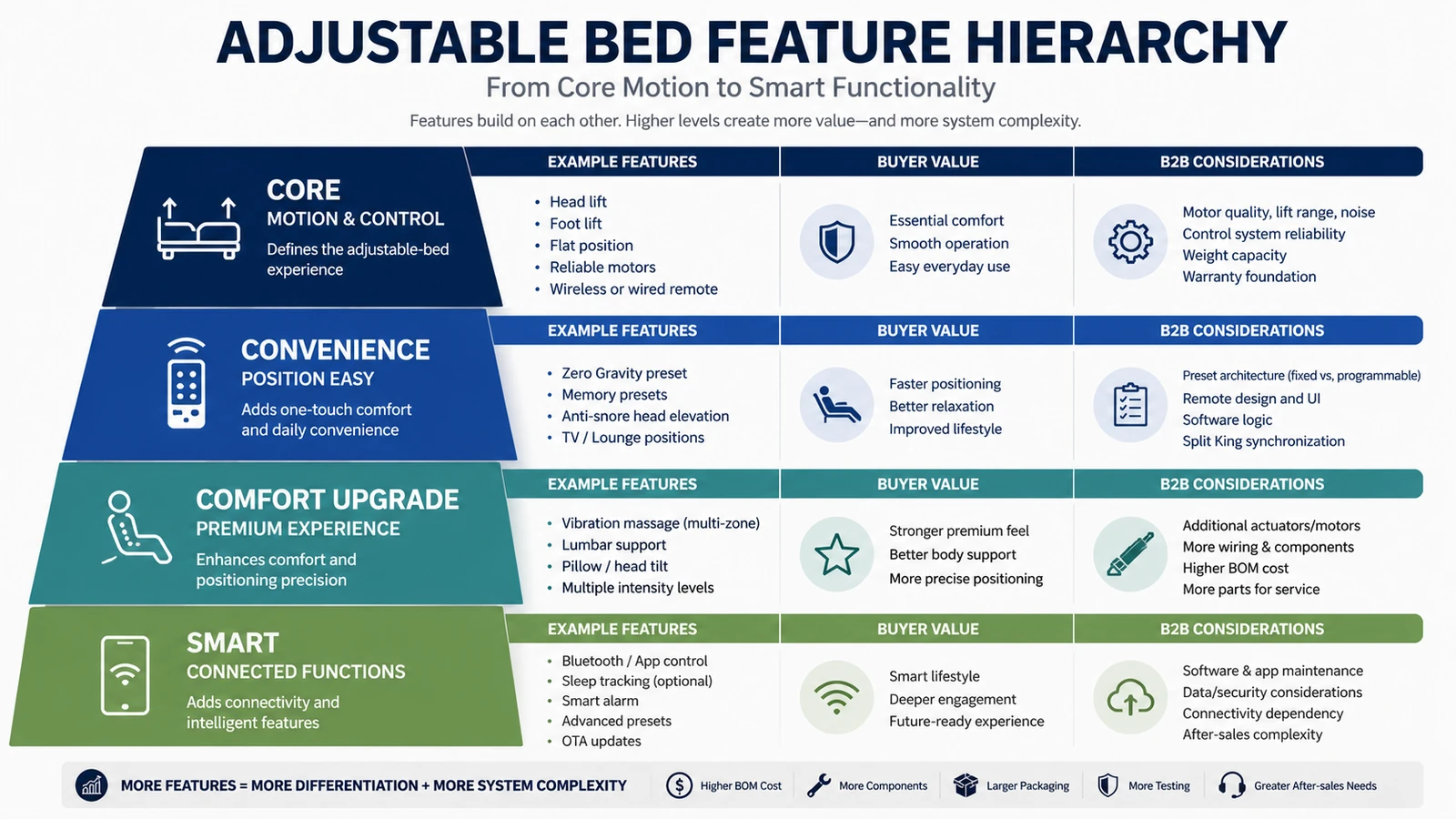
Separate the Three Function Layers
| Layer | What it does | What it does not establish |
|---|---|---|
| Motion and local control | Executes supported positioning commands through approved controls | Internet connectivity, sleep measurement or medical benefit |
| Connected control and automation | Allows supported app commands or defined automated routines | Sensor measurement or validated health outcomes |
| Sleep sensing and insights | Collects specified signals and produces supported estimates or feedback | Clinical diagnosis, therapeutic effectiveness or accuracy across every user |
The layers are not a mandatory upgrade sequence. A manufacturer can develop a connected product without sleep sensing, or a sensing product without a moving platform. A physical remote remains valuable where it meets the intended use and is supported by the product design.
For a finished upholstered format, the KFY SMART S1–S4 smart bed range provides a separate product category from the E-series motion platforms. Confirm the actual functions for each chosen configuration. The word smart in a product name should never be used as evidence of sensors, cloud access or AI capabilities.
Validate the Connected Experience Before Launch
The consumer-facing setup may involve a compatible phone, app, operating system, account, network or another dependency. The buyer should establish which of these are genuinely required and what happens when they are unavailable. For instance, Sleep Number's official technology compatibility requirements identify supported devices and network conditions for its own smart-bed systems. These requirements illustrate a product-specific dependency, not a universal specification.
For a connected OEM program, request a documented function map, supported markets and languages, account/setup requirements, behaviour without internet access, update responsibility, replacement-phone procedure and escalation route. Any offline behaviour must be checked for the actual model; do not promise it based on the presence of a remote.
If sleep data is collected, establish what data the system uses, where it is processed, who can access it, what controls the customer has, and who is responsible for support and applicable privacy obligations. Sleep Number's SleepIQ technology description and privacy mode documentation are examples of a specific company's published sensing and privacy controls, not a representation of KFY products.
Distinguish Sleep Insights From Medical Claims
The National Sleep Foundation's 2026 position statement on consumer sleep technology emphasizes understanding the potential uses and limitations of these technologies. Its June 30, 2026 smart-bed data report pairs survey findings with data from a particular commercial sleep-tracking ecosystem. Neither source demonstrates that an unrelated adjustable bed improves sleep or measures sleep accurately.
For U.S. marketing, the FTC's health products compliance guidance explains the importance of substantiating objective and implied claims, particularly health claims. Review destination-market requirements separately. Do not describe a consumer comfort product as a medical diagnostic or treatment device without an appropriate, separately established regulatory and evidence basis.
KFY SMART's Feature-to-Evidence Approval Framework
KFY SMART proposes a practical six-field record for every feature a B2B buyer plans to advertise. It connects the selling proposition to the engineering and service information needed to support that proposition. This is a proposed procurement tool, not a published testing standard or a record of completed factory tests.
| Record field | Required decision |
|---|---|
| Customer use case | What situation does the feature address, and why is it valuable for this tier? |
| Defined function | What exact movement, command, accessory or output is delivered by this SKU? |
| Operating conditions | What mattress, installation, supply, device or other conditions apply? |
| Evidence reference | Which approved specification, sample demonstration, test record or other evidence supports the claim? |
| Approved retail wording | Which statement is supported, what qualifications must be visible and what is excluded? |
| Lifecycle owner | Who handles setup guidance, revisions, replacement parts, software where applicable and customer escalation? |
An Illustrative Feature Review
Consider a retailer requesting an app-controlled base as an upgrade. A sample moves when a phone button is pressed. That demonstration supports only the observed command on that particular setup. It does not establish compatibility with every phone, operation without internet, future app support or sleep monitoring. Before release, the retailer should agree on the supported phone requirements and markets, approved setup instructions, fallback behaviour and responsible support team. If an evidence item is missing, mark it pending rather than treating it as included.
The same logic applies to a purely mechanical feature. A demonstration of lumbar movement without the intended mattress does not establish the user experience with that mattress. The buyer should record the test configuration and separately approve the descriptive retail wording.
Feature Claim Review Status
Use four simple status values: approved with evidence, optional and subject to confirmation, not supported, and pending verification. The last two should never be converted into sales promises. Optional functions should be attached to the relevant model or quotation, not advertised across an entire range. If an electronics or mechanical revision changes the evidence behind a claim, return that claim to review before releasing new packaging or listings.
Features That Also Increase After-Sales Complexity
An additional actuator or vibration motor can create a separate replacement item. A connected function may create ongoing software or account support responsibilities even where the mechanism itself has not changed. Consider both the physical service chain and the digital service chain when approving a new feature.
For physical systems, identify the base model, component revision, compatible replacement part and authorized service pathway. For connected systems, identify the app owner, supported versions, documentation responsibility and support contact. A useful service record tells a retailer what was actually shipped rather than relying on the appearance of a remote or a marketing name.
Use the remote control systems guide for control architecture, the spare parts guide for parts planning, and the power-outage guide for documented emergency behaviour. A normal flat command is not evidence of emergency lowering when electricity is unavailable.
How Should Brands Build a Good-Better-Best Adjustable Bed Line?
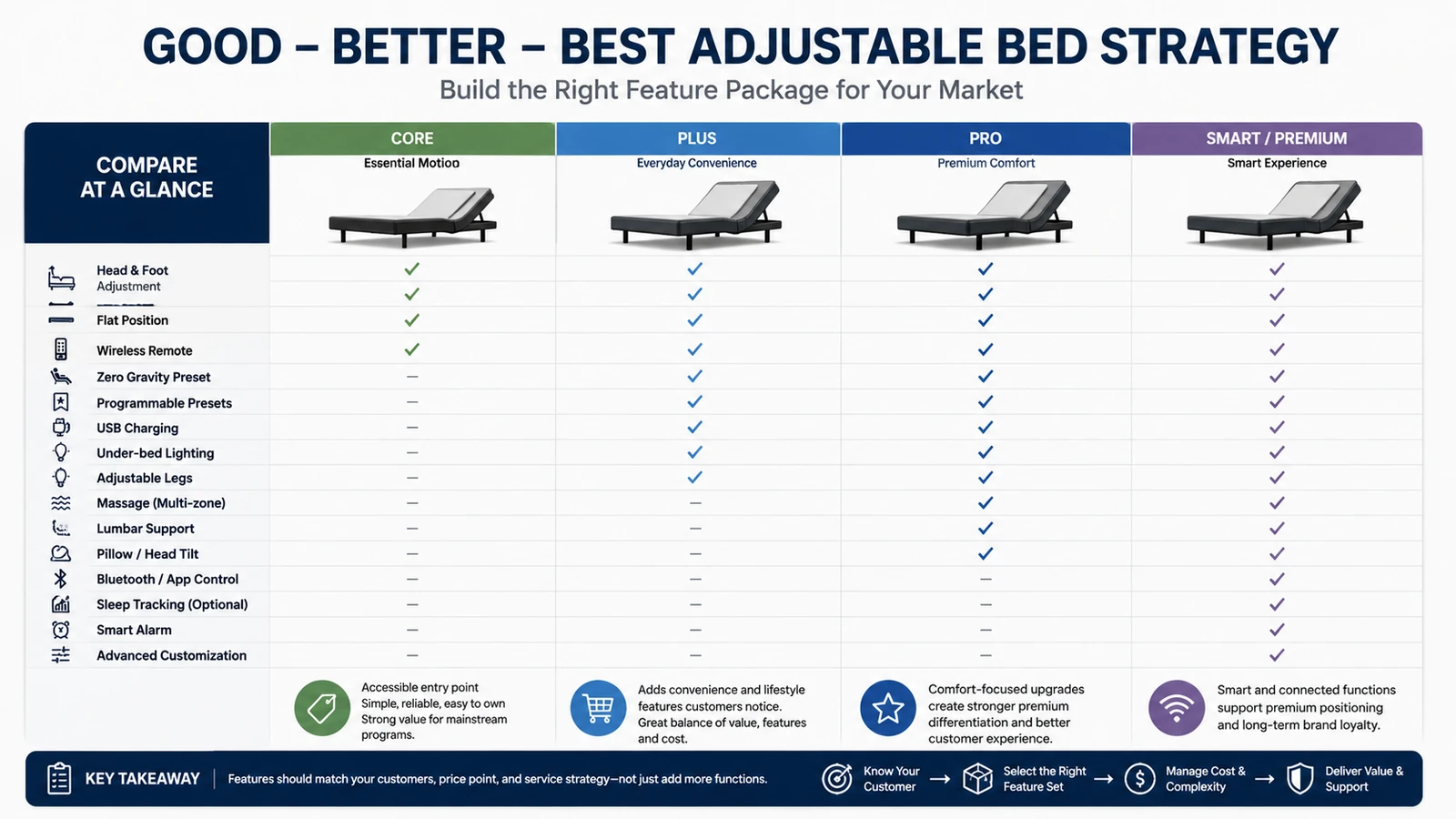
The following is an illustrative feature package model, not a KFY E-series specification or an assertion that any tier must contain every listed option.
| Tier | Example priority | Reason to trade up |
|---|---|---|
| CORE — Motion | Required head/foot adjustment and intuitive control | Access to the essential adjustable experience |
| PLUS — Convenience | Selected presets, lighting or charging | Easier repeated use or practical convenience |
| PRO — Advanced positioning | Selected massage, lumbar or pillow tilt functions | A demonstrable difference in positioning or relaxation experience |
| SMART — Connectivity | Selected connected controls or other separately validated capabilities | A useful connected experience, with support defined |
Do not simply move all possible functions into the highest-priced product. Every addition should have a customer-facing reason and an approved support plan. A premium mechanical product can be commercially appropriate without app connectivity. A connected entry model can also make sense in a channel that values a specific digital function.
For a complete assortment and channel strategy, see the B2B retail assortment guide.
Feature Planning Is Also Cost Planning
A feature can affect the bill of materials, electronics, assembly, packaging, inspection, training, spare parts, warranty exposure and ongoing software support. The unit quotation alone may not capture all of those obligations.
When comparing two quotations, align the included configuration first. If an app, remote, cable, special control box or additional actuator is excluded from one quotation, record that difference before comparing price. Separate upfront development and tooling, per-unit cost, service stock and ongoing support obligations where relevant. Confirm commercial terms with the selected supplier; do not assume a fixed cost premium for any feature.
A useful purchasing decision is one that retains its meaning when it moves from quotation to approved sample, production release and retail documentation.
What Should Buyers Ask Before Selecting Adjustable Bed Features?
Use this checklist before approving a feature package:
- Which functions are essential to the customer's intended use, and which are optional differentiators?
- Which precise model, size and revision supports each advertised function?
- What commands, movement conditions and mattress pairing have been approved?
- Which physical components or connected services does the function depend on?
- Are presets fixed or programmable, and how do reset and interruption behave?
- What phone, account, network or software requirements apply, if any?
- What evidence supports each retail claim, including any health-related wording?
- What accessories, instructions and documentation are included in the actual quotation and packaging?
- Who owns component compatibility, replacement parts, software support and warranty responsibilities?
- How will the approved feature record be checked when production components or software change?
Attach the feature-to-evidence record to the approved sample specification. Use the OEM sampling guide for the broader acceptance plan and the RFQ checklist to communicate the commercial scope before quotation.
FAQ
What are the most important adjustable bed features?
For a mainstream full-articulation program, prioritize dependable head and foot movement, smooth operation, intuitive control and a reliable way to return to flat. Other features should be selected for the customer, channel and approved configuration.
Is Zero Gravity a necessary adjustable bed feature?
No. It is a positioning preset that can add convenience. Its actual posture and control behaviour vary by model; it does not establish a medical benefit or a universal angle.
Is massage worth adding to an adjustable bed base?
It can differentiate a relaxation-focused product, but buyers should demonstrate the actual experience through the intended mattress and account for the added controls, components and service requirements.
What is lumbar support on an adjustable bed?
It generally refers to an additional localized support or positioning mechanism. The structure, range and interaction with a mattress need to be confirmed for the selected model.
What is pillow tilt on an adjustable bed?
It refers to additional upper articulation in designs that support it. The available movement and whether it can be controlled independently are model-specific.
Are app-controlled adjustable beds better than remote-controlled bases?
Not automatically. An app may add convenient control, but suitability depends on the customer's preferences, the actual supported functions, setup requirements and long-term support. A well-designed physical remote may be sufficient for a particular program.
Does every smart bed track sleep?
No. Powered motion, connected control and sleep sensing are different capabilities. Check the actual configuration and documentation instead of assuming sleep tracking from a smart bed label.
Can an adjustable bed improve sleep or relieve pain?
An adjustable bed can provide selectable positions where supported. A specific sleep or health outcome cannot be inferred from movement alone. Any health-related claim needs appropriate evidence for the exact product and intended use.
What should a B2B buyer verify before approving an adjustable bed feature?
Confirm the intended customer use, exact configuration, supported function, operating conditions, evidence, approved retail wording and the team responsible for lifecycle support. Record the decision against the approved sample and release revision.
Build the Right Adjustable Bed Feature Package
KFY SMART works with mattress brands, furniture companies and distributors on adjustable bed base and finished smart bed programs. Product development and quality coordination are conducted with strategic manufacturing partners. The available structure, controls, customization and support scope depend on the selected platform and project requirements.
Share your target market, retail channel, product format, mattress construction, dimensions, required positioning functions, optional features, branding needs and estimated order volume. We can discuss a suitable project scope and identify the functions that require further technical confirmation before quotation or sample approval.
Explore Adjustable Bed Bases
Explore Finished Smart Beds
Discuss Your OEM / ODM Project
Further reading: Split King vs. King configurations and adjustable base weight and structure.
Sources & References
- Purple — Adjustable Bases: manufacturer descriptions of selected configurations; not independent tests.
- Sleep Number — App and Smart Bed Technology Compatibility Requirements: product-specific connected-system requirements.
- Sleep Number — What Is SleepIQ Technology?, September 18, 2026: company description of mattress sensing and user insights.
- Sleep Number — App Privacy Mode, September 18, 2026: model-specific privacy functionality.
- Dzierzewski et al., Consumer sleep technology: A position statement from the National Sleep Foundation, Sleep Health, April 2026; online March 5, 2026. DOI: 10.1016/j.sleh.2026.02.003. Scientific/association guidance, not a product endorsement.
- National Sleep Foundation — Smart Bed Data, June 30, 2026: survey and a specific commercial sleep-tracking dataset, not evidence of KFY capability.
- U.S. Federal Trade Commission — Health Products Compliance Guidance: general U.S. claim substantiation guidance; not legal clearance for a specific product.