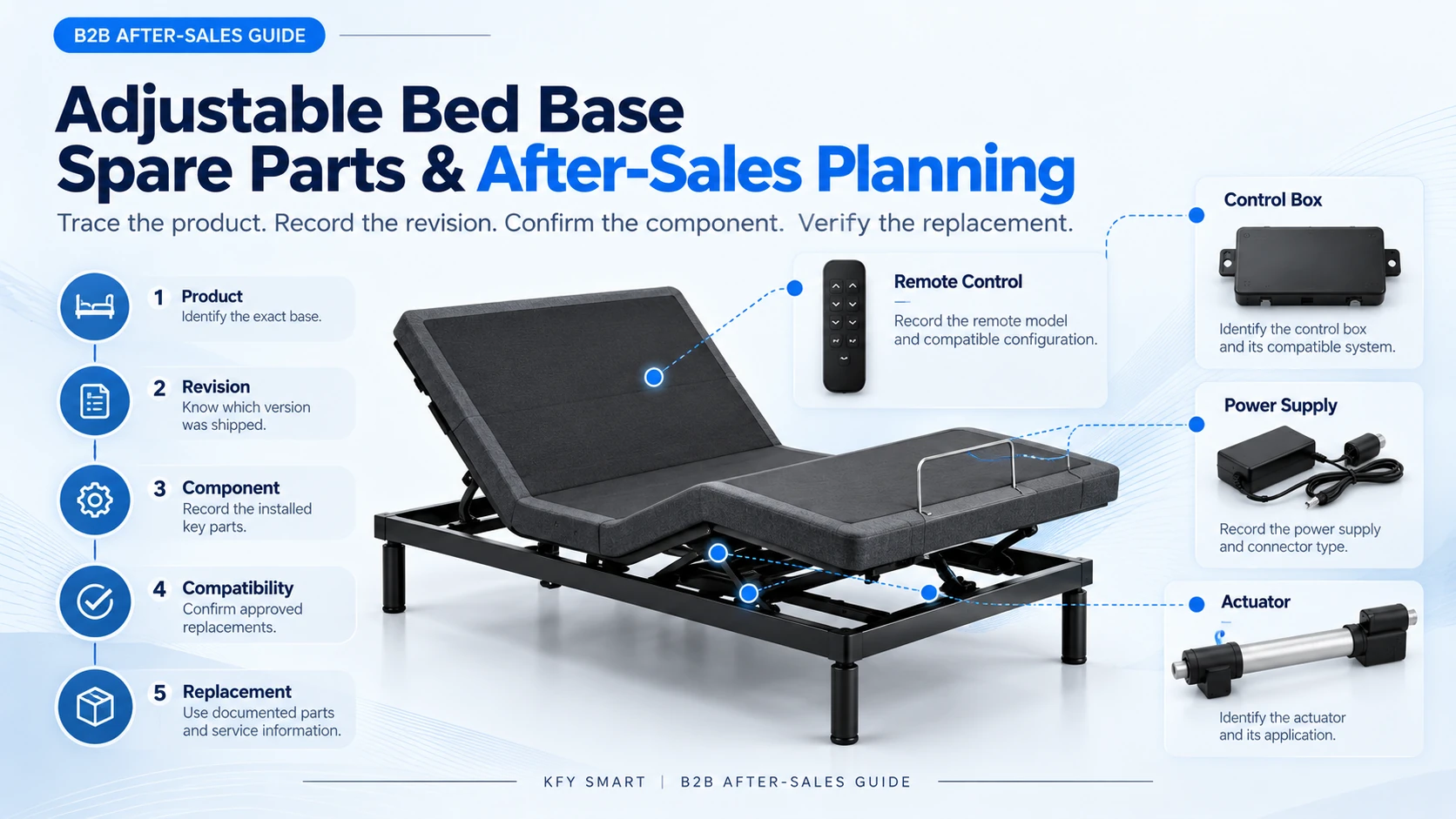
For an adjustable bed base program, after-sales planning should not begin when the first customer reports a problem.
It should begin before mass production.
A remote control may be lost. A power supply may need replacement. A control box may need to be identified several years after shipment. A retailer may need to know which component belongs to an older production batch. A private-label brand may discover that two visually similar replacement parts are not actually interchangeable.
For an end user, these situations look like individual service problems.
For mattress companies, furniture brands, distributors and private-label buyers, they point to a larger B2B question:
Can the exact product configuration still be identified and supported after it has entered the market?
That is why spare-parts planning should be treated as part of product specification and lifecycle management—not simply as a warranty issue.
Quick Answer: What Should B2B Buyers Confirm About Adjustable Bed Spare Parts?
Before approving an adjustable bed base for mass production, B2B buyers should confirm how the finished product and its critical components will be identified later.
A useful after-sales reference should connect:
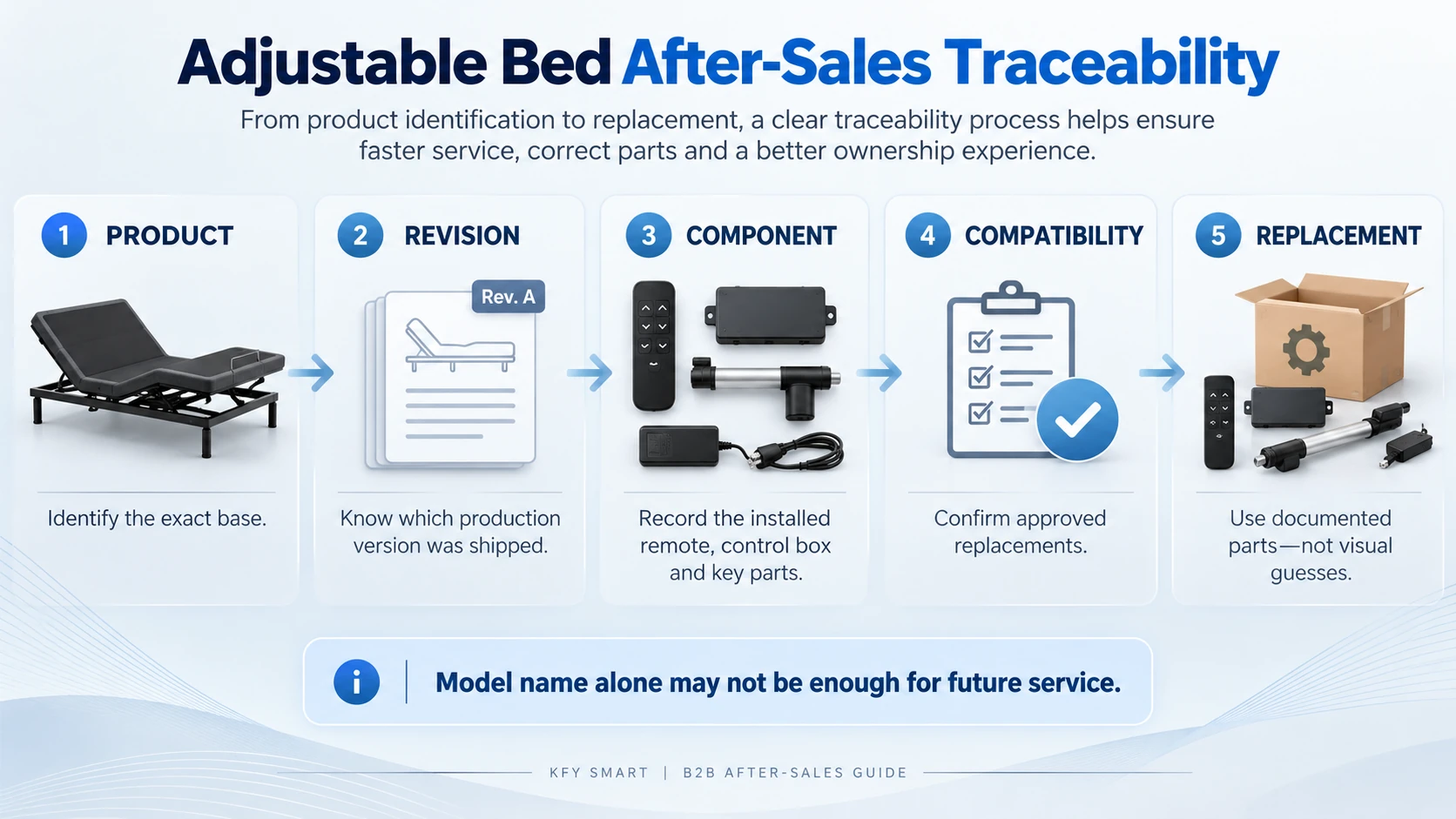
Product Model → Production Revision → Remote → Control Box → Power Supply → Actuator / Drive Components → Connectors → Approved Replacement → Documentation
The exact components vary by adjustable-base design.
The important point is not to create one universal spare-parts list.
It is to create a traceable record for the specific production configuration being purchased.
This makes future troubleshooting, replacement-part matching, repeat orders and product changes easier to manage.
Why Spare-Parts Planning Starts Before Mass Production
During sourcing, most attention naturally goes to product functions.
Buyers compare:
- head and foot articulation;
- remote-control functions;
- preset positions;
- massage options;
- USB or lighting;
- app control where applicable;
- frame structure;
- mattress compatibility;
- packaging;
- price.
These questions matter.
But once a product enters the market, another question becomes equally important:
Can the buyer identify exactly what was installed in that production batch?
Consider a private-label adjustable base sold for several years.
A customer contacts the retailer because the remote no longer works.
The retailer sees the brand name and bed model, but that information alone may not establish:
- which control system was installed;
- whether the remote changed between production revisions;
- which control box is compatible;
- whether the original component is still available;
- whether an approved replacement exists;
- whether replacement requires pairing or another service procedure.
This is why sample approval and after-sales planning should connect.
The approved production reference should not only define what the factory must manufacture today.
It should also provide enough information to identify the product tomorrow.
Adjustable Bed Spare Parts Are a Compatibility Question
One of the biggest mistakes in after-sales support is assuming that two components are compatible because they look similar.
That can be risky with adjustable-bed electronics.
Major adjustable-base brands use product identifiers, serial numbers, part numbers or production versions to help determine replacement compatibility.
For example, replacement remotes sold by established adjustable-base manufacturers are commonly listed for specific product families or part numbers rather than presented as universal devices.
Some products can even have different replacement components for different production versions of the same adjustable-base model.
The B2B principle is simple:
Appearance is not proof of compatibility.
A replacement component should be confirmed against the exact product configuration.
That applies not only to remotes.
Depending on the product architecture, compatibility questions can also involve:
- control boxes;
- power supplies;
- actuators;
- cables;
- connectors;
- synchronization components;
- accessories;
- software or app-related hardware.
The exact replacement rules should come from the selected product specification and component supplier—not from visual comparison alone.
Product Revision Can Matter More Than the Model Name
A product model may remain commercially unchanged while an internal component changes.
That is normal in many manufactured products.
A supplier may update a control component because of:
- component availability;
- supplier changes;
- engineering improvement;
- market requirements;
- cost optimization;
- certification requirements;
- control-system updates.
But from an after-sales perspective, a component change can create an important question:
Does the new component remain compatible with the previous production version?
The answer cannot be assumed.
A component change may affect:
- remote compatibility;
- connectors;
- control functions;
- pairing procedures;
- replacement options;
- labels;
- manuals;
- troubleshooting documents.
That is why a useful B2B production record should include a revision or effective production reference, rather than recording only the commercial model name.
For example:
| Field | Example of What to Record |
|---|---|
| Finished Product | Approved adjustable-base model |
| Production Revision | Approved revision / effective batch |
| Control Box | Installed approved reference |
| Remote | Installed approved reference |
| Power Supply | Installed approved reference |
| Actuator | Installed approved reference |
| Manual | Approved document version |
| Effective Production Date | When the configuration entered production |
The exact identification format can vary.
What matters is that future teams can determine what was actually shipped.
Which Adjustable Bed Components Should Be Traceable?
Not every component needs the same after-sales strategy.
Start with the components most relevant to product operation, identification and future service.
Remote Control
Record:
- approved remote reference;
- functions included;
- compatible control configuration;
- product or part number where applicable;
- relevant pairing or operating documentation.
Do not assume that another remote with the same button arrangement will work.
Control Box
The control box can act as an important interface between the remote, power system, actuators and additional functions.
Record:
- exact approved reference;
- connected functions;
- connector configuration;
- compatible remote or control method;
- production revision.
If the control system changes later, check whether after-sales compatibility changes as well.
Power Supply
Power components should be identified by the selected product configuration.
Important information can include:
- approved component reference;
- electrical specification;
- connector type;
- destination-market configuration.
Do not substitute a power component based only on physical appearance.
Actuator / Drive Components
Adjustable bases can use different drive architectures.
Depending on the model, an actuator may control:
- head articulation;
- foot articulation;
- additional movement functions.
Buyers should know which actuator configuration belongs to the approved product and what information will be required if service is needed later.
Cables and Connectors
Cables are easy to overlook because they appear simple.
But connector type, wiring configuration and system architecture can change replacement compatibility.
When a cable or connector is service-critical, record it as part of the approved configuration.
Mechanical Accessories
After-sales planning may also include model-dependent items such as:
- mattress retainers;
- legs;
- brackets;
- selected hardware;
- synchronization accessories.
These should still be matched to the specific product where compatibility matters.
Build a Spare-Parts Compatibility Matrix
For OEM and private-label programs, a simple spreadsheet can prevent a surprising amount of confusion later.
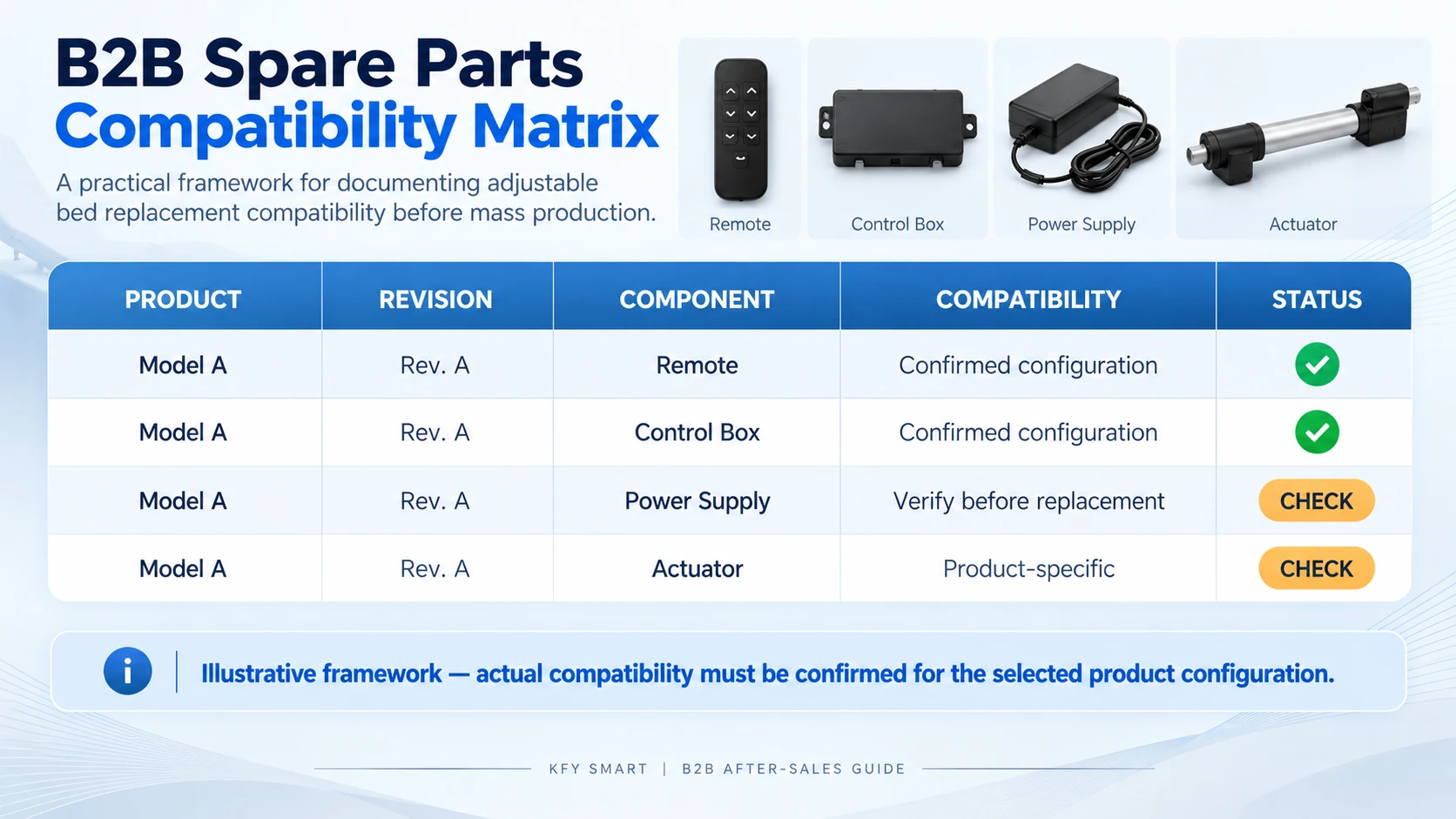
A practical matrix might include:
| Product | Revision | Component | Component Reference | Compatibility | Document | Replacement Status |
|---|---|---|---|---|---|---|
| Model A | Rev. A | Remote | Approved reference | Rev. A only / confirmed range | Manual version | Confirm |
| Model A | Rev. A | Control Box | Approved reference | Confirmed configuration | Wiring reference | Confirm |
| Model A | Rev. A | Power Supply | Approved reference | Confirmed configuration | Specification | Confirm |
| Model A | Rev. A | Actuator | Approved reference | Confirmed position/function | Service reference | Confirm |
For a more complete system, add:
- label photo;
- connector photo;
- supplier confirmation;
- effective production date;
- last production date;
- replacement part;
- superseded part;
- replacement lead time;
- warranty relationship;
- service notes.
Do not fill these fields with assumptions.
If replacement availability has not been confirmed, record it as To Be Confirmed.
That is better than creating a false sense of certainty.
Spare-Parts Availability and Warranty Are Different Questions
A warranty defines commercial responsibilities under specific terms and conditions.
Spare-parts planning answers a different question:
How can the product be identified and supported when a component needs attention?
These topics overlap, but they are not interchangeable.
For example, a buyer may need to know:
- whether a component is covered by warranty;
- whether it can be replaced separately;
- whether an approved replacement exists;
- whether the original component has been superseded;
- how long replacement supply is expected to continue;
- whether labor or installation is included;
- who confirms compatibility.
The answers depend on the supplier, product and commercial agreement.
Therefore:
Warranty coverage ≠ guaranteed long-term spare-parts availability.
Both should be discussed during sourcing.
For more detail on warranty evaluation, see the KFY SMART Adjustable Bed Base Warranty B2B Guide.
What Should a Private-Label After-Sales File Contain?
A strong private-label program should leave enough information for a future service team to understand the product without relying on the memory of the original salesperson.
A practical after-sales file can include:
1. Approved Product Specification
The final production configuration—not an early quotation.
2. Production Revision Record
Record when important component or configuration changes became effective.
3. Component Identification
Include the approved references for critical electronic and mechanical components.
4. Product and Component Label Photos
Photos can help future teams identify a product even when documentation is incomplete.
5. Manuals
Keep the manual version connected to the correct production configuration.
6. Wiring or Connection Reference
Where appropriate, retain the approved reference for control-system connections.
7. Replacement Compatibility Information
Record confirmed replacements and any restrictions.
8. Troubleshooting Documentation
Use product-specific procedures rather than generic instructions.
9. Warranty Information
Record the applicable warranty terms and process.
10. Escalation Path
Define who should review cases that cannot be resolved through normal documentation.
For distributors operating across multiple markets, maintaining these records can make support substantially more structured.
Component Changes Should Trigger an After-Sales Review
In OEM/ODM production, a component change should not be treated as a purchasing substitution only.
Suppose a different control box is proposed during repeat production.
Before approval, ask:
- Does it provide the same required functions?
- Does it use the same remote?
- Are the connectors unchanged?
- Does the wiring change?
- Does the manual need updating?
- Do labels change?
- Does the replacement strategy change?
- Can old and new versions be identified in the market?
The same principle applies to other service-critical components.
A technically acceptable production change may still create an after-sales problem if the two versions later become difficult to distinguish.
For private-label brands, change control should therefore consider both:
Production Compatibility + Future Serviceability
What Information Should Be Collected Before Requesting Support?
When an adjustable-bed service request arrives, replacing components immediately is rarely the best first step.
Start by identifying the product.
A useful support record can include:
Product Identification
- finished product model;
- serial number or production identifier where available;
- approximate production or purchase date;
- product label photos.
Component Identification
- remote front and back;
- control-box label;
- power-supply label;
- relevant actuator or component label.
Symptom
Avoid vague descriptions such as:
“The bed is broken.”
Instead record:
- which function is affected;
- which functions still work;
- whether the issue is continuous or intermittent;
- when it started;
- whether any component was recently changed.
Installation
Where relevant, note:
- single or split configuration;
- furniture installation;
- destination-market electrical setup;
- recent relocation or reinstallation.
Visual Evidence
Photos or short videos can help a supplier understand the exact product and symptom before recommending a component.
This reduces the risk of treating every issue as a failed remote, motor or control box.
Troubleshooting Should Come Before Random Part Replacement
A base that does not respond correctly does not automatically need a new control box.
A remote issue does not automatically mean the remote is incompatible.
A movement issue does not automatically mean the actuator has failed.
The symptom should be evaluated using the approved troubleshooting documentation for the specific product.
A practical escalation sequence is:
Identify Product → Identify Configuration → Record Symptom → Follow Approved Troubleshooting → Identify Suspected Component → Confirm Replacement Compatibility → Replace or Escalate
This approach is especially important for B2B programs where hundreds or thousands of products may share the same brand but not necessarily the same production revision.
Random part replacement may solve one case.
A documented service process helps manage the entire program.
What Should Buyers Ask Before Approving Mass Production?
Add these questions to the final OEM/ODM review.
Product Identification
- How will the finished product be identified later?
- Is there a model, serial number or other traceable production reference?
Control System
- Which remote and control box are installed?
- How are they identified?
- Are compatibility relationships documented?
Replacement Components
- Which components can be replaced separately?
- Which replacements are currently available?
- What information is needed to order the correct component?
Production Revisions
- How will future component changes be recorded?
- Can different production versions be distinguished?
Documentation
- Which manual belongs to this configuration?
- Are pairing, reset or troubleshooting instructions configuration-specific?
Warranty
- What is covered?
- What is excluded?
- What is the process for warranty cases?
Commercial Planning
- Should the buyer hold selected spare parts?
- What lead times apply?
- How will international customers be supported?
There is no universal correct spare-parts package.
The correct plan depends on product configuration, sales volume, market coverage, replacement lead time and the buyer’s own service model.
Different B2B Buyers Need Different After-Sales Strategies
Mattress Companies
If an adjustable base is sold together with a mattress, customers often perceive the combination as one sleep system.
The mattress brand should therefore know how the adjustable-base configuration can be identified and supported.
Furniture Brands
Furniture programs may integrate the adjustable base into upholstered or decorative structures.
Future service access should be considered together with furniture design.
Distributors and Retailers
Retail networks need simple product-identification procedures.
Sales and customer-service teams should know what information to collect before escalating a problem.
Hotels and Apartments
Project installations increase the importance of repeatable configuration.
If multiple rooms use the same system, identifying the installed production version can simplify maintenance and future replacement planning.
Private-Label Programs
Private-label buyers carry their own brand in front of the customer.
They therefore need enough technical traceability to support products even when the end user never sees the original component manufacturer.
How KFY SMART Approaches Adjustable Bed Product Programs
KFY SMART works with mattress companies, furniture brands, distributors, retailers and other B2B partners developing adjustable-bed and smart-sleep product programs.
The product-development process can include coordination around:
- product positioning;
- model and size selection;
- motor and control configuration;
- OEM/ODM requirements;
- private-label details;
- packaging;
- quality control and inspection;
- documentation planning by configuration and market.
Production is carried out through long-term strategic manufacturing partners, while KFY SMART coordinates product development, requirements and quality-control activities.
Because control systems and available options can vary by model and project, functions and component details should always be confirmed for the selected configuration.
The same rule applies to after-sales planning:
Do not assume a component or replacement strategy applies across every adjustable-bed model. Confirm it for the product being purchased.
B2B Adjustable Bed After-Sales Readiness Checklist
Before mass production, confirm:
- Finished Product Identification
The production model and configuration can be identified later.
- Production Revision
Important internal changes have a traceable effective reference.
- Remote Identification
The approved remote and its compatibility are documented.
- Control-Box Identification
The installed control configuration is recorded.
- Power and Drive Components
Service-critical components can be identified.
- Connector / Wiring Reference
Relevant connection information is retained.
- Manual Version
The correct documentation is linked to the correct production version.
- Replacement Compatibility
Approved replacement information is confirmed rather than assumed.
- Warranty Process
Commercial responsibility and service procedures are clear.
- Change-Control Process
Future component changes trigger a review of documentation and replacement compatibility.
If these ten points are unclear before production, they are unlikely to become easier several years after the products enter the market.
FAQ
Are adjustable bed replacement remotes universal?
No. Remote compatibility depends on the specific adjustable-base control system, product model, component version and functions. Buyers should confirm the exact compatible replacement rather than selecting a remote based only on appearance.
Can an adjustable bed control box be replaced separately?
It depends on the product architecture and available replacement components. Confirm the exact model, connectors, remote compatibility and control functions before replacing a control box.
What spare parts should an adjustable bed distributor stock?
There is no universal list. Stocking decisions should consider the installed product configuration, sales volume, service history, replacement lead time, compatibility and the cost of customer downtime.
Why should the production revision of an adjustable bed be recorded?
Because an internal component may change while the commercial model name remains the same. A production revision helps buyers identify which remote, control box, power supply or other component belongs to a specific batch.
Is a replacement part compatible if the connector looks the same?
Not necessarily. Physical appearance alone does not prove electrical, control or software compatibility. Confirm the approved replacement for the exact product.
Is spare-parts availability the same as warranty coverage?
No. Warranty coverage defines responsibilities under specific terms, while spare-parts availability concerns whether suitable replacement components are available and how they are identified. Both should be confirmed separately.
What information should a retailer collect before requesting adjustable-bed support?
Start with the product model or serial identification, production or purchase date if available, component-label photos, remote information and a clear description or video of the symptom.
Should spare-parts planning be included in an OEM adjustable-bed project?
Yes. For B2B and private-label programs, component identification, revision control, documentation and replacement compatibility should be considered before mass production so future support does not depend on guesswork.
Conclusion
An adjustable bed base is not only a frame that must work when it leaves the factory.
For a B2B buyer, it is a product that may need to be identified, maintained and supported years after the original purchase order.
That changes the sourcing question.
Instead of asking only:
“Can you provide spare parts?”
Ask:
“Can we identify the exact production configuration, know which replacement belongs to it, and maintain that information as the product changes?”
The strongest after-sales system starts with traceability.
Product → Revision → Component → Compatibility → Documentation → Replacement
Build that chain before mass production, and future service becomes much easier to manage.
Planning an Adjustable Bed Base OEM/ODM Program?
Share your target market, product size, positioning, estimated quantity, required functions and after-sales requirements.
KFY SMART can help coordinate the product configuration and identify the technical and documentation details that should be confirmed before mass production.