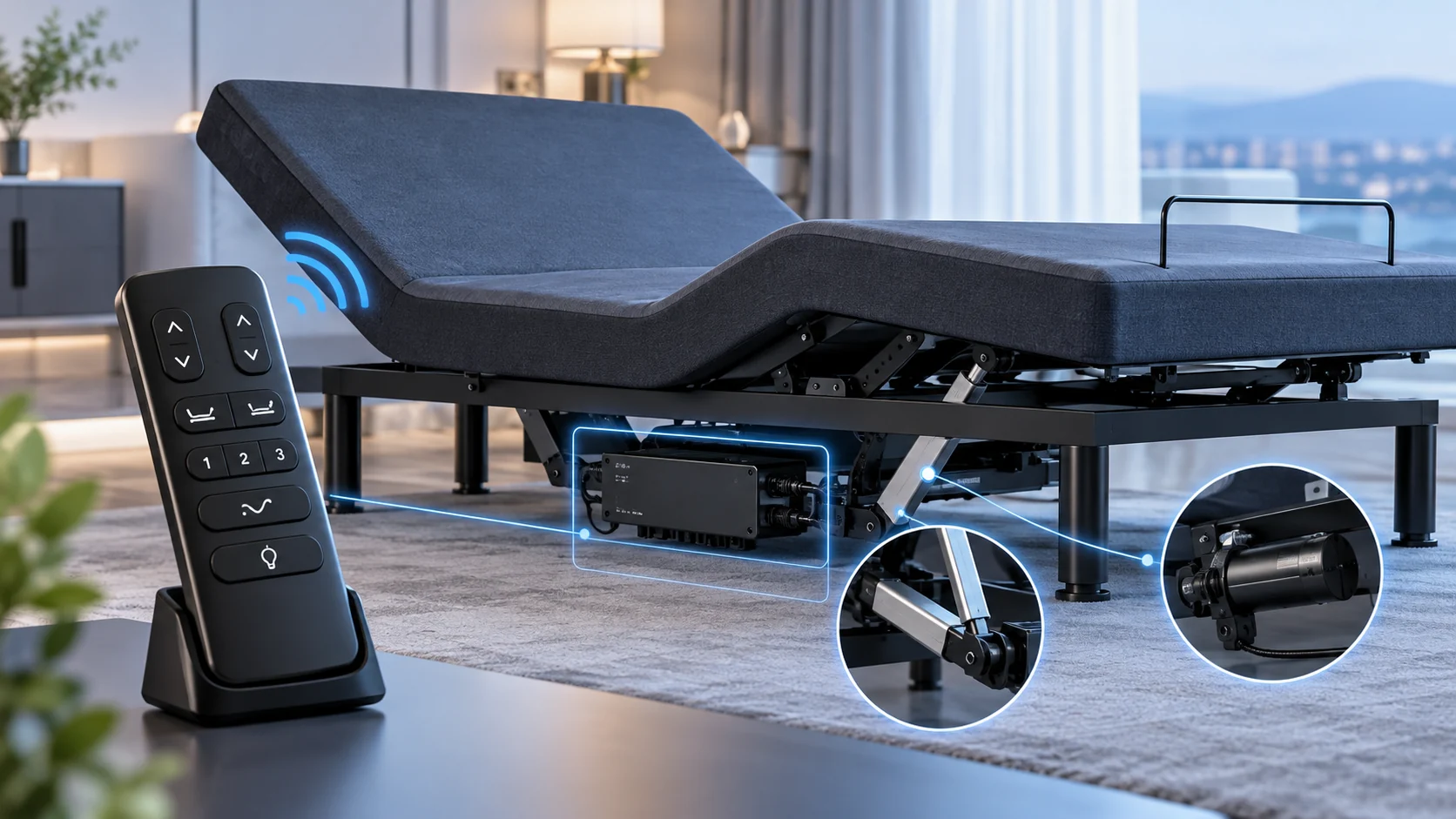
Why the Remote Is More Than a Handset
When buyers compare adjustable bed bases, the remote is easy to treat as a cosmetic accessory:
- How many buttons does it have?
- Is it wireless?
- Can our logo be printed on it?
For an OEM/ODM program, those are secondary questions.
The more important question is:
What control architecture sits behind the remote?
A typical adjustable-base control chain can involve the handset, receiver or control box, actuator system, power supply and optional components such as massage motors, under-bed lighting, synchronization accessories or app connectivity.
Commercial control systems show how wide that range can be. Depending on the selected platform, a handset may provide relatively simple head and foot adjustment or may support memory positions, lighting, massage and other functions.
For a B2B buyer, this means that selecting a remote is really a system-definition decision.
1. Start With the Function Map, Not the Remote Appearance
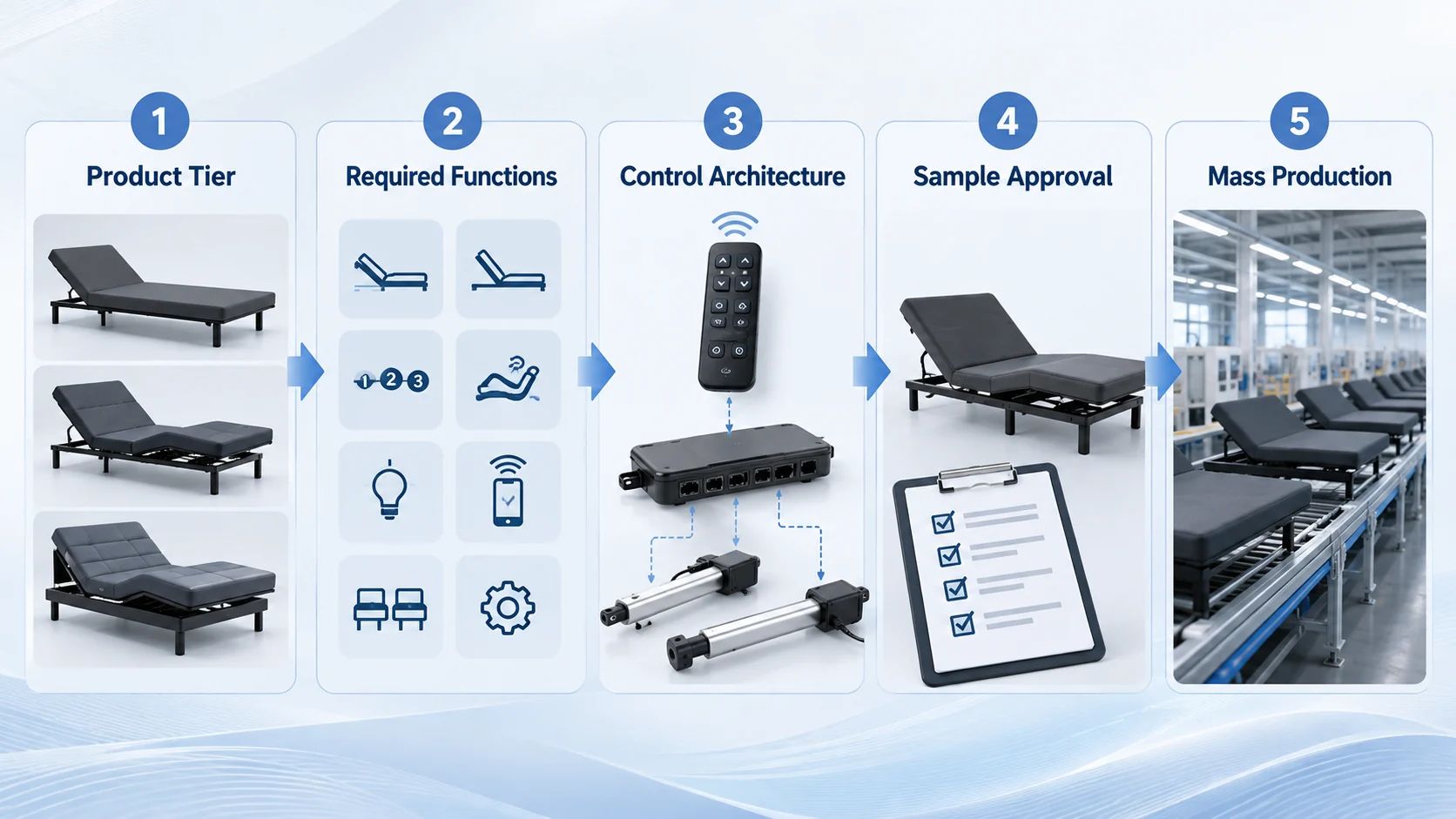
Before comparing remote shapes, create a function map for the intended product tier.
Basic Control
A basic adjustable base may only require:
- Head up/down
- Foot up/down
- Combined movement or flat position, depending on system design
Mid-Level Control
A more differentiated retail product may add, where supported by the selected configuration:
- Preset positions
- Programmable memory
- Under-bed lighting
- Additional articulation channels
Advanced Control
Higher-spec configurations may incorporate options such as:
- Massage controls
- Multiple memory positions
- Smartphone control
- Additional accessory control
- More complex user-interface functions
These should never be assumed to be universally available. Different handset and control-system combinations can support different functions.
KFY SMART procurement view:
Buyers should define the intended retail tier first and only then configure the control interface. Adding buttons that the product positioning does not require can increase complexity without necessarily improving the buyer proposition.
2. Treat the Remote, Control Box and Motor System as One Architecture
A remote cannot be evaluated purely by appearance.
The underlying questions include:
| Procurement Question | Why It Matters |
|---|---|
| Which control box is used? | Determines system compatibility |
| Which actuator configuration is used? | Determines available movements |
| Which functions are mapped to the handset? | Determines user experience |
| How is the handset paired? | Affects assembly and after-sales support |
| Are optional accessories connected through the same system? | Affects BOM and service complexity |
| Can replacement controls be supplied later? | Affects lifecycle support |
This is particularly important when an OEM program changes suppliers, electronics revisions or feature levels.
A remote that looks almost identical to another remote should not automatically be treated as interchangeable.
3. Wireless Does Not Mean Universally Compatible
Wireless handsets are common in modern adjustable comfort beds.
But “wireless” describes the user experience, not universal interoperability.
Pairing procedures can be system-specific. Replacement-control compatibility can also depend on the exact base and control configuration.
For B2B procurement, replacement compatibility should therefore be verified against identifiers such as:
- Base model
- Control-box model or revision
- Remote model
- System configuration
- Connector/interface arrangement where relevant
- Enabled functions
Procurement rule:
Do not build an after-sales strategy around the assumption that visually similar remotes are interchangeable.
4. Pairing Should Be Part of the After-Sales Design
Remote pairing often becomes visible only after a customer reports a problem.
That is too late.
Before mass production, buyers should understand:
- Whether the production remote arrives pre-paired
- How a replacement remote is paired
- What the end user or service team must do
- Whether the procedure changes between control-system revisions
- What information customer service needs before dispatching a replacement
For private-label programs, this creates a simple but valuable deliverable:
A model-specific pairing guide linked to the exact control-system revision.
That document can reduce unnecessary replacement shipments and make remote-related support easier for distributors and retailers.
For related service planning, see adjustable bed base warranty planning. For movement-related symptoms, see adjustable bed troubleshooting.
5. Memory Positions Need a Clear Product Definition
“Memory” can mean different things in different control systems.
A buyer should establish whether a proposed system uses fixed presets, user-programmable favorite positions, or both.
Some current commercial handsets support multiple favorite positions, while other systems provide simpler functionality.
Therefore, an RFQ should not simply say:
“Remote with memory.”
A better specification is:
“Define the required preset and/or programmable-position functions, confirm the supported number and behavior for the proposed control configuration, and verify them on the approved sample.”
That turns a marketing term into a testable requirement.
6. App Control Is a System Decision, Not a Checkbox
Smartphone control can be valuable, particularly for higher-tier sleep products, but it should not be added simply because a buyer wants the word “smart” on the specification sheet.
A compatible control architecture is required.
For B2B buyers, app-control evaluation should therefore include:
Hardware Compatibility
Does the proposed actuator/control architecture actually support the intended mobile-control solution?
Function Parity
Which handset functions are also available through the app?
User Onboarding
How does a consumer discover, connect and use the app?
Lifecycle Support
Who maintains the app, compatibility and user documentation over the product lifecycle?
Market Positioning
Does app control genuinely improve the target retail proposition enough to justify the additional support complexity?
At KFY SMART, app control is treated as a configuration-dependent option, not a universal feature across every adjustable-base product.
7. Private Label Goes Beyond Printing a Logo
Remote customization can be commercially useful because the handset is one of the parts consumers interact with most frequently.
Depending on the selected control platform, customization may extend to elements such as icons, branding, colors or surface treatment.
But private-label buyers should evaluate three layers separately:
Brand Layer
Logo, appearance, icons and packaging.
Function Layer
Button map, memory functions and optional controls.
Technical Layer
Control-box compatibility, actuator architecture, pairing and replacement strategy.
The third layer is the one most likely to create expensive after-sales problems if it is not frozen properly.
8. Control-System Consistency Must Continue Into Mass Production
The approved sample should establish more than the remote's appearance.
The approved control configuration should be traceable to the production definition.
A useful control-system freeze can include:
- Remote model/revision
- Control-box model/revision
- Motor/actuator configuration
- Power configuration
- Function map
- Pairing method
- Optional accessories
- Approved labels/icons
- User instructions
- Replacement-parts reference
This connects directly with the broader mass-production QC process.
A supplier changing a component to something that “looks equivalent” is not enough if pairing behavior, functions or service compatibility changes.
For this reason, the remote/control system should be included in BOM and revision control, not handled as a generic accessory.
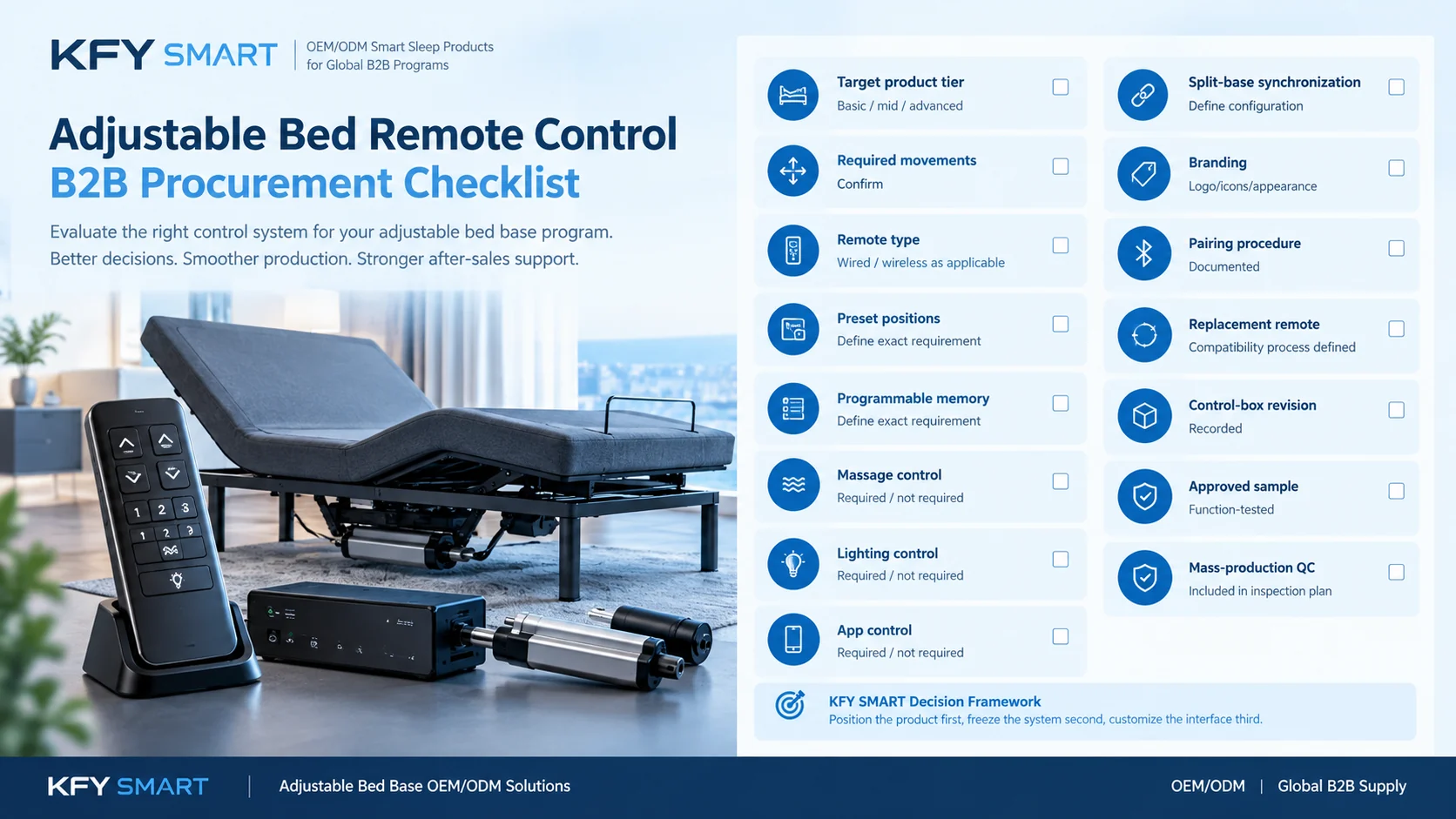
9. A Practical B2B Control-System Checklist
Before approving an adjustable-bed control package, buyers can ask:
| Check | Buyer Decision |
|---|---|
| Target product tier | Basic / mid / advanced |
| Required movements | Confirm |
| Remote type | Wired / wireless as applicable |
| Preset positions | Define exact requirement |
| Programmable memory | Define exact requirement |
| Massage control | Required / not required |
| Lighting control | Required / not required |
| App control | Required / not required |
| Split-base synchronization | Define configuration |
| Branding | Logo/icons/appearance |
| Pairing procedure | Documented |
| Replacement remote | Compatibility process defined |
| Control-box revision | Recorded |
| Approved sample | Function-tested |
| Mass-production QC | Included in inspection plan |
This is the KFY SMART decision framework we would use when discussing a control configuration with a B2B buyer:
Position the product first, freeze the system second, customize the interface third.
10. What to Put in an RFQ
Instead of requesting:
“Adjustable bed with wireless remote.”
A stronger B2B RFQ should specify:
- Desired movements
- Intended product tier
- Required preset or memory behavior
- Whether massage is needed
- Whether lighting is needed
- Whether app control is needed
- Branding expectations
- Split-base synchronization requirements where applicable
- Target market
- Expected replacement-parts support
The manufacturer can then propose a compatible architecture rather than guessing from a feature list.
That approach is particularly useful for mattress companies and furniture brands developing several price tiers, because different SKUs do not necessarily need identical control complexity.
FAQ
Are adjustable bed remotes universal?
Buyers should not assume so. Compatibility depends on the underlying control architecture, configuration and revision. A visually similar wireless handset does not establish compatibility.
Can an adjustable bed remote be private labeled?
Some control platforms support customization such as logos, icons, colors or surfaces, but available customization depends on the selected system and project.
Does every adjustable bed support app control?
No. App control requires a compatible control architecture. KFY SMART also lists app control only for selected product configurations.
What should buyers record for replacement remotes?
At minimum, keep the base/control configuration and relevant model or revision information linked to the approved product specification. Compatibility should be confirmed before replacement parts are shipped.
Should the remote be included in quality inspection?
Yes. For an OEM/ODM program, the approved function map, pairing behavior, labeling and relevant controls should be checked against the approved configuration rather than treating the handset as a cosmetic accessory.
Planning an Adjustable Bed Base Program?
Share your target market, product tier, required movements, control functions and private-label requirements. KFY SMART can help review the adjustable-base configuration and coordinate compatible control, branding and OEM/ODM options for quotation.