Why Adjustable Bed Base Assortments Become Too Complicated
Adjustable bases are easy to over-specify. A supplier may offer dozens of combinations involving head and foot adjustment, presets, massage, lumbar support, under-bed lighting, USB charging, Bluetooth or app control, zero clearance, foldable structures and wall-saving or sliding mechanisms.
The sourcing team can easily turn these options into too many SKUs. A customer standing in a mattress store does not want to compare twelve technical BOMs. The salesperson needs to explain something much simpler: What do I get at this level—and why should I move to the next one?
Tempur-Pedic's current power-base range provides a useful consumer-facing example: its Ease model focuses on core adjustment, while Ergo, Smart and ProSmart progressively introduce additional comfort, smart and relaxation functions. The lesson for B2B buyers is not to copy those exact features. It is to make sure each tier has a clear commercial role.
Start With Customer Segments, Not Features
A common mistake is: We have ten available functions. How many models can we build? A better starting point is: Which customer groups does the retailer need to serve?
Value-Oriented Buyer
The customer wants adjustable comfort but is highly sensitive to the total mattress-set price.
Mainstream Buyer
The customer expects full head-and-foot adjustment, convenient control and a finished product that feels clearly above an entry-level base.
Upgrade Buyer
The customer is willing to pay more for additional comfort, convenience, premium structure or easier integration.
Premium Buyer
The customer is buying a more complete sleep experience rather than only basic articulation. These segments do not need the same BOM; they need different reasons to buy.
The Good-Better-Best Framework
GOOD — Make Adjustable Comfort Accessible
The entry-level product should answer one basic question: Can we deliver the core adjustable-bed experience at an accessible retail position?
Typical priorities may include head and foot articulation, straightforward remote control, flat position, essential structural stability, simple installation and manageable logistics. The entry product does not need every available convenience function; adding too many features can reduce the reason to trade up.
B2B objective: Create an easy first step from a static foundation into adjustable sleep.
BETTER — Build the Mainstream Volume Product
For many retailers, the second level can become the most commercially important SKU. It should feel noticeably better than entry level without moving into a difficult premium price position. Potential differentiators may include, depending on the project, upgraded full-frame construction, additional presets, improved control options, under-bed lighting, charging functions, different upholstery, zero-clearance capability or selected comfort upgrades.
The exact features are less important than the commercial principle: the customer should understand the upgrade quickly. If the salesperson needs five minutes to explain why Better costs more than Good, the step-up is probably too weak.
BEST — Sell an Experience, Not a Longer Feature List
A premium adjustable base should not simply contain everything the factory can install. Premium positioning works better when several features combine into a coherent experience: more sophisticated motion, premium comfort functions, advanced massage, lumbar or additional articulation, smart control, furniture integration, premium upholstery or an upgraded remote/control experience.
Best should create a different ownership experience—not simply a longer specification sheet.
When a Fourth “Flagship” Tier Makes Sense
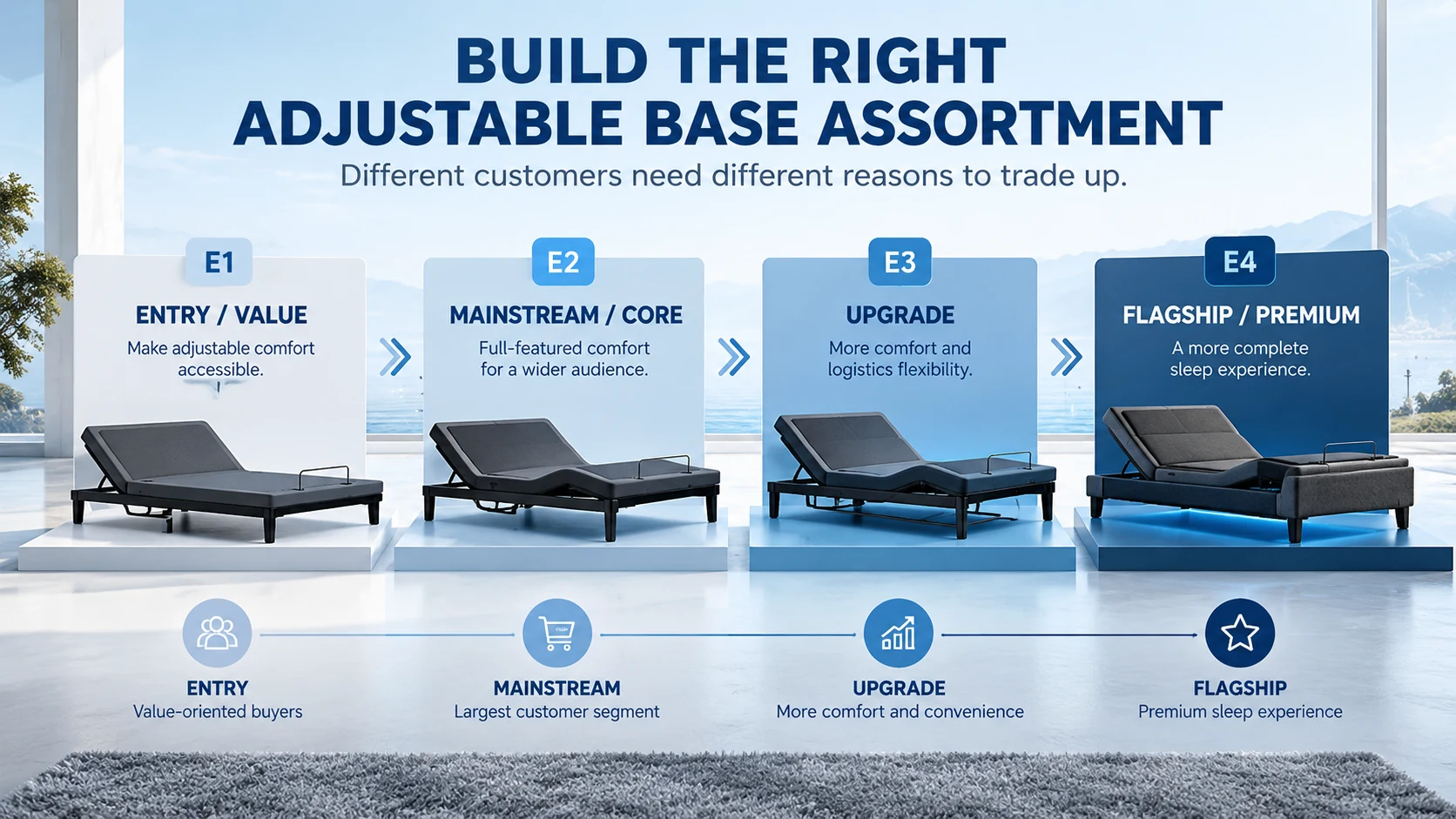
Not every retailer needs only three levels. A fourth tier can make sense when the premium product introduces a genuinely different mechanical or smart-sleep proposition: Entry → Core → Premium → Flagship.
This works especially well when the flagship product includes something customers can immediately see or feel, such as sliding or wall-saving movement, additional articulation, integrated smart functions, distinctive premium design or advanced control architecture. If the fourth model adds only one small convenience feature, it probably does not deserve its own SKU.
KFY SMART Example: Translating Four Platforms Into Retail Roles
KFY SMART's current adjustable-base line is organized into four positioning levels. This is a practical retail-assortment reference, not a mandatory universal structure: OEM/ODM customers may configure or combine the line differently for their market.
| Retail Role | KFY Platform | Current Positioning |
|---|---|---|
| Entry / Value | E1 | Budget |
| Mainstream | E2 | Mid-range |
| Upgrade | E3 | High-end |
| Flagship | E4 | Flagship |
E1 — Value-Focused Entry
KFY SMART positions E1 as a British-style slatted platform intended for value-focused distribution and entry-level programs. Its commercial role is straightforward: bring adjustable functionality into an accessible assortment position.
E2 — Mainstream Core
E2 uses an American-style full-frame architecture and is positioned for mainstream mattress, furniture and retail programs. For a retailer, this is the kind of platform that can become a core adjustable-base SKU.
E3 — Upgrade Through Logistics + Product Positioning
E3 introduces a foldable structure and is positioned around higher-end programs where logistics efficiency is also important. An upgrade does not have to come only from adding electronic features: structure, shipping efficiency, installation model and channel suitability can also differentiate a tier.
E4 — Flagship
E4 is positioned as a premium sliding-style platform for higher-level B2B programs and deeper configuration. That makes it more suitable for a flagship role than simply creating “E3 plus one extra button.”
Do Not Copy the Same Feature Into Every Tier
Feature creep is one of the fastest ways to damage a Good-Better-Best strategy. If every model has the same adjustment, presets, lighting, charging, massage and control method, the only remaining differentiation may be upholstery or price. At that point, the retailer is competing against itself.
A healthier approach is to identify must-have features necessary across the range; step-up features used to justify movement into the next tier; flagship features reserved for premium differentiation; and optional project features available when a specific customer or channel requires them but not necessary in the standard assortment. In OEM/ODM, available does not mean standard.
For guidance on assigning meaningful functions to each tier, see which adjustable bed features actually matter for B2B programs.
A Simple Feature-Ladder Test
Before approving each SKU, ask: Can a salesperson explain the difference in one sentence?
- Good: Core adjustable comfort.
- Better: Full mainstream comfort plus convenience.
- Best: Premium comfort and advanced experience.
- Flagship: Distinctive motion or smart-sleep platform.
If the answer becomes “This model has function A, while the other has function A plus function B, except some sizes have C,” the assortment is becoming too complicated.
Match the Adjustable Base to the Mattress Assortment
Adjustable bases should not be planned in isolation from mattresses. For mattress retailers, the customer typically evaluates the sleep system, not the base alone.
- Entry Mattress + Entry Base: Accessible adjustable bundle.
- Mainstream Mattress + Core Base: Volume-selling sleep-system package.
- Premium Mattress + Premium Base: Higher-ticket comfort bundle.
- Flagship Mattress + Flagship Base: Complete premium sleep experience.
The exact pairing depends on the retailer's merchandising strategy, but it helps prevent situations where a premium adjustable base has no logical mattress partner—or an entry mattress is paired with an overly complex base.
Retail Showroom and E-Commerce Assortments Should Not Be Identical
Showroom Retail
Physical stores can support more explanation. Sales staff can demonstrate articulation, presets, massage, sliding movement and structural differences, so a broader step-up ladder may work.
E-Commerce
Online products need faster differentiation. The product card, comparison table and video must communicate the difference without a salesperson. That generally increases the importance of simple tier names, visually obvious feature differences, clear comparison tables, manageable packaging, straightforward installation and easy after-sales support.
Configuration planning, including the distinction between King and Split King setups, can also affect a retail program; see Split King vs. King adjustable bed bases.
Assortment Planning Is Also an Inventory Decision
Every additional adjustable-base SKU creates operational consequences. It may require another carton, inventory position, remote/control configuration, replacement-part mapping, product manual, showroom sample, sales-training module or after-sales reference.
A new SKU should ideally answer: Which customer or channel problem does this model solve that the existing lineup does not? If there is no clear answer, adding the SKU may increase complexity more than revenue opportunity. Logistics and handling are also part of that decision; read why adjustable bed bases can be heavy for brands and distributors.
KFY SMART B2B Assortment Framework
When discussing adjustable-base programs with mattress companies, retailers or distributors, KFY SMART recommends working through five questions:
- Who is the target customer? Value, mainstream, premium or specialist?
- What retail price ladder is the brand trying to build? Do not start from a supplier catalogue; start from market positioning.
- Which features create meaningful step-ups? Reserve some features to create clear upgrade reasons.
- Which structure fits the channel? Full frame, foldable, zero-clearance or more advanced motion may affect both merchandising and logistics.
- How much operational complexity can the retailer support? More SKUs also mean more inventory, sales training and after-sales complexity.
The objective is not to offer every possible configuration. It is to create an assortment that is easy to understand, easy to sell and practical to operate.
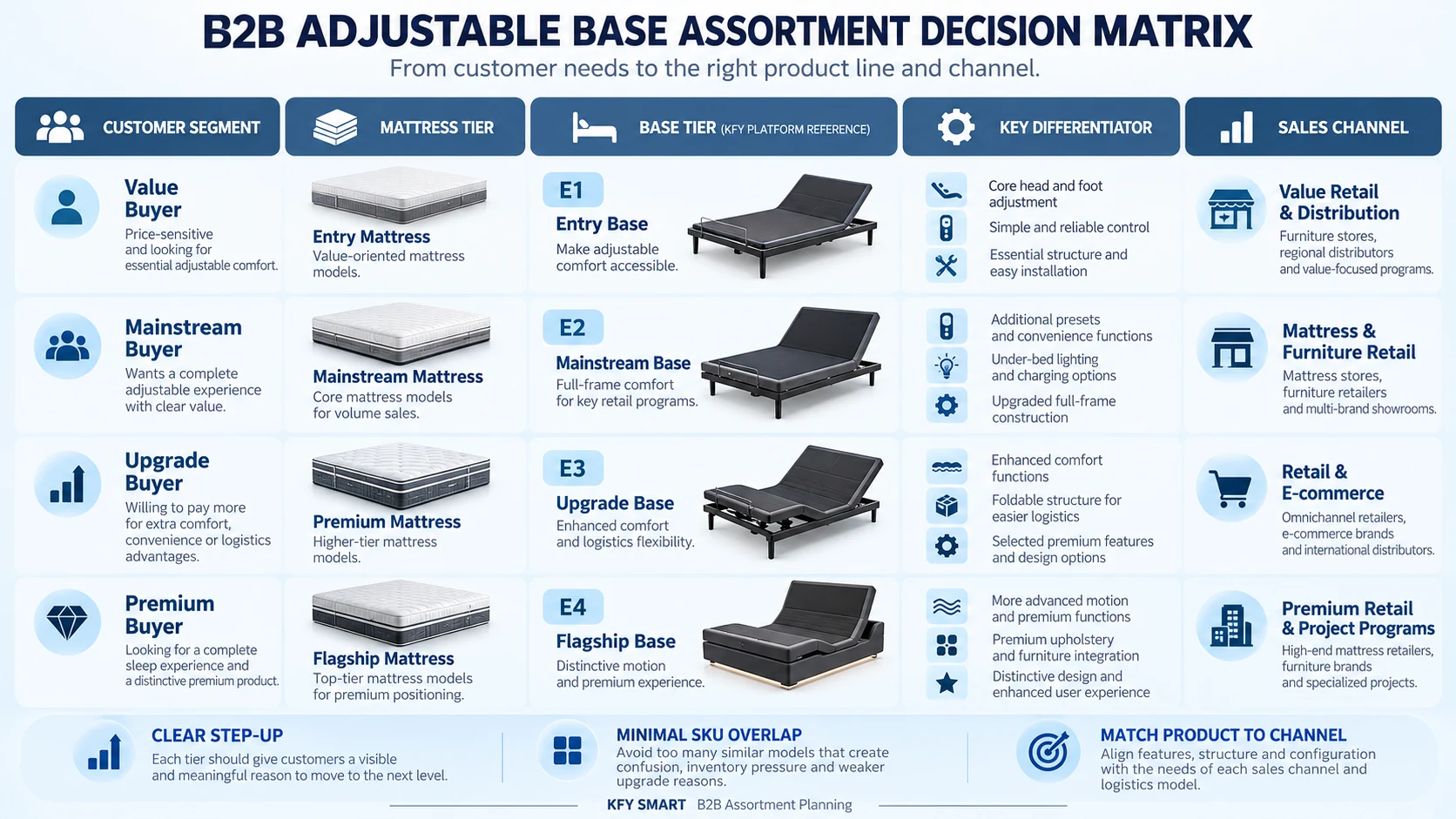
A B2B Assortment Scorecard
Before adding a model, score it against these questions:
| Decision Area | Question |
|---|---|
| Customer | Which shopper does this tier serve? |
| Positioning | Why does it exist in the lineup? |
| Step-Up | What makes it clearly better than the tier below? |
| Mattress Pairing | Which mattress tier should it sell with? |
| Channel | Showroom, e-commerce, distributor or project? |
| Logistics | Does structure/package fit the channel? |
| Sales Training | Can staff explain it simply? |
| After-Sales | Can parts and support be managed? |
| Margin | Does the tier create enough commercial room? |
| SKU Role | Would removing this model leave a real gap? |
The final question is particularly useful. If removing a SKU does not create a noticeable hole in the assortment, the SKU may not be necessary. Warranty and service planning should likewise grow deliberately with the range; see the adjustable bed base warranty guide for B2B buyers.
Common Assortment Mistakes
Too Many Similar Models
Minor specification differences create customer confusion and inventory duplication.
Entry Model Is Too Feature-Rich
There is no reason to upgrade.
Premium Model Has Features but No Story
A long BOM is not the same as premium positioning.
Ignoring Logistics
A product can be commercially attractive but operationally difficult for the sales channel.
Ignoring After-Sales Complexity
Every new control system or configuration creates another service scenario.
Building Around the Supplier Instead of the Shopper
The supplier's complete capability list should not become the retailer's product range.
FAQ
How many adjustable bed base models should a retailer carry?
There is no universal number. Many programs can be built around three clear Good-Better-Best levels, while some retailers benefit from a fourth flagship tier. The key is that every SKU has a distinct role.
What should an entry-level adjustable bed base include?
That depends on the target market, but the entry tier should deliver the essential adjustable experience without including so many upgrade features that higher tiers become difficult to justify.
Should massage be included in every adjustable base?
Not necessarily. Massage can be used as a step-up feature depending on the market and positioning. KFY SMART treats many advanced functions as configuration-dependent rather than universal standard equipment.
Are more adjustable bed base SKUs better for retailers?
Not automatically. More SKUs increase inventory, training, merchandising and after-sales complexity.
Should mattress and adjustable base assortments be planned together?
For mattress retailers, yes. The total mattress-and-base ticket and positioning should make commercial sense as a complete sleep system.
Can KFY SMART develop different adjustable-base tiers for private-label programs?
KFY SMART supports configurable adjustable-base programs including structure, branding, packaging, upholstery, motors/controllers and selected function combinations. Final availability and commercial terms depend on the chosen model and project requirements.
Conclusion
The strongest adjustable bed assortment is not the one with the most models. It is the one where every model has a clear job.
A practical structure is often Entry → Mainstream → Upgrade → Flagship, with each level providing a visible and commercially meaningful reason to step up.
For mattress brands, furniture retailers and distributors, the real assortment challenge is not “How many adjustable bases can our supplier make?” It is “How many adjustable bases does our customer actually need us to sell?”
That distinction can reduce SKU overlap, simplify sales training and create a clearer path from first purchase to premium upgrade.
Build an Adjustable Base Line Around Your Market
Share your target market, mattress assortment, intended retail tiers, quantity and private-label requirements with KFY SMART. We can help evaluate which adjustable-base platform and configuration fits each level before sampling and quotation.