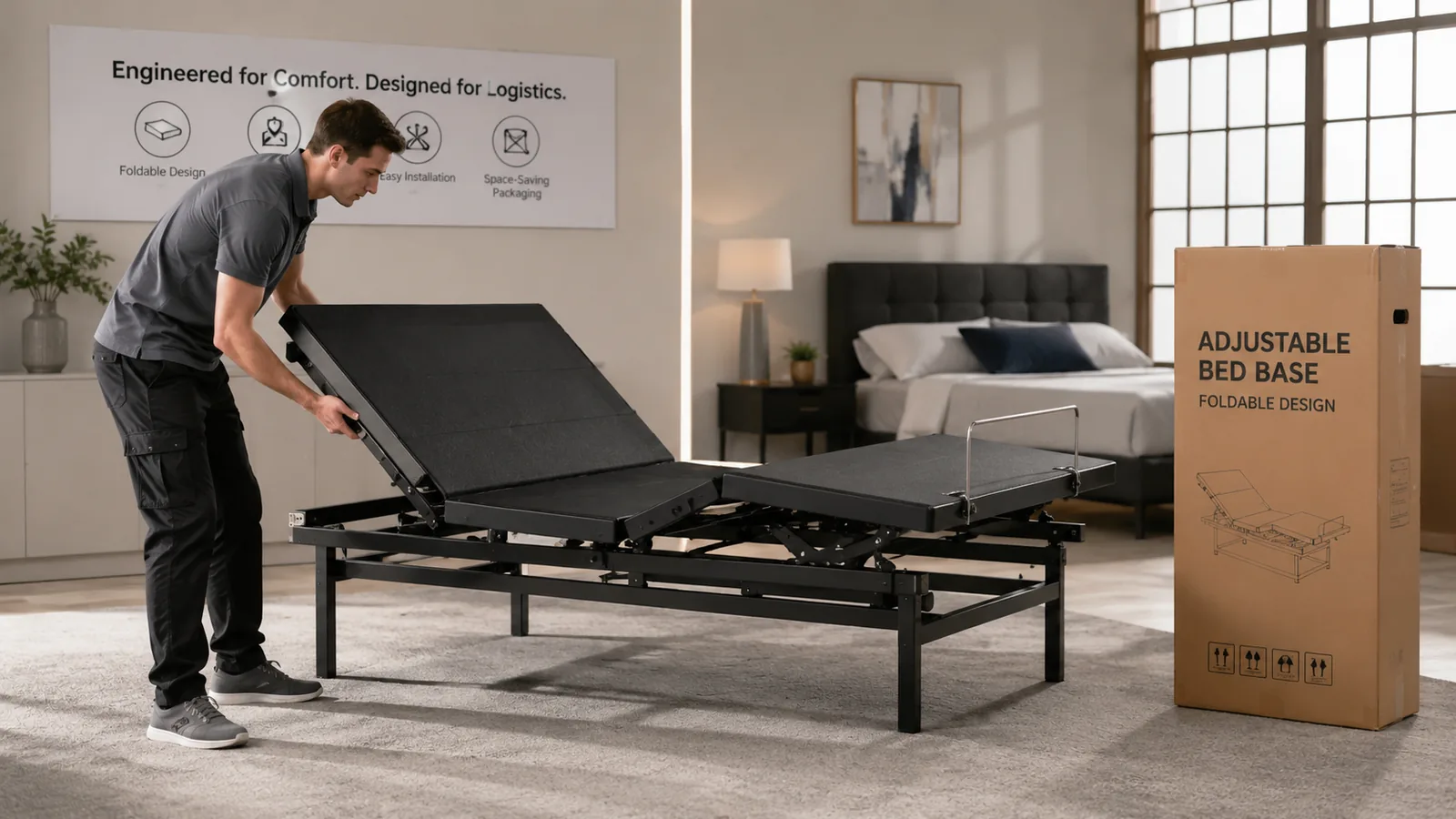
One of the first things many people notice when handling an adjustable bed base is its weight.
Unlike a conventional bed frame, an adjustable base is a moving mechanical system. It has to support a mattress and sleepers while repeatedly raising and lowering different sections of the sleeping platform.
That requires more than a simple frame.
An adjustable base can include a steel structure, articulated deck sections, motors, linkages, control boxes, power components, legs and optional comfort or connectivity features.
For consumers, that extra weight may simply make installation more difficult.
For mattress brands, furniture companies, retailers and distributors, however, adjustable bed base weight is also a product-development and logistics issue.
It can affect packaging, warehouse handling, international shipping, last-mile delivery, installation and ultimately the customer experience.
Why Are Adjustable Bed Bases Heavy?
The short answer is structural strength plus mechanical components.
An adjustable bed base needs to perform two jobs simultaneously:
- Support the mattress and users safely.
- Move sections of that load repeatedly through different positions.
This creates different engineering requirements from a conventional static foundation.
Several parts of the product contribute to the total weight.
1. Steel Frame Structure Adds Strength — and Weight
The frame is one of the most important structural elements of an adjustable base.
Unlike a conventional static bed frame, an adjustable base experiences forces while different sections of the platform move.
Structural strength is therefore required around areas such as:
- Main frame rails
- Cross members
- Articulation points
- Hinges
- Motor mounting positions
- Support legs
- Moving platform sections
Simply reducing steel does not automatically make a better adjustable bed.
For B2B buyers, the more useful question is whether the product provides the right balance between:
- Structural stability
- Product weight
- Manufacturing cost
- Packaging
- Transportation
- Target retail price
This balance will differ between an entry-level adjustable base and a premium product intended for more demanding applications.
2. Motors and Drive Components Add Additional Mass
Adjustable bases contain components that conventional bed frames do not require.
Depending on the configuration, these may include:
- Head-lift motor
- Foot-lift motor
- Control box
- Linkage system
- Power supply
- Wiring
- Remote-control receiver
- Massage components
- Lighting
- USB or connectivity modules
A more feature-rich adjustable base may therefore require additional components compared with a simpler entry-level model.
That does not mean a heavier base is automatically better.
It means buyers should compare the complete configuration, rather than looking only at finished dimensions or the number of functions listed on a quotation.
3. Moving Platform Sections Require Reinforcement
The sleeping platform itself must change position while continuing to support the mattress.
That requires hinges, moving sections and reinforced connection points.
When the head section rises, for example, the product is no longer simply supporting a flat vertical load.
The mechanism, frame and motor system are working together to move part of the sleeping surface. Structural design also affects how consistently the platform moves under load; see our guide to uneven adjustable-bed lifting and actuator validation.
A well-designed adjustable base therefore needs to balance:
- Motion range
- Structural stability
- Noise control
- Durability
- Product weight
- Manufacturing complexity
These factors should be evaluated together during product development.
Why Adjustable Bed Base Weight Matters to B2B Buyers
For an individual consumer, adjustable bed base weight often becomes noticeable during delivery or installation.
For a mattress brand, distributor or retailer, however, the same issue starts much earlier.
Weight influences several stages of the supply chain.
Factory Handling
Finished adjustable bases need to move between:
- Assembly
- Functional testing
- Inspection
- Packaging
- Warehouse storage
- Container loading
Product design therefore affects factory handling before the base ever reaches the customer.
International Shipping
For global B2B programs, the finished product is only one part of the shipping calculation.
Buyers also need to understand:
- Net product weight
- Gross packed weight
- Carton dimensions
- Number of cartons
- Container loading efficiency
- Freight method
A compact package and a lightweight product are not necessarily the same thing.
Both specifications matter.
Warehouse Handling
Distributors may receive hundreds or thousands of units.
Warehouse teams need to know whether cartons can be handled safely and efficiently within the existing operation.
Important questions include:
- Can one person handle the carton?
- Are two people required?
- Is warehouse equipment necessary?
- How much floor space is required?
- How easily can cartons be stacked or moved?
These operational details can affect the true cost of a product program.
Last-Mile Delivery
Large adjustable bases may eventually need to move through:
- Residential doorways
- Apartment elevators
- Narrow corridors
- Staircases
- Bedrooms with limited installation space
This is particularly important for:
- E-commerce
- Direct-to-consumer mattress brands
- Furniture delivery
- Senior-care products
- Home-care projects
A product that performs well in a showroom can still create a poor customer experience if delivery and installation are unnecessarily difficult.
Installation
Adjustable bases often require more handling than conventional foundations.
Installation may involve:
- Moving the packaged base into position
- Opening or unfolding the structure
- Installing legs
- Connecting motors and controls
- Connecting power
- Pairing remotes
- Testing movement
- Positioning the mattress
Some adjustable-base manufacturers specifically recommend two people for setup because of the size and weight of the product.
For B2B buyers, installation requirements should therefore be understood before the product reaches the market.
Product Weight and Package Size Are Not the Same Thing
This distinction is especially important.
A product can remain structurally substantial while being designed to occupy a more manageable package.
In other words:
A foldable design may improve logistics without dramatically reducing total product weight.
This is one reason foldable adjustable bed bases have become relevant for certain distribution models.
The buyer should request both:
Net product weight
and
Packed dimensions / gross weight
These specifications answer different questions.
Net weight describes the physical product.
Packed dimensions and gross weight help describe how the product moves through the supply chain.
What Is a Foldable Adjustable Bed Base?
A foldable adjustable bed base is designed so that the product can fold into a more compact configuration for transportation, storage or installation.
The purpose is not simply to add a folding hinge.
From a B2B perspective, a foldable structure can help address practical issues such as:
- Carton dimensions
- Storage space
- Doorway access
- Warehouse handling
- Residential delivery
- Installation workflow
Several established adjustable-bed manufacturers already use foldable or courier-friendly designs as part of their logistics strategy.
This shows that packaging and delivery are increasingly part of adjustable-bed product design—not something considered only after development has finished.
Foldable Does Not Automatically Mean Lightweight
This is an important distinction.
A foldable adjustable bed base can still contain:
- Steel structures
- Motors
- Mechanical linkages
- Electronic controls
- Upholstered platform sections
- Support legs
The main commercial advantage may therefore be more efficient package geometry and handling, rather than a dramatic reduction in net product weight.
For distributors and importers, this difference matters.
A product that remains structurally appropriate while becoming easier to package, store and move may be more useful than a product designed only to minimize weight.
Why Foldable Designs Can Matter for E-Commerce
E-commerce changes the logistics requirements of adjustable sleep products.
Traditional furniture distribution may rely on:
- Regional warehouses
- Specialist delivery teams
- Scheduled installation
- White-glove delivery
An online program may involve a longer logistics chain:
Factory → International Freight → Warehouse → Fulfillment → Last-Mile Carrier → Customer Home
Every additional handling stage increases the importance of packaging.
For an e-commerce mattress or furniture brand, useful questions include:
- Can the packaged base move through the intended carrier network?
- Can customers move it through a standard doorway?
- How many people are required for installation?
- Can the product be stored efficiently?
- Is the packaging appropriate for multiple handling stages?
These are product-development questions—not simply shipping questions.
When Should a Brand Consider a Foldable Adjustable Bed Base?
A foldable design may be especially relevant for several business models.
Mattress Brands
Mattress brands expanding into adjustable bases may want products that integrate into their existing warehouse and delivery systems.
Adding an adjustable base should not require completely redesigning the company's fulfillment operation.
Furniture Brands
Furniture companies may need adjustable bases that can integrate with different bed-frame programs while remaining manageable through existing distribution channels.
E-Commerce Retailers
Online sellers should pay particular attention to:
- Carton dimensions
- Gross weight
- Installation requirements
- Last-mile delivery
- Customer assembly
Packaging becomes part of the customer experience.
Distributors and Importers
International distributors need to think beyond the factory price.
They should evaluate:
- Shipping
- Container planning
- Warehousing
- Regional transportation
- Installation support
- After-sales requirements
Hotels and Apartments
Hospitality projects may involve installing multiple products within a limited project schedule.
Installation efficiency, replacement access and product handling may therefore become important operational considerations.
Senior Care and Home Care
Products used in occupied homes may need to move through narrower spaces and existing residential environments.
Handling and installation planning can therefore be especially important.
Different sales channels require different product priorities.
There is no single adjustable-base structure that is automatically best for every market.
What Should B2B Buyers Ask Before Selecting an Adjustable Bed Base?
A professional sourcing discussion should go beyond a list of remote-control functions.
Before comparing quotations, buyers should request information in four areas.
Product Structure
Confirm:
- Finished dimensions
- Net weight
- Rated load capacity
- Frame construction
- Motor configuration
- Available sizes
- Foldable or non-foldable structure
Rated load should be compared by definition, not by the headline number alone. See the guide to adjustable bed base weight capacity for the mattress, distribution, size and per-base questions to verify.
Packaging
Confirm:
- Carton dimensions
- Gross weight
- Packing method
- Number of cartons
- Protective packaging
- Shipment configuration
Installation
Confirm:
- Required assembly
- Recommended number of installers
- Leg installation procedure
- Motor connections
- Control pairing
- Power connection
- Installation instructions
Target-Market Configuration
Confirm:
- Plug type
- Voltage
- Remote configuration
- App requirements
- Packaging language
- Product labels
- Private-label specifications
These specifications can have as much influence on the success of a distribution program as adding another comfort function.
Standard vs. Foldable Adjustable Bed Bases
Neither structure is automatically better.
A standard adjustable base may be appropriate when:
- A traditional product structure is preferred
- Existing logistics can handle the package efficiently
- The sales model includes specialist delivery
- Storage limitations are less important
A foldable design may be more attractive when:
- Packaging dimensions matter
- Warehouse space matters
- Products move through multiple logistics stages
- Residential delivery is important
- E-commerce is a major channel
- Easier handling is a commercial priority
The correct decision depends on the complete business model.
Don't Evaluate an Adjustable Base Only in the Showroom
A common sourcing mistake is evaluating adjustable bases primarily from the customer's visible feature list.
Buyers compare:
- Zero Gravity
- Remote presets
- Massage
- USB ports
- App control
- Lighting
These features can be important.
But a successful B2B adjustable-bed program also depends on everything that happens before the product reaches the customer's bedroom.
A more complete product-development sequence is:
Target Market → Sales Channel → Product Structure → Functions → Packaging → Delivery → Installation → After-Sales
This approach helps brands avoid selecting a product that looks attractive on a specification sheet but creates unnecessary friction elsewhere in the supply chain.
Adjustable Bed Base Solutions from KFY SMART
KFY SMART develops adjustable bed bases for mattress brands, furniture companies, distributors and project-based buyers.
The current adjustable base product line covers different product structures and market positions, allowing buyers to select products according to target market, distribution requirements and required functions.
For projects where packaging and logistics efficiency are important considerations, buyers can also evaluate KFY SMART's foldable adjustable bed base solutions.
E3 Foldable Adjustable Bed Base
Depending on the selected product and project requirements, KFY SMART can coordinate B2B specifications including:
- Product size
- Frame configuration
- Control functions
- Fabric and finish
- Plug and voltage
- Packaging
- Private-label requirements
The objective is not to treat every market as requiring the same standard adjustable base.
Product structure, functions and logistics should be considered together.
How This Relates to Mattress Compatibility
Adjustable-base logistics are only one part of building a complete adjustable sleep program.
The mattress also needs to work correctly with the moving platform.
Brands developing a mattress-and-base combination should therefore evaluate:
- Mattress flexibility
- Mattress thickness
- Base dimensions
- Load capacity
- Retention
- Packaging
- Installation
For a detailed compatibility checklist, see:
Can Any Mattress Be Used on an Adjustable Bed Base?
Considering the mattress and base as one product system can reduce avoidable problems later in the distribution process.
FAQ
Why are adjustable bed bases so heavy?
Adjustable bed bases contain structural frames, motors, articulated platform sections, linkages and control components that conventional static bed frames do not require. The structure also needs to support the mattress and users while moving through different positions.
Are foldable adjustable bed bases lighter?
Not necessarily. A foldable structure may primarily reduce package dimensions or improve handling rather than dramatically reducing total product weight.
Why does package size matter for adjustable bed bases?
Package dimensions can affect warehouse storage, international shipping, last-mile delivery, doorway access and installation. For e-commerce and distributor programs, packaging can therefore be an important product-development consideration.
Can one person install an adjustable bed base?
Installation requirements depend on the specific model. Some manufacturers recommend two people because of the size and weight of the base. Buyers should always follow the installation requirements provided for the selected product.
What should distributors check before importing adjustable bed bases?
At minimum, distributors should confirm finished dimensions, net weight, gross packed weight, carton dimensions, rated load capacity, electrical requirements, motor configuration, assembly requirements and packaging specifications.
Is a foldable adjustable bed base better for e-commerce?
It can offer advantages when compact packaging, handling and residential delivery are important. However, the complete product—including structure, functions, weight, packaging, cost and installation—should be evaluated together.
What is more important: adjustable-bed features or logistics?
Both matter. Consumer-facing features help position the product, while logistics determine how efficiently the product moves from factory to customer. Strong B2B product planning considers both before production.
Plan the Product and the Logistics Together
For adjustable sleep products, logistics should not begin after the product has already been selected.
Structure, motors, dimensions, packaging, delivery and installation all influence the commercial viability of an adjustable-bed program.
KFY SMART works with global B2B partners on adjustable bed bases, smart beds and smart mattress programs for different markets, distribution models and private-label requirements.
Planning an adjustable bed program? Discuss your target market, sales channel, product configuration, packaging and private-label requirements with KFY SMART.