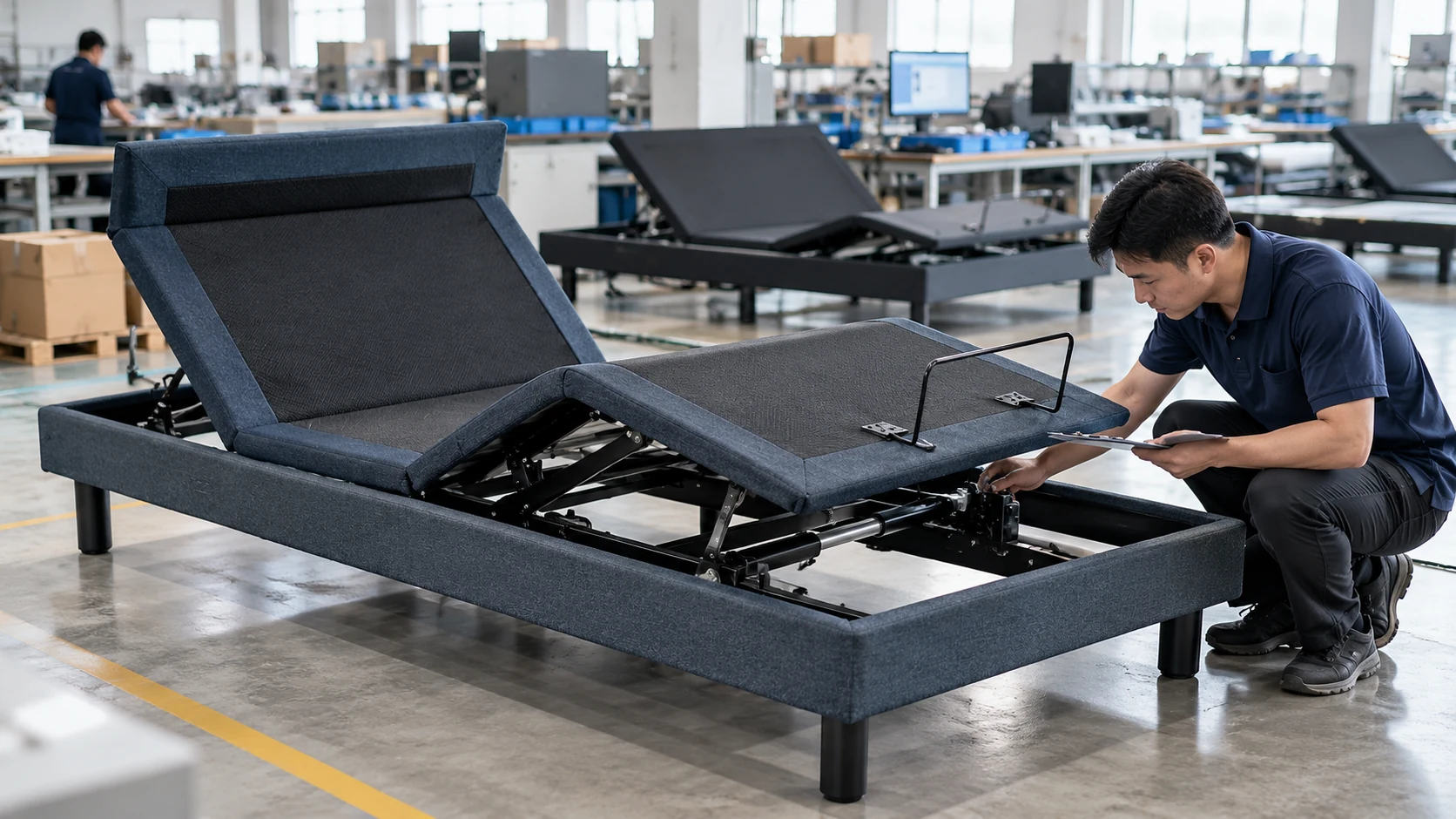
What Should B2B Buyers Validate in an Adjustable Bed Base Sample?
| Validation Area | What the Buyer Should Confirm |
|---|---|
| Configuration | Is this the exact model and specification being quoted? |
| Structure | Is the frame stable, aligned and correctly assembled? |
| Movement | Do head and foot sections operate smoothly and consistently? |
| Motors & Controls | Are the approved components installed and functioning correctly? |
| Noise & Stability | Is operation acceptable under realistic use conditions? |
| Compatibility | Does the base work with the intended mattress and bed-frame setup? |
| Functions | Do presets, massage, USB, lighting or smart functions work as specified? |
| Appearance | Does the upholstery and finish meet the intended retail positioning? |
| Packaging | Can the product survive practical warehousing and international distribution? |
| Documentation | Are labels, manuals, specifications and component details correct? |
| Production Reference | Can the approved sample be clearly reproduced in mass production? |
Why OEM Sampling Is a Production Decision
A buyer can confirm that an adjustable bed base moves during a short demonstration. That is useful, but it is not enough for an OEM or private-label program. The sample must show what is included in the commercial agreement and what the production order is expected to reproduce.
A sample should not only prove that the adjustable bed works. It should define what mass production is expected to reproduce.
That means buyers should review the sample against a written configuration, not against a general catalog image or a verbal understanding. The same discipline supports a clearer discussion when learning how to choose an adjustable bed base manufacturer in China: product requirements should be defined before commercial comparisons are made.
Confirm the Exact Sample Configuration Before You Start Testing
Before operating the base, identify the model, size, frame structure, motors, control box, power supply, remote, legs, upholstery, mattress retainer, accessories, packaging and branding details actually present. If an item differs from the quotation or configuration sheet, record the difference before the evaluation becomes subjective.
Optional features should be treated the same way. Massage, USB charging, lighting, preset positions, app control and other functions should be verified only when they are included in the selected configuration. A buyer should not approve a sample on the assumption that an option visible on a different model will automatically be included later.
Inspect the Frame and Mechanical Structure
Start with the parts that support movement. Inspect frame alignment, moving joints, brackets, fasteners, platform sections, legs, weld or fastening quality where visible, and the relationship between moving sections. The aim is not to make a laboratory claim from one sample; it is to identify whether the sample is assembled correctly and whether its structure reflects the agreed program.
Operate the base while observing for rubbing, interference, loose hardware or inconsistent movement. Capacity should also be reviewed as a structural question rather than as a headline number alone; the adjustable bed base weight-capacity guide helps buyers identify the definition and conditions behind a quoted figure.
Test the Full Head and Foot Adjustment Range
Run the head and foot sections from flat to their available raised positions and back again. Observe whether movement is smooth, whether sections remain aligned, and whether the sample behaves consistently after repeated operation. Use the intended control method and verify that the motion matches the selected configuration.
Where left-to-right behavior or load distribution appears inconsistent, do not assume the issue is cosmetic. Record the operating condition, mattress used and any relevant placement details. The guide to uneven adjustable-bed lifting and structural validation provides a useful framework for discussing actuators, installation and distribution of load.
Evaluate Noise and Stability Under Realistic Conditions
Evaluate the sample in conditions that resemble its intended use, including with the planned mattress where possible. Listen for changes in sound during movement and observe vibration, rocking, shifting or contact between components. A quiet result with no mattress or no realistic load may not answer the same question as an in-use evaluation.
Use a written observation record rather than relying on memory. Note the position, selected function, mattress, flooring or support arrangement, and the behavior that should be reviewed. This helps prevent vague feedback such as “too noisy” from becoming an unclear production instruction.
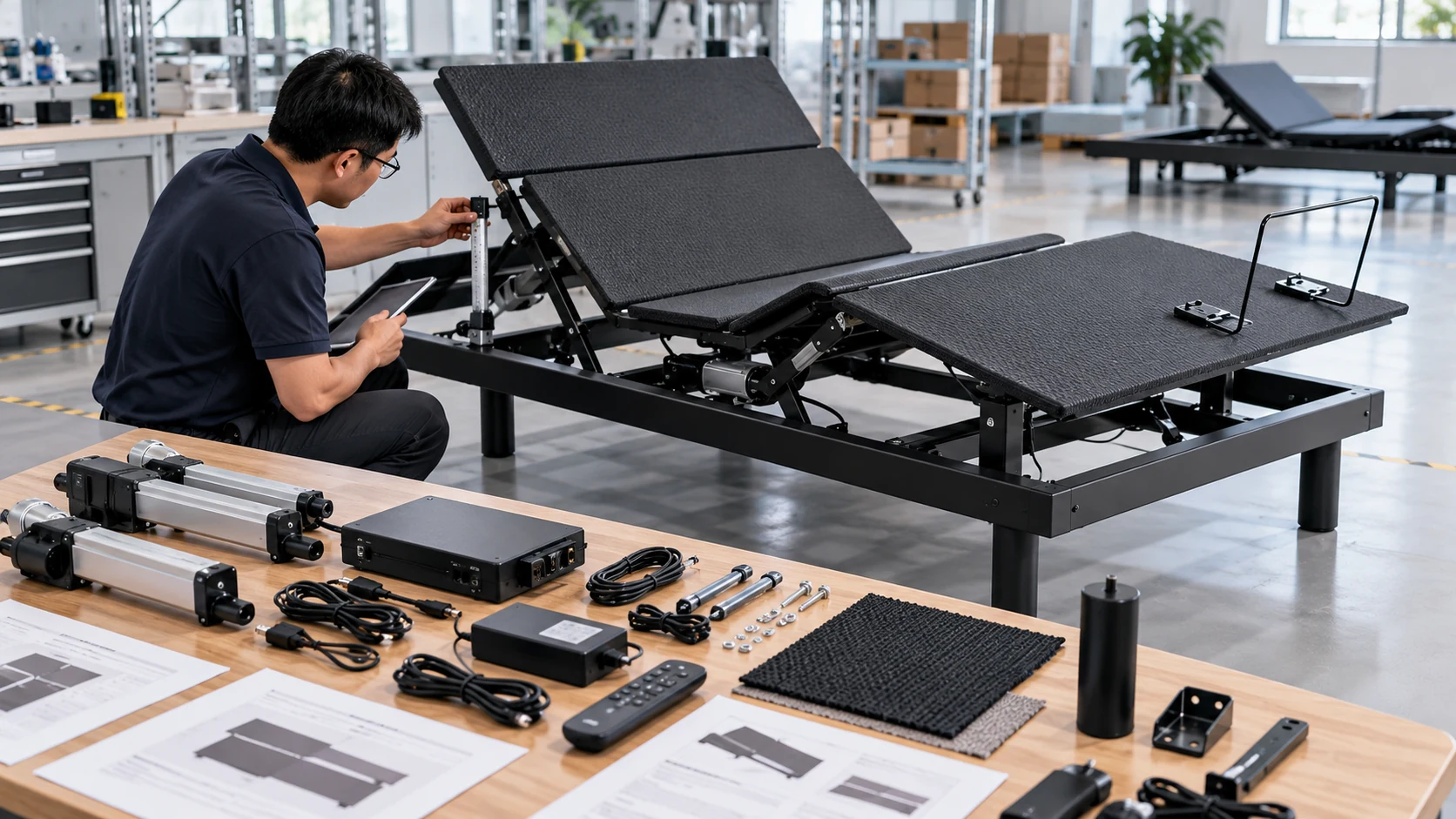
Verify the Motor and Control Components
Confirm the motor, control box, power supply, remote control, wiring and any synchronization or accessory components used in the sample. These components should correspond to the agreed configuration. Buyers should also confirm that normal commands, paired controls and selected safety or reset procedures can be followed according to the documentation supplied for the project.
Component identification is useful for future service planning. It supports discussion of replacements, control compatibility and documentation without claiming that every component is identical across all product configurations.
Test Every Function Included in the Quotation
Make a checklist from the quotation and test each included item. This can include head and foot adjustment, flat return, preset positions, massage, USB, lighting, remote functions and selected smart functions. Record both the result and the exact function tested.
For example, a massage system should be assessed as the specified system, not as a generic feature label. Buyers can use the adjustable bed base massage systems guide to clarify the questions behind a selected massage configuration.
Test the Adjustable Base With the Intended Mattress
Mattress compatibility and mattress retention are separate questions. Place the intended mattress construction on the sample and review flexibility, contact points, movement throughout the adjustment range and whether the mattress remains in a practical position. A mattress may flex while still needing an appropriate retention approach.
For a broader evaluation, see Can Any Mattress Be Used on an Adjustable Bed Base?. The result should be documented with the mattress type and thickness actually evaluated, not generalized to every mattress in a product line.
Check Bed Frame and Installation Compatibility
If the base will be installed inside a decorative bed frame, platform or storage-bed system, verify internal dimensions, support, leg position, moving clearances, headboard and footboard relationships, cable paths and future service access. The bed-frame compatibility guide identifies the furniture checks that should be completed before approval.
For a zero-clearance program, confirm that the selected configuration is designed for the intended support arrangement. A zero-clearance adjustable base requires its own support and movement review; it should not be assumed from nominal mattress size alone.
Inspect Upholstery and Retail Appearance
Review the details that a retailer and end customer will see: upholstery material, color reference, stitching, visible hardware, surface finish, legs, branding, labels and overall presentation. Compare those details to the agreed retail position rather than to a general “premium” expectation.
Where a private-label element is pending, identify it as pending. A clean approval record separates approved appearance details from changes still requiring a revised sample, artwork approval or final confirmation.
Do Not Ignore Packaging During Sample Approval
Packaging should be reviewed for the handling conditions the project expects: warehousing, container loading, international distribution, retail handling or direct delivery. Check carton condition, product protection, included hardware, accessory placement, visible labels and opening experience where relevant.
The goal is not to promise a damage-free outcome in every logistics situation. It is to identify whether packaging, protection and documentation match the selected product and route requirements before they are repeated at scale.
Review Labels, Manuals and Documentation
Compare labels, manuals, specifications and component details with the actual sample configuration. Confirm that model names, functions, installation instructions, control descriptions and private-label content are correct for the product being approved. Documentation should not describe functions that are absent from the sample or omit functions that have been selected.
Market and configuration requirements can differ. Keep final documentation review tied to the destination market and the approved product configuration rather than relying on a generic document set.
Record Every Change Requested After Sampling
After testing, turn comments into precise actions. Record what must change, why it must change, who will confirm it, and whether it requires a revised sample. “Improve stability” is not a complete production instruction; a useful record identifies the observed condition and the agreed resolution.
Separate requested changes from accepted deviations. This avoids treating informal messages as a substitute for the final approved configuration.
Adjustable Bed Base Sample Approval Record
Use a controlled record to connect the physical sample with the final production reference.
| Area | Approved Reference |
|---|---|
| Product Model | Confirmed model and version |
| Size | Approved market-specific size |
| Frame Structure | Sampled structure and assembly reference |
| Motors | Installed motor specification |
| Control Box | Approved controller reference |
| Power Supply | Specified power component |
| Remote | Approved remote and function layout |
| Presets | Included preset positions |
| Massage | Selected massage configuration, if included |
| USB / Lighting | Selected accessory functions, if included |
| Upholstery | Approved material, color and finish |
| Legs | Approved leg type and height |
| Mattress Retainer | Approved retention component, if included |
| Accessories | Included hardware and accessories |
| Labels | Approved label content and placement |
| Manuals | Approved instructions and documentation |
| Packaging | Approved carton and protection approach |
| Branding | Approved private-label details |
| Approved Changes | Controlled list of agreed revisions |
| Approval Date | Buyer approval record |
Decide Whether a Second Sample Is Necessary
A second sample is useful when requested changes affect a critical product characteristic, such as structure, movement, electrical components, controls, upholstery, packaging or private-label details. It can also be appropriate when the first sample was not the exact final configuration.
Do not request a second sample merely to repeat a clear approval. Use it to validate changes that cannot be responsibly confirmed from photos, documents or a revised configuration sheet alone.
Lock the Configuration Before Mass Production
Once the sample is approved, lock the final configuration, approved changes, documentation and packaging reference. This gives the buyer and production partners a common reference for what must be reproduced. It also makes future inspections and repeat orders easier to discuss because the approved benchmark is clear.
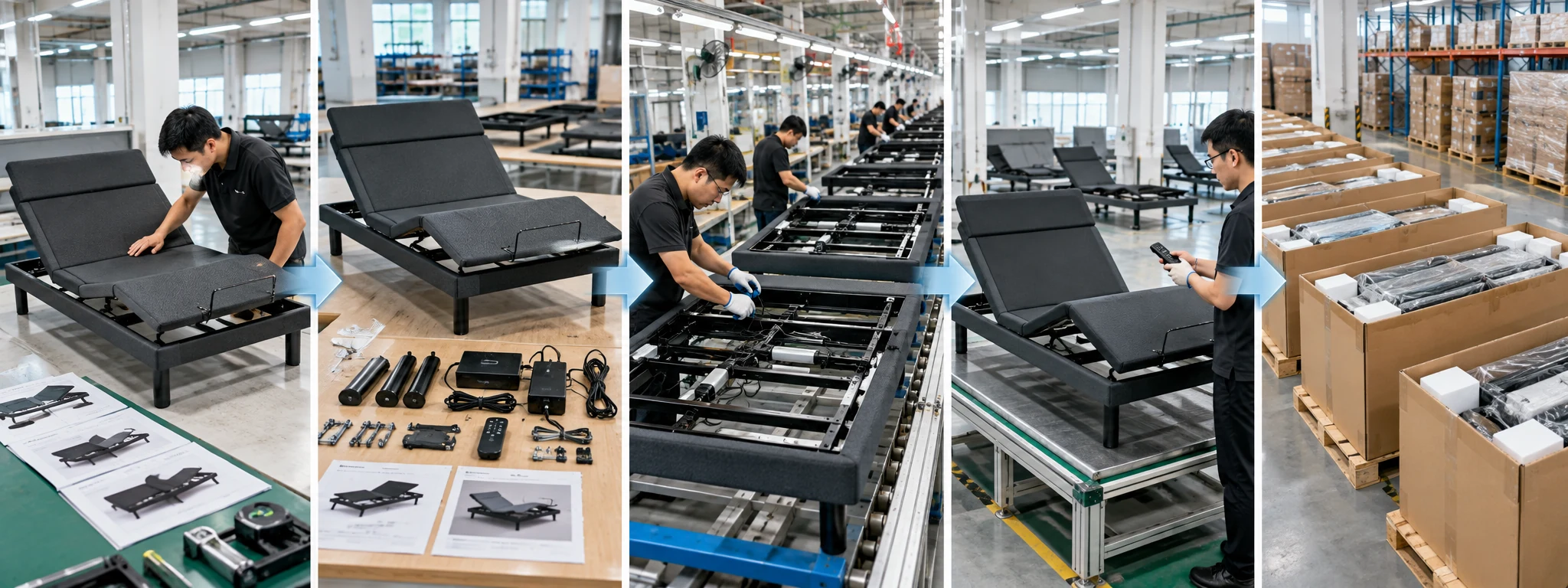
The approval stage is complete only when the configuration, requested revisions and production reference are clear enough to be reproduced consistently.
Adjustable Bed Base OEM Sample Inspection Checklist
- Confirm the Exact Configuration against the quotation and specification sheet.
- Inspect the Frame and Mechanical Structure for alignment, assembly and visible component relationships.
- Test the Complete Adjustment Range for consistent head and foot movement.
- Evaluate Noise and Stability in realistic conditions with the intended setup where possible.
- Verify Motors and Controls installed in the selected configuration.
- Test Every Specified Function included in the quotation.
- Check Mattress and Furniture Compatibility with the intended product system.
- Inspect Appearance and Private-Label Details against the agreed retail position.
- Approve Packaging and Documentation for the selected market and project.
- Create a Production Reference with approved specifications and recorded changes.
How KFY SMART Supports Sample Validation
KFY SMART works with mattress companies, furniture brands, distributors, retailers and other B2B partners developing adjustable-bed programs. Support can include product and configuration selection, OEM/ODM coordination, private-label requirements, packaging review, quality-control and inspection coordination, and documentation planning by configuration and market.
Production is carried out through long-term strategic manufacturing partners, while KFY SMART coordinates development, product requirements, quality control and inspection.
Standard MOQ can start from 20 pieces, and typical lead time can be around 45 days, but final MOQ, timing, customization scope and documentation depend on the selected product configuration and project requirements.
Before You Approve Your Adjustable Bed Base Sample
Before approval, make sure the buyer team has a shared record of the target market, required size, product positioning, included functions, estimated quantity, private-label requirements and any remaining sample or specification concerns. This creates a better basis for the next production decision than an informal approval based on appearance alone.
Planning an Adjustable Bed Base OEM Project?
Share your target market, required size, product positioning, required functions, estimated quantity, private-label requirements and current sample or specification concerns. We can help you structure a clearer approval reference before mass production.