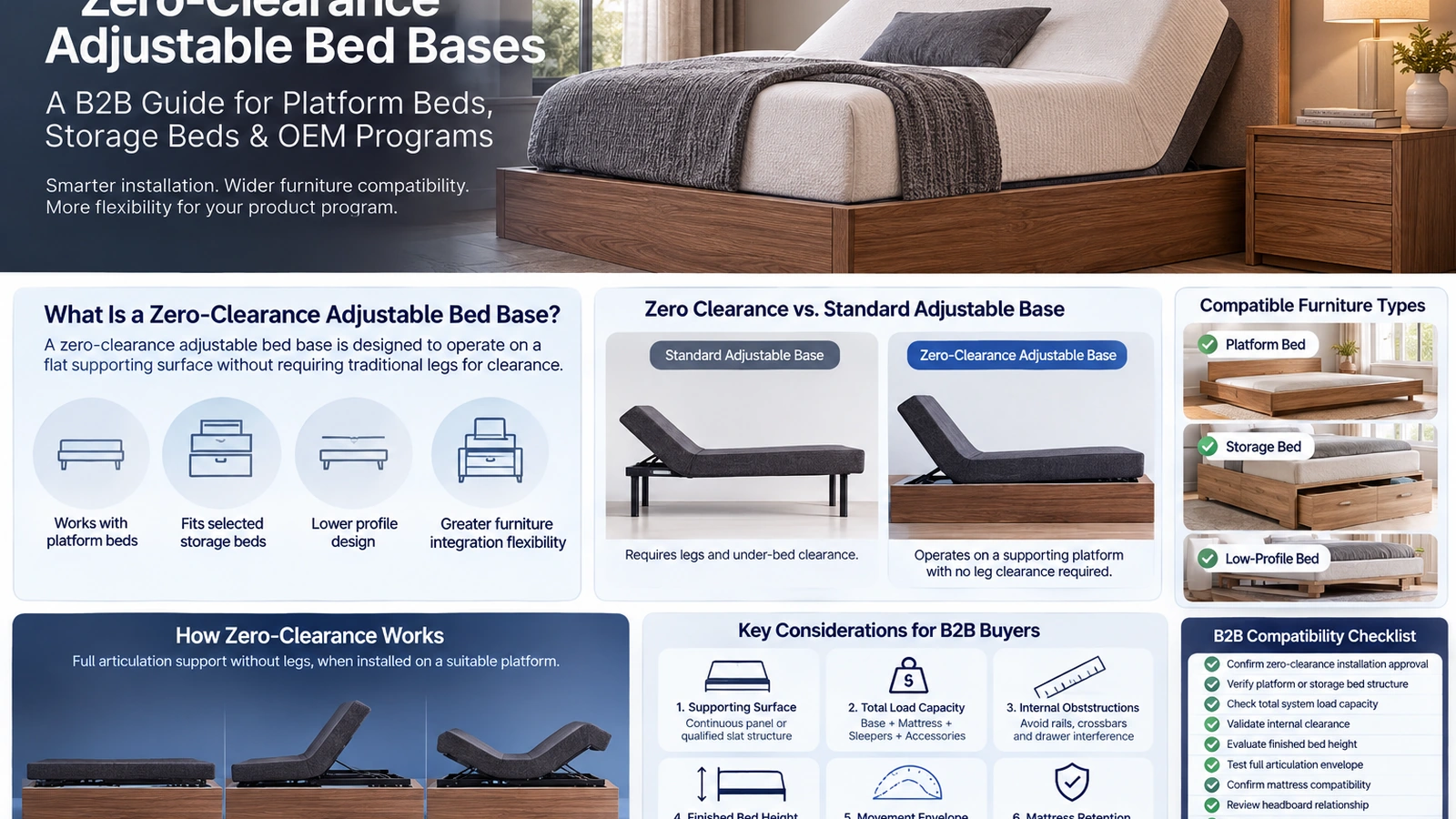
For a mattress brand, furniture company or retailer, a zero-clearance adjustable bed base can make a more integrated bed program possible. It is not, however, a shortcut around engineering review. The selected base, mattress and surrounding furniture must work as one complete application.
A zero-clearance adjustable bed base is designed to operate on an appropriate supporting surface without relying on conventional legs for operating clearance, when that installation is approved for the specific product. Configuration availability should be confirmed against the specific product platform and OEM/ODM project requirements.
What Does “Zero Clearance” Mean on an Adjustable Bed Base?
In an approved installation, the base is supported by an appropriate surface rather than depending on conventional legs to create operating clearance below it. Zero clearance is a base capability, not universal furniture compatibility. It does not mean every base can be placed on every platform, storage bed or decorative frame.
It also does not mean that moving parts need no room. Support construction, cables, mechanisms and the complete articulation path still need an application-specific review.
Zero Clearance vs. Standard Adjustable Base: What Changes?
A standard installation commonly uses a base’s own support legs. A zero-clearance configuration is designed for a specified supported installation without relying on those legs for operating clearance. The distinction affects the base’s approved installation mode and the furniture’s engineering obligations, not merely the appearance of a lower profile.
Buyers should request the selected platform’s installation documentation rather than removing legs or changing support assumptions after procurement.
Can a Zero-Clearance Adjustable Base Be Used on a Platform Bed?
It may be possible, provided the base is approved for the proposed installation and the platform bed is assessed as a support system. Static fit is not enough. The furniture must accommodate the base while flat and throughout the complete movement envelope.
The practical review includes supporting surface, load capacity, internal obstructions, finished height and movement envelope—not only nominal mattress size.
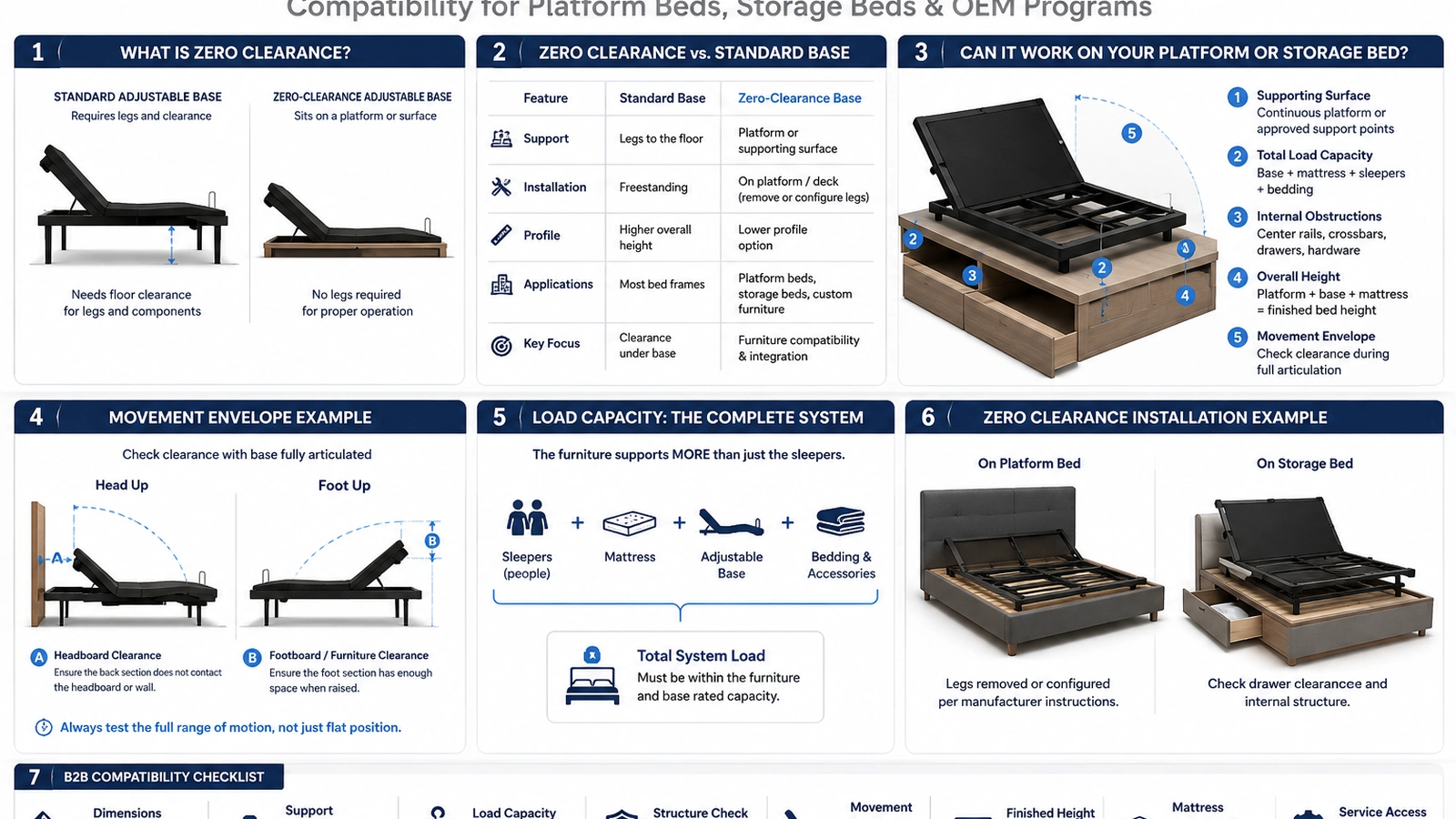
Supporting Surface
The supporting surface needs to be appropriate for the selected product and installed as approved. Review its continuity, structural layout and any features that could interfere with moving components, cables or service access. Do not assume a platform with a visually flat top is automatically suitable.
Total Load Capacity
Furniture capacity and adjustable-base capacity are separate questions. A furniture structure may need to support the complete system:
Adjustable Base
+ Mattress
+ Sleepers
+ Bedding / relevant accessories
Those elements are not necessarily calculated identically by every manufacturer or certification system. Confirm the adjustable-base rated load separately from the supporting furniture rated load; the complete system needs to satisfy both applicable requirements.
Internal Obstructions
Check center rails, cross members, brackets, drawer mechanisms, wiring routes and fasteners against the base’s proposed location and movement envelope. A component that is clear while flat can become an interference point during articulation.
Overall Finished Height
Finished sleep height affects retail expectations, bedside-furniture relationships and user access. Review it as a system rather than publishing a universal target:
Furniture platform height
+ Adjustable base profile
+ Mattress thickness
= Approximate finished sleep height
Movement Envelope
Compatibility must be considered during articulation, not only while flat. Review the full movement envelope around the headboard, side rails, footboard, drawer mechanisms, center rails, cross members, brackets, cables and service access. This review should include the intended mattress because its behavior is part of the moving system.
Can a Zero-Clearance Base Work With a Storage Bed?
A storage-bed application can be reviewed, but drawers, lift hardware, compartments and other internal structures often add constraints. The base must have approved support and enough room for the full movement envelope, without blocking drawers, pinching cables or preventing future service.
For a broader furniture review, see our adjustable bed base and existing bed frame compatibility guide.
Why Weight Capacity Is Often Misunderstood
A base rating does not automatically describe what a platform or storage bed can support, and a furniture rating does not automatically approve an adjustable-base installation. Treat the base, mattress, occupants and relevant accessories as a complete product system, while retaining the distinct requirements of the base and furniture.
Request documentation for the selected configuration; do not infer a universal load limit from a product category or a visual design.
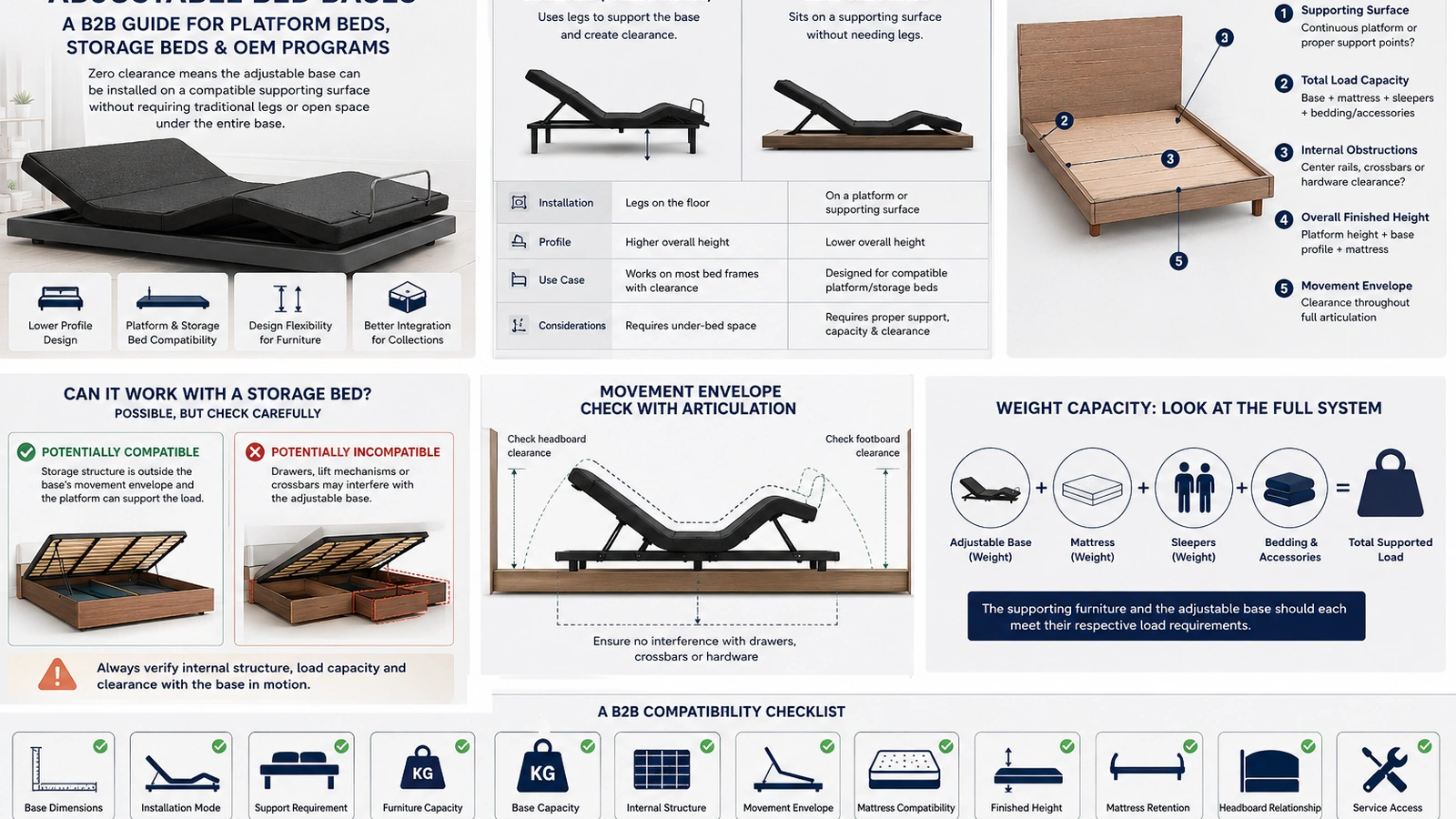
Zero Clearance Does Not Mean Zero Mechanical Space
Zero clearance concerns the approved support and installation configuration. It does not remove the need for space around moving mechanisms, electrical components, cables or service points. Keep the motion and service requirements visible in furniture drawings, installation instructions and sampling reviews.
Zero Clearance vs. Wall Hugger: They Solve Different Problems
Zero clearance concerns installation and support configuration. Wall hugging concerns movement geometry relative to the headboard or wall. One does not automatically imply the other. A B2B program may assess both concepts, but each needs its own product, furniture and motion review.
See the Wall Hugger adjustable bed base guide for the movement-geometry discussion.
A B2B Compatibility Checklist
- Base dimensions and approved installation mode
- Support requirement and furniture capacity
- Adjustable-base capacity and complete-system load
- Internal furniture structure and the full movement envelope
- Mattress compatibility and retention approach
- Finished bed height and headboard relationship
- Cable routing and service access
Use drawings and a representative motion review before approving the application. A visual fit check alone is not an engineering approval.
What Mattress Brands Should Consider
Mattress brands should align mattress dimensions, thickness, construction, flexibility and retention needs with the intended base and furniture program. For a mattress-specific review, see Can Any Mattress Be Used on an Adjustable Bed Base?.
What Furniture Brands Should Consider
Furniture brands need clear drawings for the supporting surface, internal dimensions, rails, cross members, drawers, headboard and service routes. The furniture must meet its own applicable requirements while accommodating the approved base configuration and the complete movement envelope.
What Retailers and Distributors Should Consider
Retail teams should explain zero clearance as an application-dependent capability rather than a universal compatibility claim. Product training should identify the furniture types and installation details that need confirmation before purchase or installation.
What Hotels and Senior-Care Projects Should Consider
Project buyers should evaluate repeated room layouts, fixed furniture, power access, delivery paths and future service needs. Adjustable motion should not be presented as a medical outcome; safety, intended user environment and local requirements remain project-specific.
What to Include in an OEM/ODM Zero-Clearance RFQ
Provide a complete project brief: target market; mattress size, thickness and construction; furniture type and drawings; internal dimensions; target base profile; load requirement; required functions; mattress retention; target finished height; packaging; private-label requirements; certification or market-access requirements; and expected order quantity. This allows the product platform and application to be reviewed together. Buyers should also consider adjustable bed feature selection against the specific project requirements.
KFY SMART's B2B Approach
KFY SMART supports B2B development of adjustable bed bases for mattress brands, furniture companies, retailers and distributors. Configuration availability should be confirmed against the specific product platform and OEM/ODM project requirements; no current model should be assumed to support zero-clearance installation without that confirmation.
For related logistics planning, see Why Are Adjustable Bed Bases So Heavy?.
FAQ
What is a zero-clearance adjustable bed base?
A zero-clearance adjustable bed base is designed to operate on an appropriate supporting surface without relying on conventional legs for operating clearance, when that installation is approved for the specific product.
Can a zero-clearance adjustable base sit directly on a platform bed?
It may when the selected base is approved for that installation and the platform provides suitable support, load capacity, internal geometry and movement clearance. Zero clearance is a base capability, not universal furniture compatibility.
Can I remove the legs from any adjustable bed base?
No. Leg removal and supported installation must be confirmed for the specific product platform and project requirements. Do not assume that a conventional base can operate safely without its legs.
Will a zero-clearance adjustable base work with a storage bed?
It can be evaluated for a storage-bed application, but drawers, cross members, internal obstructions, support construction and the full movement envelope must be checked before compatibility is approved.
How should weight capacity be evaluated?
Review the adjustable-base rated load and the supporting furniture rated load separately. The complete system, including the base, mattress, sleepers and relevant bedding or accessories, needs to satisfy both applicable requirements.
Is zero clearance the same as wall hugger?
No. Zero clearance concerns installation and support configuration. Wall hugging concerns movement geometry relative to the headboard or wall. One does not automatically imply the other.
Are zero-clearance adjustable bases suitable for OEM or private-label programs?
They can be considered for OEM or private-label programs when the product platform, furniture application, market requirements and configuration availability have been reviewed for the specific project.
What information should a B2B buyer provide for a zero-clearance project?
Provide the target market, mattress and furniture specifications, drawings and internal dimensions, load and function requirements, finished-height target, packaging, private-label requirements, certifications and expected order quantity.
Sources
Plan Your Zero-Clearance Program
Planning a zero-clearance adjustable-base program? Send KFY SMART your mattress specification, furniture drawings, target dimensions and market requirements so the complete application can be reviewed before sampling.