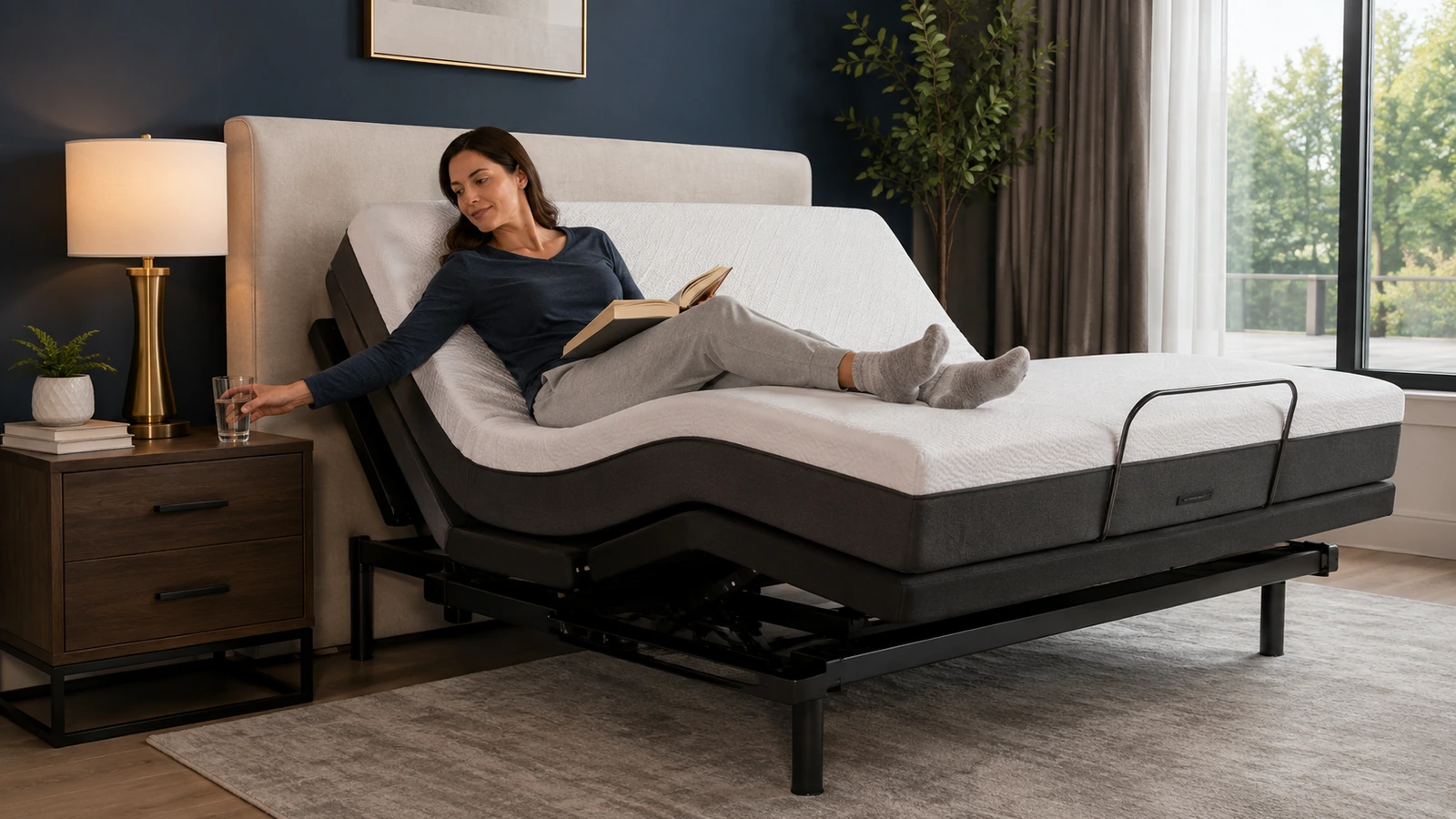
For mattress brands, furniture companies, retailers and project buyers, a wall hugger adjustable bed base can sound like a straightforward premium feature. In practice, it changes the motion conversation from a simple head-up position to the relationship between the sleeper, the mattress, bedside furniture and the bed frame.
That makes it a useful B2B topic: the feature may improve the experience in the right program, but it also asks buyers to consider mechanical configuration, weight, packaging, installation and service together.
What Is a Wall Hugger Adjustable Bed Base?
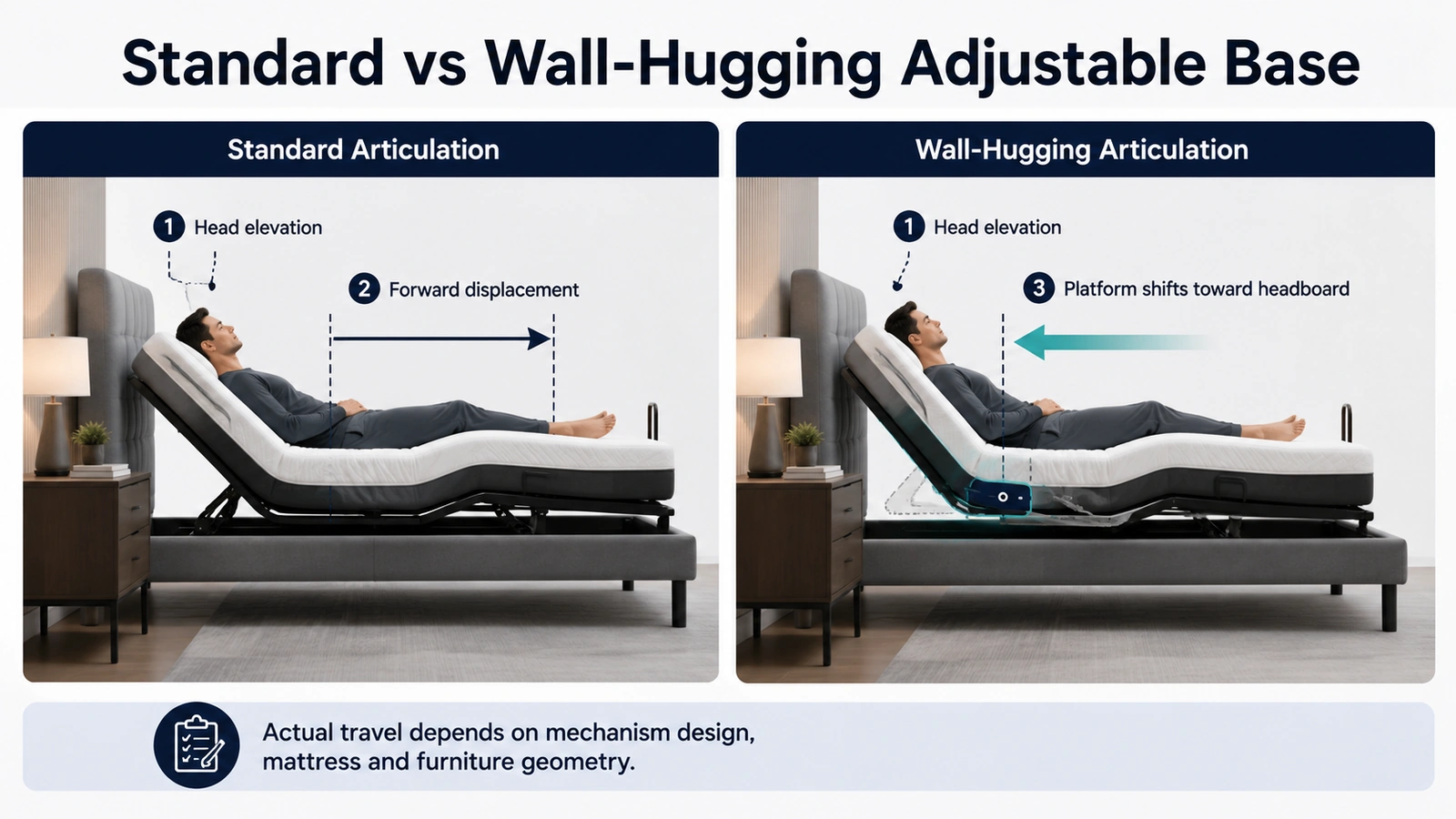
A standard adjustable base typically raises the sleeper upward and forward as the head section articulates. A wall-hugging mechanism adds translational movement intended to shift the sleeping platform toward the headboard while the head section rises.
The objective is designed to reduce forward displacement and help keep bedside furniture easier to reach. It does not mean that every sleeper remains in exactly the same position: the real result depends on mechanism design, mattress behavior, articulation angle and furniture geometry.
Terms such as wall hugger and wall saver are often used for this general motion objective. For sourcing, the important question is the demonstrated motion behavior of the selected platform rather than the label alone.
Wall Hugger vs. Standard Adjustable Base
With standard articulation, the upper body generally travels forward as the head section lifts. A wall-hugging adjustable bed adds a coordinated movement intended to offset part of that forward travel by bringing the platform back toward the headboard.
The feature can be relevant for customers who read, rest or work in bed and want convenient access to a nightstand, lamp, charger or water. It can also be relevant when a furniture layout leaves little room to reposition bedside pieces.
Why Are Wall Hugger Adjustable Bases Less Common?
Wall-hugging motion is not a universal default because the desired movement can require more coordinated mechanical design than a conventional articulated platform. That additional complexity may affect the structural layout, component count, validation requirements and after-sales planning depending on the platform.
For B2B buyers, the question is not whether complexity is inherently good or bad. It is whether the intended customer experience justifies it in the target market and price position.
The Hidden B2B Question: Feature Value per Unit of Complexity
Premium adjustable-base programs benefit from a sourcing framework that connects the feature to the full commercial system:
Customer Value
→ Mechanical Complexity
→ Added Weight
→ Logistics Impact
→ Service Risk
A wall hugger adjustable base may create meaningful customer value in some room layouts. Buyers should compare that value with the implications for structure, carton design, container loading, installation instructions, spare parts and service training.
Wall Hugging and Product Weight
A more complex motion mechanism may increase component count, structure and logistics considerations depending on the design. That can influence how the product is handled in the factory, warehouse, delivery network and customer home.
It is not responsible sourcing to assume a fixed weight increase or a universal price premium. Request the engineering specification, packed dimensions and actual weights for the selected configuration before finalizing a program.
For a related discussion of structure and delivery planning, see Why Are Adjustable Bed Bases So Heavy? What Brands and Distributors Should Know About Foldable Designs.
Wall Hugging and Existing Bed Frames
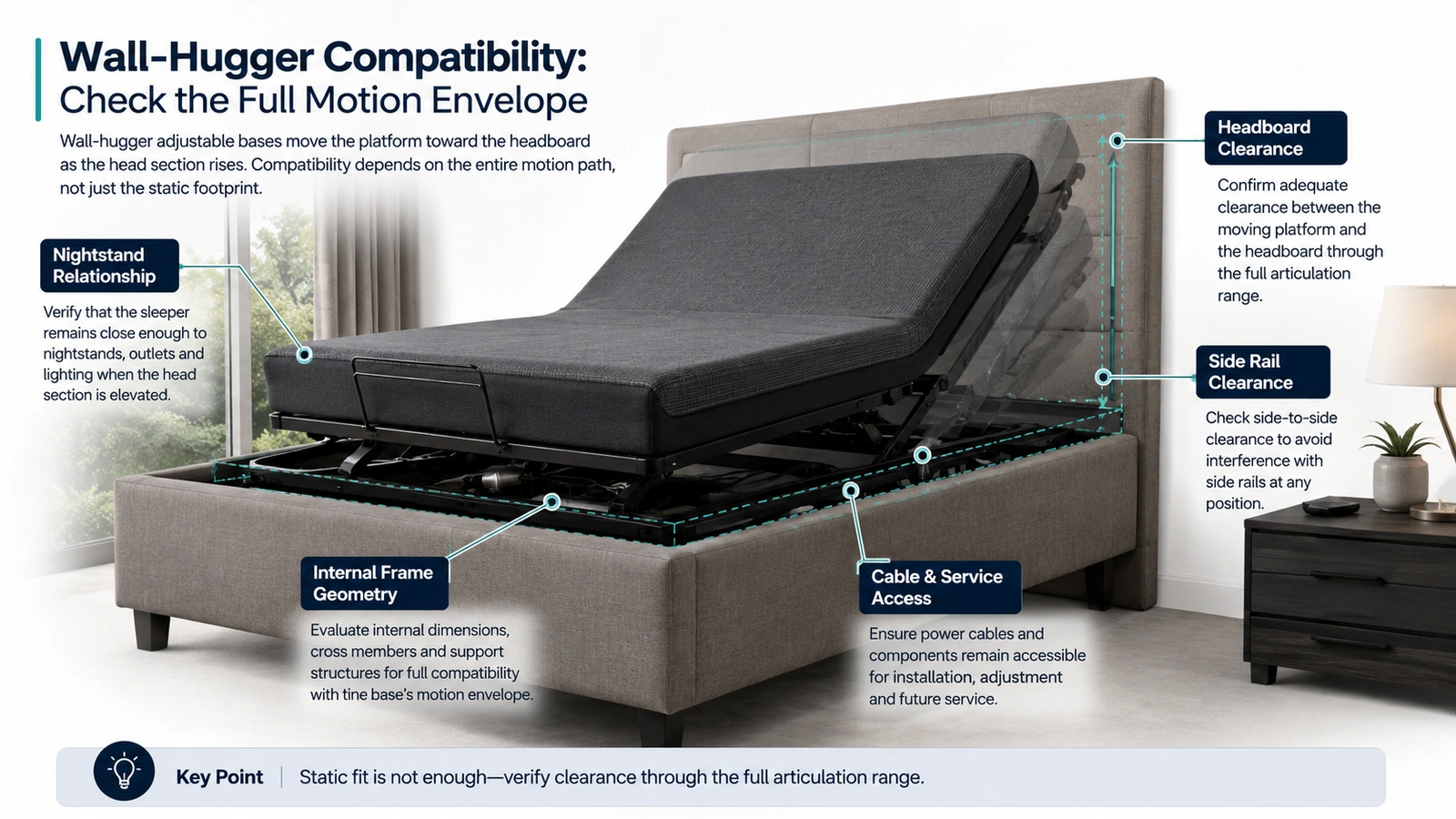
For furniture brands, static fit is not enough. A base can appear to fit inside a bed frame while flat, yet contact a headboard, side rail, cross member or internal support when the platform articulates.
Evaluate the full motion envelope: internal usable width and length, headboard geometry, side rails, cross members, supporting structures, cable routing, power access, service access and the complete articulation range.
Read Can You Use an Adjustable Bed Base With an Existing Bed Frame? A B2B Compatibility Guide for the wider platform, slat and storage-bed review.
Wall Hugger Is Not the Same as Zero Clearance
Wall hugging describes movement.
Zero clearance describes installation configuration.
A product can potentially include both concepts, but one does not automatically imply the other. A zero-clearance installation still needs an approved support surface and a complete movement review; wall-hugging motion still needs its own configuration and clearance checks. For installation-specific planning, see zero-clearance adjustable bed configurations.
Mattress Selection Still Matters
The mattress is part of the moving system. Its thickness, flexibility, weight, edge construction and retention approach can affect how a chosen adjustable-base motion feels and performs.
Before specifying a platform, compare it with the intended mattress architecture and review Can Any Mattress Be Used on an Adjustable Bed Base? A Compatibility Guide for Brands and Retailers.
When Does Wall Hugging Make Sense for Mattress Brands?
Mattress brands may consider the feature when their customer proposition focuses on premium adjustable sleep, bedside convenience or a more integrated bedroom experience. The feature should be matched to the mattress flexibility range, retail story, warranty scope and customer-support process.
It may be less relevant where the assortment is positioned around straightforward entry-level motion and the target customer does not value the added experience enough to support the additional complexity.
When Does It Make Sense for Furniture Brands?
Furniture brands should begin with the bed architecture and room context. Wall-hugging motion may be worth evaluating when headboard geometry, bedside-table reach and a premium integrated look are central to the design brief.
The review needs technical drawings and a prototype motion test, not just nominal mattress dimensions. The furniture must support the selected base while preserving the full motion envelope and service access.
Retailers and Distributors: Avoid Feature-List Selling
Retailers and distributors should avoid presenting a wall-hugging function as a generic checkbox. The useful sales explanation is what the motion is designed to achieve, which room and furniture situations it can help, and what installation details still need confirmation.
Clear product training can reduce incorrect assumptions about bed-frame compatibility, wall clearance and mattress suitability.
Hotels and Apartments: Evaluate the Room, Not Just the Bed
In hospitality and apartment projects, the bed interacts with fixed furniture, power locations, cleaning paths and repeated room layouts. A small dimensional or service-access issue can be multiplied across a large installation.
Project teams should evaluate bedside furniture reach, headboard construction, delivery routes, maintenance access and replacement procedures with the real room drawings.
Senior-Care and Home-Care Applications
In care-oriented applications, bedside reach and clear installation planning can be relevant, but a motion feature should never be presented as a treatment or medical outcome. Buyers should assess the intended user environment, caregiver workflow, safety requirements and local standards for the specific project.
A B2B Wall-Hugger Sourcing Checklist
Before approving a wall-hugger adjustable base OEM or ODM program, collect and compare:
- Target customer, market and price position
- Required motion functions and demonstrated configuration behavior
- Mattress dimensions, thickness, flexibility and weight
- Furniture drawings, internal geometry and support construction
- Full motion-envelope and interference review
- Base and carton dimensions, weights and handling requirements
- Electrical, control and cable-routing requirements
- Installation instructions and service-access plan
- Packaging, container loading and delivery constraints
- Spare-parts, warranty and after-sales expectations
Should Your Next Adjustable Base Include Wall Hugging?
Not every premium adjustable base needs wall-hugging motion. The right decision depends on how much value the target customer receives from bedside reach and room integration compared with the added mechanical and commercial complexity.
Specify the function when it supports a clearly defined customer and furniture use case. Otherwise, a well-executed standard platform may be the better program choice.
Adjustable Bed Base OEM/ODM Solutions From KFY SMART
KFY SMART works with mattress brands, furniture companies, retailers and distributors developing Adjustable Bed Bases for different markets and product positions.
Configuration availability should be confirmed against the specific product platform and OEM/ODM project requirements. The review can combine required motion functions with mattress, furniture, packaging and market requirements.
FAQ
What is a wall hugger adjustable bed base?
A wall hugger adjustable bed base uses a motion concept intended to shift the sleeping platform toward the headboard as the head section rises, helping reduce forward displacement. Actual movement depends on the mechanism, mattress, articulation angle and furniture geometry.
Is wall hugger the same as wall saver?
Wall hugger and wall saver are commonly used to describe a similar objective: reducing how far a sleeper moves forward from the headboard or bedside furniture during head-up articulation. Buyers should still confirm the actual motion behavior for the selected product platform.
Is wall hugging the same as zero clearance?
No. Wall hugging describes movement. Zero clearance describes an installation configuration. A product can potentially include both, but one does not automatically imply the other.
Why can wall hugger adjustable bases be more complex?
The additional motion objective can require more component coordination and may affect structure, packaging, logistics and service considerations depending on the design. Buyers should evaluate the commercial value alongside the complete system complexity.
Does a wall hugger base work inside an existing bed frame?
It may, but static fit is not enough. The furniture must be reviewed through the full motion envelope, including internal dimensions, headboard geometry, rails, support structure, cable routing and service access.
Should every premium adjustable base include wall hugging?
Not necessarily. The feature makes most sense when the target customer values bedside reach, room layout or furniture integration enough to justify the added mechanical and commercial complexity.
What should a furniture brand send an adjustable-base manufacturer?
Send mattress specifications, finished and internal furniture dimensions, headboard and rail geometry, support construction, drawings, target market, installation requirements, packaging expectations and service-access needs.
Can KFY SMART develop wall-hugging configurations for OEM/ODM projects?
Configuration availability should be confirmed against the specific product platform and project requirements. For B2B development, KFY SMART can evaluate required motion functions together with mattress, furniture, packaging and market requirements.
Sources
Plan Your Adjustable-Bed Program
Planning a premium adjustable-bed program? Send KFY SMART your mattress specification, furniture drawings and target market to evaluate which motion and installation configuration best fits your OEM/ODM project.