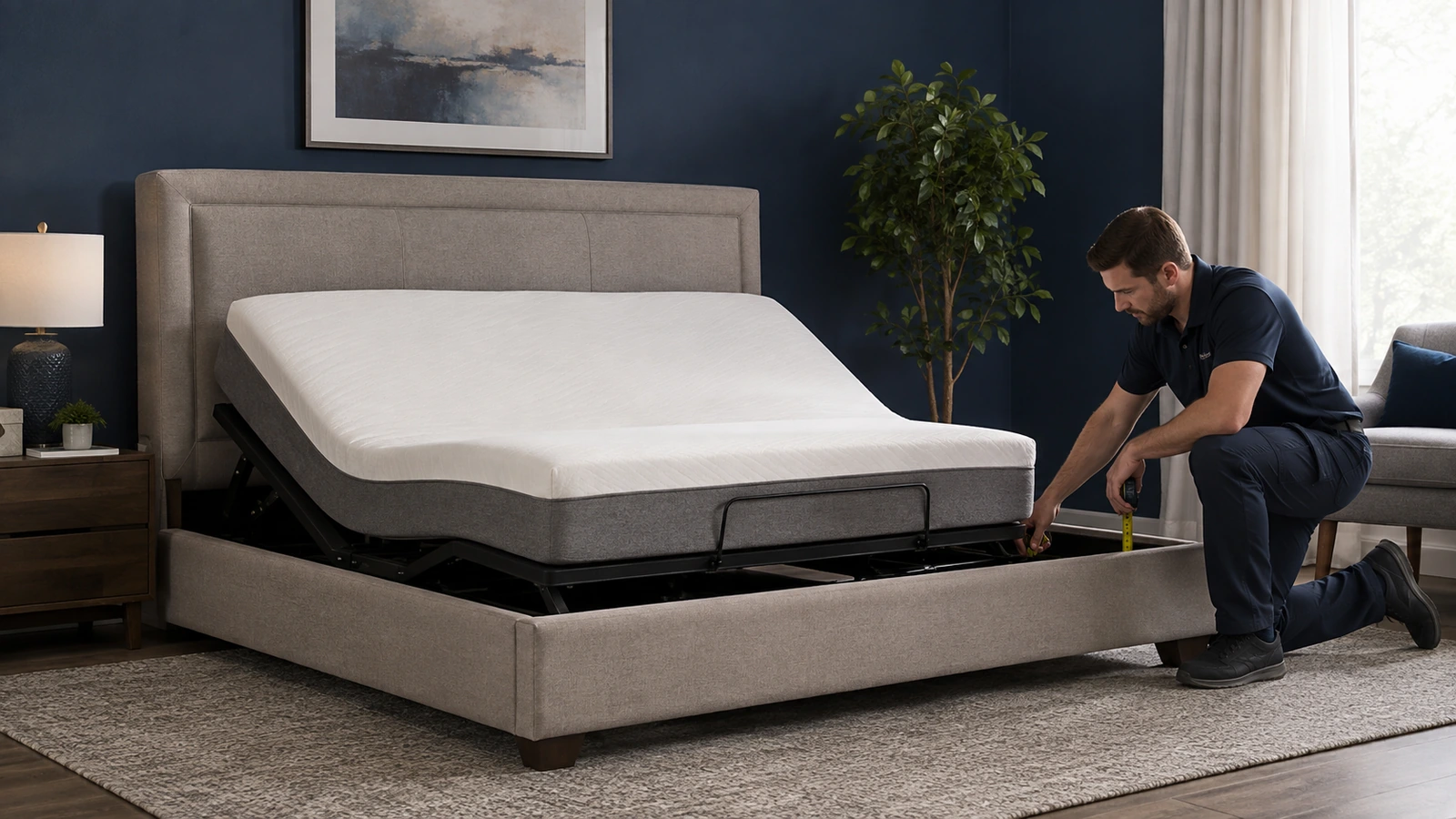
Many adjustable bed bases are marketed as compatible with existing bedroom furniture. In practice, the answer depends on far more than whether the mattress fits inside the frame.
The base, mattress and furniture must work together as one mechanical system. Internal width, support surfaces, moving clearances, electrical access and finished height can all affect whether an adjustable bed base is compatible with a bed frame.
For consumers, the question is usually whether a current bed can be reused. For mattress brands, furniture brands, retailers and distributors, it is a product-development and sourcing question that should be answered before a new SKU is approved.
Why Bed-Frame Compatibility Has Become a Bigger Issue
Adjustable bases are increasingly sold through mattress, furniture and e-commerce channels rather than only through specialist bed dealers.
That creates more combinations: a moving base inside an upholstered frame, a zero-clearance base on a platform, a split King configuration inside a larger furniture surround, or a base paired with a storage bed.
Each combination introduces different questions:
- Does the furniture provide a continuous supporting surface?
- Can the base move without touching rails, drawers or the headboard?
- Are the nominal mattress and furniture dimensions actually the same?
- Can installers access motors, controls and power connections?
- Will the finished bed height remain practical?
Compatibility should therefore be treated as an engineering review, not as a marketing assumption.
What Does “Zero Clearance” Mean on an Adjustable Bed Base?
A zero clearance adjustable bed base is designed to operate directly on a supporting surface without conventional legs. Depending on the model, that surface may be a platform, a reinforced furniture deck or another structure specified by the manufacturer.
Zero clearance does not mean “compatible with every bed frame.” It means the base has a configuration that can operate without the usual leg height, provided the supporting surface has appropriate dimensions, strength and mechanical clearance.
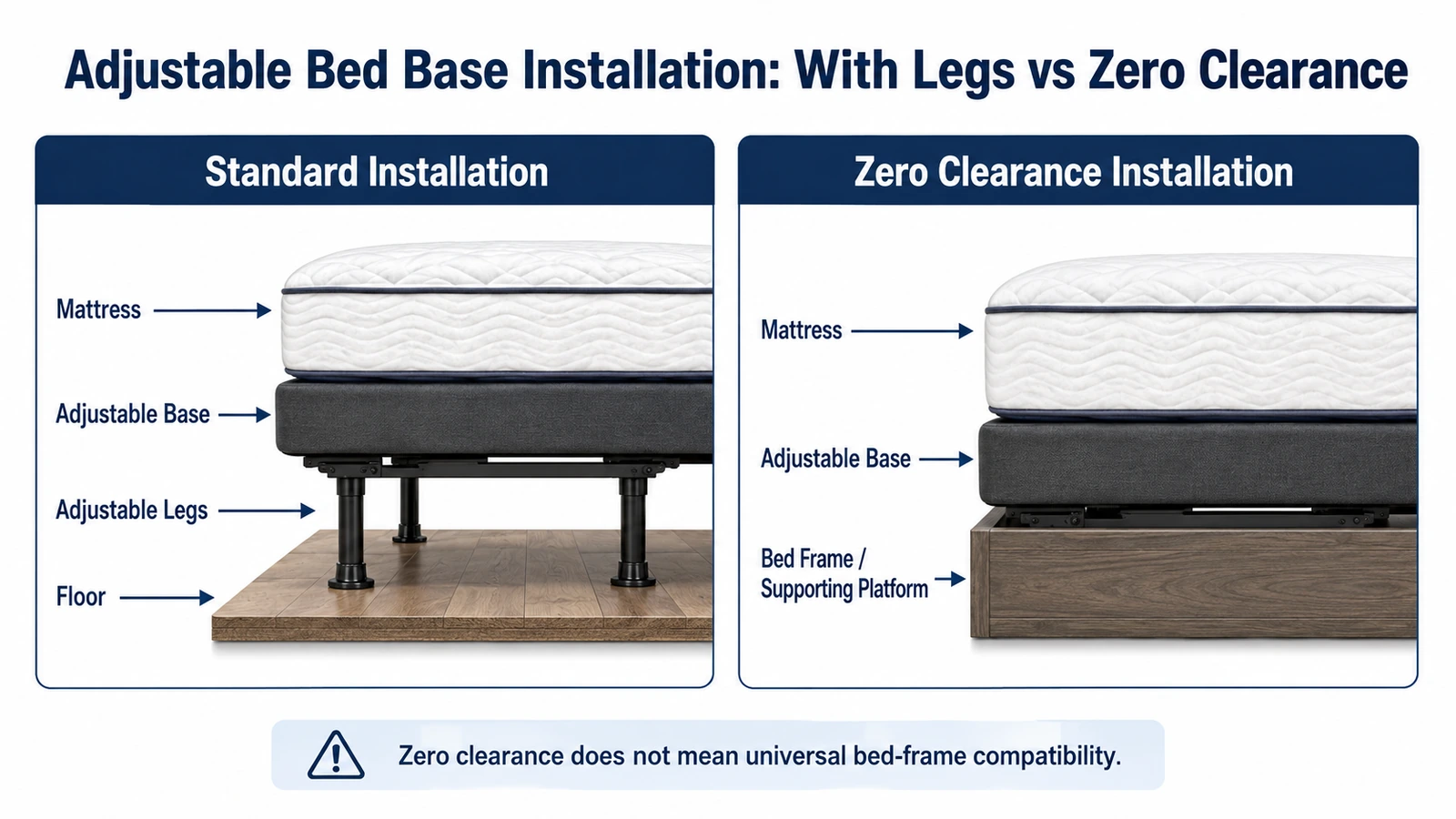
For a furniture program, the critical question is not only whether the base can sit low. It is whether the furniture can safely support the combined moving system throughout its full range of motion.
Two Common Ways to Combine an Adjustable Base With Furniture
Most furniture-compatible programs use one of two broad configurations. The correct option depends on the base design and the internal construction of the bed frame.
Option 1: The Furniture Frame Surrounds the Adjustable Base
In this configuration, a conventional adjustable base remains a self-supporting unit with its own legs or support points. The decorative bed frame surrounds it and gives the room the intended appearance.
The furniture normally needs enough internal width and length to accommodate the base, plus clearance for movement, cables and installation. The rails should not carry loads or interfere with moving platform sections unless the design explicitly calls for that support.
Option 2: A Zero-Clearance Base Sits on a Supporting Surface
In a zero-clearance configuration, the adjustable base is placed on a supporting platform or an engineered deck. This can reduce finished height and make the furniture look more integrated.
The supporting surface must be designed for the combined load and the motion of the base. Ventilation, access panels, fasteners, cable routing and service access should be included in the furniture drawings before production.
Can an Adjustable Base Be Used With a Platform Bed?
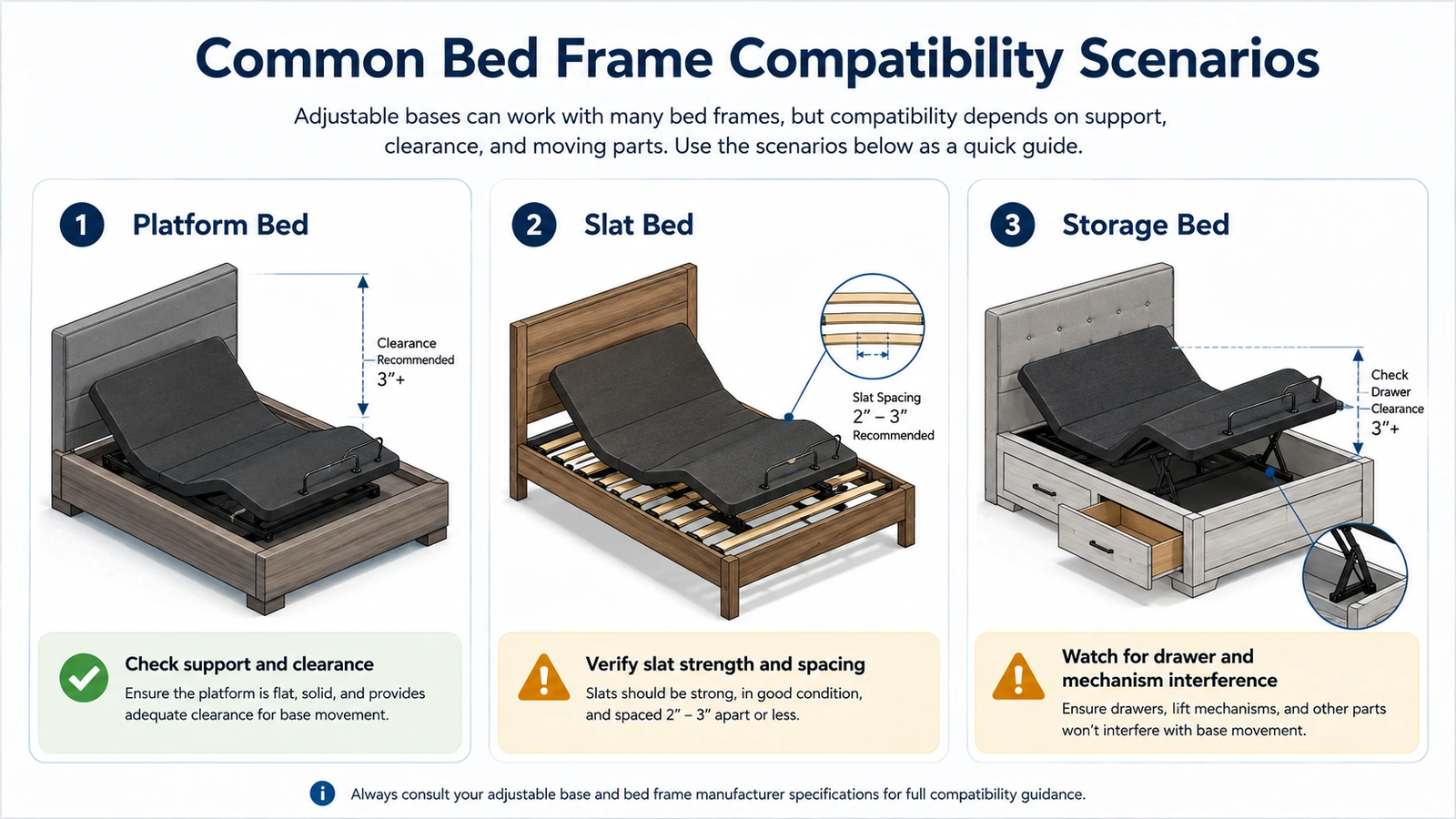
Sometimes. An adjustable base platform bed combination can work when the platform is structurally suitable and the base manufacturer permits that installation.
A platform bed may provide a useful continuous surface, but the platform still needs to be evaluated for:
- Load capacity for the base, mattress and sleepers
- Flatness and level support
- Clearance around moving sections
- Internal dimensions and corner geometry
- Access to power and control components
- Noise, vibration and contact points
A decorative platform is not automatically an engineered support platform. Brands should confirm the intended load path and test the actual base and furniture combination.
Can an Adjustable Base Sit on Bed Slats?
It depends on the base design and the slat system. An adjustable bed base with slats may be possible when the slats form a sufficiently strong, level and closely supported surface, but many bases are not designed to rest directly on widely spaced or flexible slats.
Before approving the combination, buyers should confirm:
- Maximum slat spacing
- Slat width, thickness and material
- Center support and leg locations
- Whether the base can distribute load without point damage
- Whether the slats can remain stable during articulation
If the base manufacturer requires a solid supporting surface, replacing or reinforcing the slat deck may be necessary. The answer should come from the tested installation specification rather than from the appearance of the bed frame.
Can You Use an Adjustable Base With a Storage Bed?
A storage bed creates an additional layer of complexity. Drawers, lift-up platforms, gas struts, divider panels and enclosed compartments can occupy the same space that an adjustable base needs for motion and service.
An adjustable base with storage bed program may still be feasible, but the furniture needs to be designed around the base rather than treating the base as a late replacement for a static foundation.
Why Internal Bed-Frame Geometry Matters
External mattress dimensions do not describe the complete fit. Two bed frames that accept the same nominal mattress size can have very different internal geometries.
For an OEM or ODM review, request furniture drawings or technical drawings showing:
- Clear internal width and length
- Rail and corner positions
- Headboard and footboard depth
- Platform or slat elevation
- Drawer and lift-up mechanism travel
- Leg and center-support locations
- Cable exits and service openings
The base should be tested inside the real furniture geometry through flat, head-up and foot-up positions. A static fit check is not enough if a moving section can contact the frame at another angle.
What About Split King Adjustable Bases?
A split King adjustable base uses two independently moving sections. It can fit inside a King-size furniture frame, but the furniture must be designed for the split line, synchronized movement requirements and the combined width of both units.
Buyers should verify:
- Finished dimensions of each half
- Center gap and side clearances
- Whether the furniture deck supports both units independently
- How mattresses and bedding are retained
- Remote, power and synchronization access
- Installation and removal paths
Nominal size is only the starting point. A split King configuration needs an engineering drawing and a prototype fit check before the furniture SKU is finalized.
Bed Height Is Part of Compatibility Too
A base can fit inside a frame and still produce an impractical finished bed height.
The complete height is influenced by the base, mattress, furniture deck, legs, feet and any clearance required for moving parts. Brands should evaluate the finished system rather than quoting the base height alone.
During product planning, record:
- Adjustable base height
- Mattress thickness and compression
- Furniture platform elevation
- Under-bed clearance
- Finished sleeping and sitting height
- Headboard and bedside-table relationship
These measurements affect ergonomics, visual proportions, shipping packaging and customer expectations.
A B2B Compatibility Checklist
Before approving an adjustable bed base compatible with a bed frame, buyers should collect the following information:
Adjustable Base
- Nominal size and engineering dimensions
- Combined load rating
- Leg, zero-clearance or platform-support requirements
- Moving envelope and articulation angles
- Motor, control-box and power locations
- Installation and service access
Mattress
- Finished dimensions and thickness
- Flexibility and retention requirements
- Mattress weight
- Split or non-split configuration
Furniture
- Furniture internal geometry
- Platform or slat construction
- Storage mechanism travel
- Rail and headboard clearances
- Center support and load path
- Finished bed height
Validation
- Prototype fit check
- Full-range movement test
- Noise and interference check
- Installation and removal test
- Furniture drawings / technical drawings for OEM/ODM compatibility evaluation
The combined load should be calculated as Adjustable Base + Mattress + Sleepers, not as the base rating viewed in isolation.
Confirm what the base rating includes and how it is distributed with the adjustable bed base weight-capacity checklist before approving the supporting furniture.
Why This Matters for Mattress Brands
Mattress brands often add adjustable bases to extend an existing sleep product line. If the base is sold with a decorative frame or a current furniture partner, compatibility affects the whole customer journey.
Brands should define mattress thickness ranges, split configurations, retention expectations, packaging and installation instructions together. A mattress that works on a free-standing base may need additional fit checks when placed inside furniture.
Why This Matters for Furniture Brands
Furniture brands need to design around movement, not only around the mattress outline.
Technical drawings should show the base envelope, support points, service access, cable routing and any areas where rails, drawers or upholstery could interfere. A furniture program that passes a flat fit test can still fail during head or foot articulation.
Why This Matters for Retailers and Distributors
Retailers and distributors are responsible for communicating what customers can combine. Clear compatibility rules reduce installation surprises, returns and after-sales questions.
Product listings should distinguish between a base that can be placed inside a furniture surround and a zero-clearance base that requires a specific supporting platform. The packaging and installation process should reflect the selected configuration.
Hotels, Apartments and Senior-Care Projects Need a Different Approach
Project buyers may install many units in rooms with repeated layouts and fixed access conditions. Small compatibility errors can multiply across a project.
Hotels, apartments and senior-care buyers should confirm doorway access, elevator dimensions, finished height, replacement access, cleaning requirements, electrical standards and installation sequence before purchase orders are released.
In occupied homes or furnished rooms, the ability to service or replace a base can be as important as the initial installation.
Compatibility Should Be Designed, Not Assumed
The safest product-development approach is to treat the adjustable base, mattress and bed frame as one system from the start.
Nominal size is useful for a first screen, but engineering dimensions, combined load, finished bed height, furniture internal geometry and prototype fit checks determine the real result.
When a product program involves a platform bed, storage bed, slats or a split King frame, the furniture drawings and movement tests should be part of the sourcing conversation.
Adjustable Bed Base Solutions From KFY SMART
KFY SMART develops adjustable bed bases for mattress brands, furniture companies, retailers, distributors and project buyers.
The adjustable base range includes different structures and market positions, including options for programs where furniture integration, packaging or logistics efficiency are important.
For buyers evaluating a foldable structure and delivery-oriented configuration, see the E3 Foldable Adjustable Bed Base.
KFY SMART can coordinate B2B requirements including size, frame configuration, controls, fabric and finish, plug and voltage, packaging, private-label details and furniture compatibility discussions.
FAQ
Can an adjustable bed base fit inside a regular bed frame?
It can, but only when the frame provides the required internal dimensions, support and movement clearance. A decorative surround is not automatically compatible.
What does zero clearance mean on an adjustable bed base?
Zero clearance means the base can operate without conventional legs on an approved supporting surface. It does not mean that every platform or furniture frame can support it.
Can I put an adjustable base on a platform bed?
Possibly. The platform must be level, strong enough for the combined load and clear of the base through the complete range of motion. Follow the selected base manufacturer's requirements.
Can an adjustable bed base sit directly on slats?
Only if the base is approved for that slat spacing and support arrangement. Many installations require a solid or specifically reinforced surface.
Can an adjustable base work with a storage bed?
It may work when drawer, lift-up and divider mechanisms leave the required space for movement, support and service. Storage hardware should be checked against the base drawings.
Do I need to remove the slats from my bed frame?
Not always, but the slats must meet the base's support requirements. If they do not, they may need to be removed, reinforced or replaced with an approved platform.
Will a Split King adjustable base fit inside a King bed frame?
It can fit when the frame accommodates both halves, the center interface and the required clearances. Confirm engineering dimensions rather than relying only on the nominal King label.
What information should B2B buyers send an adjustable-base manufacturer?
Send the target market, mattress specifications, nominal and engineering dimensions, furniture drawings, support construction, storage mechanisms, desired finished height and any private-label or electrical requirements.
Build the Complete Sleep System Before You Build the SKU
Adjustable-base compatibility is not a single dimension. It is the relationship between the moving base, mattress, furniture geometry, support structure, finished height and installation process.
Planning an adjustable-bed program for your mattress, furniture or distribution business? Send KFY SMART your target market, mattress specifications and furniture dimensions to discuss a compatible OEM/ODM configuration.