An adjustable bed base can be convenient while electricity is available. But what happens when the power goes out while the head or foot section is raised? For a mattress brand, furniture retailer or OEM buyer, the answer cannot be taken from a generic feature list. It must come from the exact base configuration, power system and approved user instructions.
1. Why Power-Loss Behavior Belongs in an Adjustable-Base RFQ
Many adjustable-base quotations emphasize head and foot articulation, programmable positions, upholstery, massage or remote-control options. Yet a buyer may receive no clear answer to one practical customer-service question: If the electricity fails while the bed is elevated, what can the owner actually do?
That gap matters because the same sales phrase—such as “battery backup” or “power-down”—can conceal different operating conditions. The buyer needs to know whether the backup device is built in or separate, whether batteries are supplied, whether the user must locate a control under the frame, and whether an emergency function returns the system to flat or supports other commands.
The purpose is not to demand the most complicated power system in every SKU. It is to make a conscious product decision, document the trade-off and avoid an unexpected promise in a retail listing or service manual.
2. Emergency Lowering vs. Battery Backup vs. Continued Operation
These terms describe related but different capabilities. They should be specified separately rather than treated as interchangeable.
| Buyer term | What it should mean in a specification | Question to ask before approval |
|---|---|---|
| Emergency lowering / power-down | A documented means of moving a raised base toward its approved flat position after power loss, if the selected design supports it. | What initiates the movement, and under what conditions will it work? |
| Battery backup / emergency power source | An alternate source of electrical energy, whose capacity and supported actions depend on its design. | Is the battery/device included, installed or connected only when needed, and what commands can it supply? |
| Continued operation | Operation of defined bed functions after mains power is lost, if supported by the particular system. | Which functions, for how long and under what load? Is this supported at all? |
A product can have an emergency lowering mechanism without offering normal battery-powered articulation. Conversely, a buyer should not infer the existence of an approved emergency procedure merely because a power system has a battery-related component.
The supplier's model-specific manual, wiring/configuration reference and approved sample—not the marketing term alone—must define the answer.
3. How Different Adjustable Beds Handle Power Failure
Emergency power-down devices
Some manufacturers provide a dedicated power-down control. For example, Tempur-Pedic's official support information for the TEMPUR-Ergo Premier describes a button on the power supply and specifies replacement of two 9-volt batteries after the procedure. Its instructions also note that lowering is slower during emergency power-down. This is a feature of that identified model, not a general rule for adjustable bases. Source: Tempur-Pedic Premier support.
Tempur-Pedic's TEMPUR Ergo Advanced support instead describes an Emergency Power Down Box and an explicit button/indicator procedure. Even within a brand, the location and operating sequence can differ. Source: Tempur-Pedic Advanced support.
Battery-assisted return to flat
Another product may use batteries or a detachable backup accessory to support a limited return-to-flat action. Battery count, location, expected life and required post-use replacement must all come from that particular product's approved documentation. Some official manuals distinguish emergency batteries from batteries used for ordinary remote controls; they are not automatically interchangeable.
Other manufacturer-specific designs
Ergomotion lists Power Outage Protection among the disclosed technologies for its ErgoFlex range and describes returning the base to a flat position with a button on a power-down box. This provides another real example of a manufacturer-defined feature, but it should not be used as a claim about KFY SMART models. Source: Ergomotion ErgoFlex.
External backup power
A purchaser may also ask whether an external backup power supply is suitable. Compatibility with electronics, load, grounding and the supplier's warranty/operating requirements must be confirmed by the approved manufacturer and a qualified professional. Do not assume that connecting a generic power bank or UPS is a validated substitute for a model's emergency power-down device.
4. What if the Base Is Raised When the Electricity Fails?
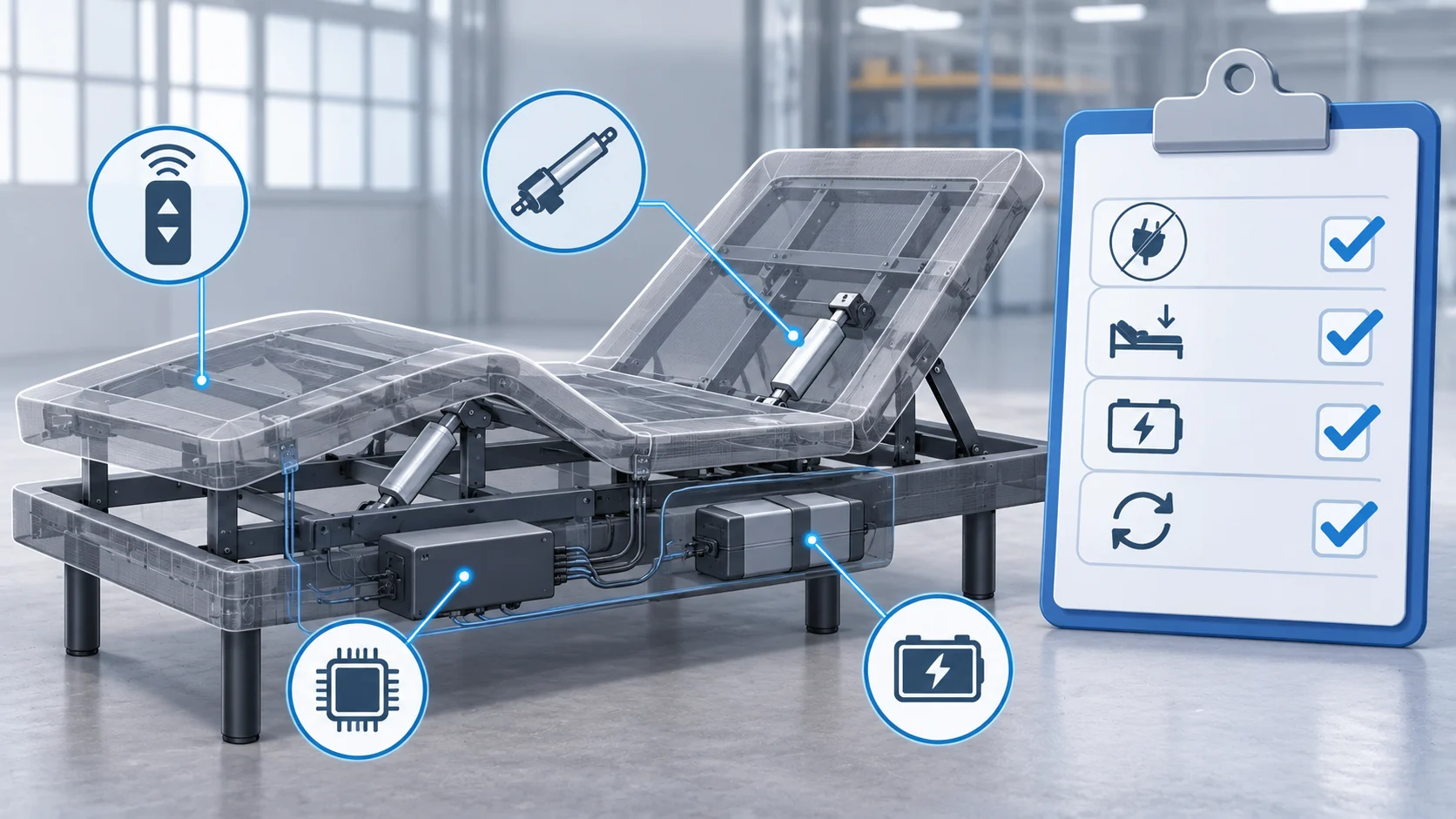
The relevant customer scenario is a bed that stops in an articulated position. A safe user response starts with checking the model-specific manual and using only the manufacturer's authorized emergency procedure, if one exists. The procedure might involve a dedicated control, a pre-specified backup accessory or a particular sequence. If the product has no approved emergency operation, service or restoration of mains power may be required.
Users should not force the mattress platform or linkage down, pull actuator pins, open electrical housings or improvise a battery connection. Moving mechanisms can create pinch points; manufacturer support information explicitly calls for keeping hands and arms clear during emergency lowering. Source: Tempur-Pedic Advanced support.
For an OEM program, the commercial issue is whether the customer will know what to do before an outage occurs. A clear instruction card can sometimes create more practical value than an unfamiliar feature name on a product sheet.
5. Can Every Adjustable Bed Return to Flat Without Electricity?
No universal return-to-flat capability should be assumed. Whether a base can move depends on the chosen power source and controller, the available emergency command, mechanical condition and the approved operating limits.
A “FLAT” button on a normal remote is only a command interface. Without the electrical energy or control logic needed to execute it, the presence of that button does not establish an emergency lowering feature. The same caution applies to app controls, memory positions and voice integrations.
Buyers should distinguish three different explanations when a bed does not move: a normal loss of electrical supply, a control or communication issue, and a mechanical/electrical fault. These require different service pathways. KFY SMART's existing remote-control system guide addresses pairing and control compatibility, while its uneven-lifting guide deals with movement and structural diagnosis. Neither should be mistaken for an approved power-outage procedure.
6. KFY SMART's Proposed OEM Power-Loss Decision Framework
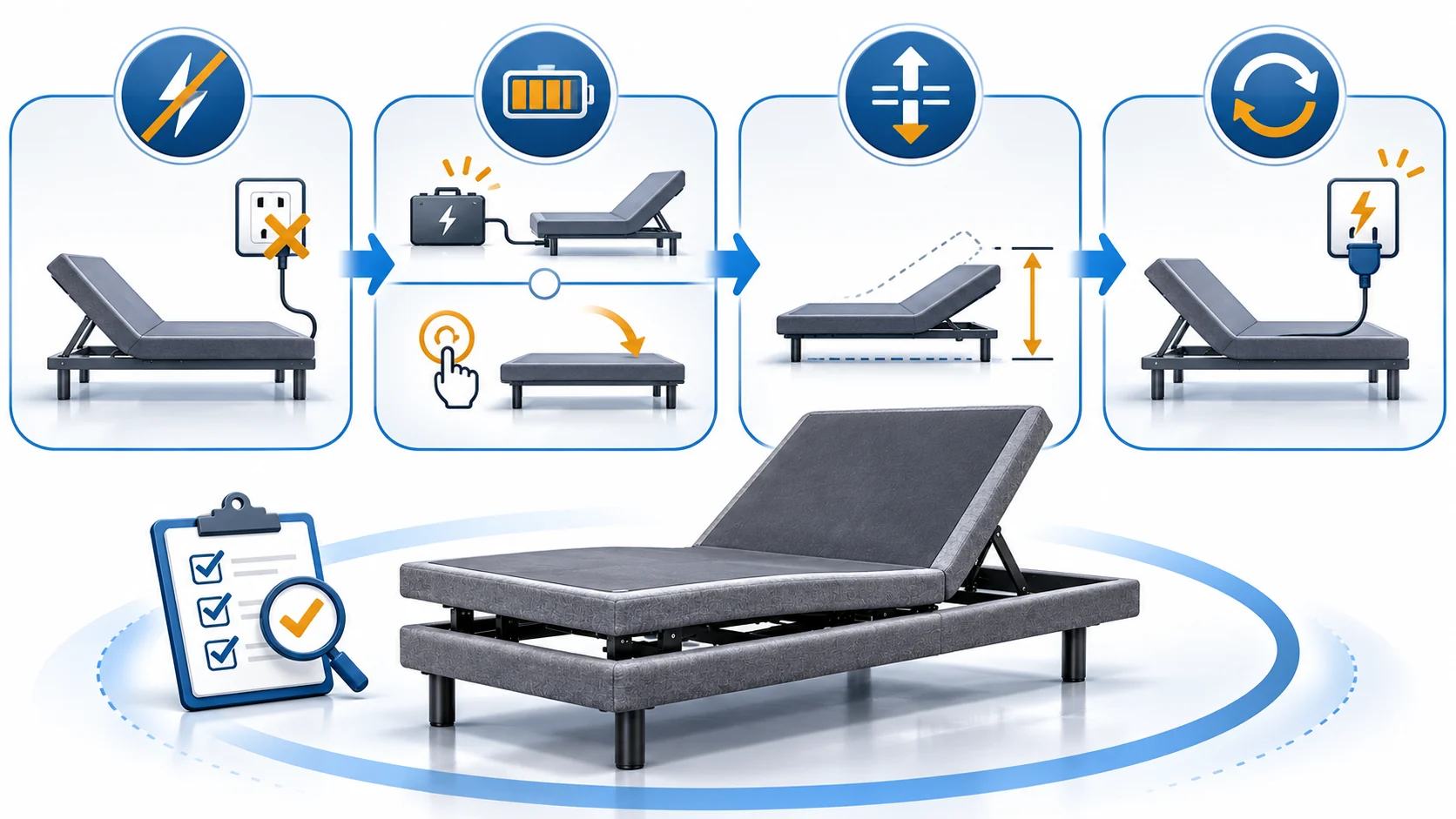
For a B2B program, KFY SMART proposes evaluating power-loss behavior as a five-part decision chain:
Power Loss → Available Power Source → Supported Command → Movement Limit → Recovery
This is a procurement-review framework developed for this article. It is not a published test standard, and it does not assert that KFY has verified a particular backup device.
- Power loss: What exact event is being considered—mains outage, unplugged adapter, disconnected control box or another fault? Do not combine unlike events.
- Available power source: Is there an approved backup device? Where is it located, and must the user supply/install batteries?
- Supported command: Can the user initiate emergency lowering? By which documented button, remote key or accessory?
- Movement limit: Is only downward movement allowed? Can the process be interrupted? Are load and position limitations specified?
- Recovery: After mains power returns, must a battery be removed/replaced, a controller reset or a remote re-paired? Who handles support if the base does not respond?
A buyer can score every candidate configuration as documented and demonstrated, documented but not yet demonstrated, not supported, or not confirmed. A quote should not be promoted from “not confirmed” to “standard feature” without evidence.
7. What OEM Buyers Should Verify Before Production
The following is a useful Power-Loss Function Verification Record template. It deliberately records evidence rather than assuming a product passes.
| Record field | Evidence or decision required |
|---|---|
| Product identity | Approved model, size, revision and OEM configuration |
| Actuation/control architecture | Control-box and actuator identifiers for this revision; approved source of truth |
| Normal supply | Rated input and approved power-supply reference from supplier documentation |
| Emergency feature | Yes / No / Optional / Pending verification; exact feature name |
| Backup accessory | Part number, supply scope, battery requirements and accessibility |
| Starting position | Head/foot positions used in the authorized verification |
| Supported action | Specific approved control and permitted direction/movement |
| Observed result | Outcome recorded on an authorized sample; no invented runtime figures |
| Return to service | Approved steps after mains power returns |
| User documentation | Model-specific instructions and languages; retail-box inclusion confirmed |
| Approval | Reviewer, date, sample/reference ID, unresolved issues and sign-off |
One useful internal rule is to attach the manual revision to the sample approval record. Otherwise, a later control-box or accessory change could leave retail instructions describing a different product than the one shipped.
8. How to Validate Power-Loss Behavior Safely
Testing should be conducted by qualified personnel who have the product manufacturer's test instructions, access controls and appropriate safety precautions. Do not perform an improvised power cut while a consumer is occupying the bed, and do not expose moving mechanisms to hands or loose objects.
A controlled validation sequence
Before the test: Verify the exact sample revision and approved manual. Confirm an unobstructed test area, the appropriate mattress/load setup specified by the manufacturer and who has authority to stop the test.
During the test: Under the manufacturer's procedure, record the chosen initial position, the defined power-loss condition, the approved emergency action, whether movement occurs and any observed limitations. Avoid assigning a pass/fail result from a single marketing demonstration.
After the test: Restore the normal approved supply as directed by the manual. Record whether ordinary controls resume correctly and whether batteries, accessories or instructions require replacement or reset. Repeat only if the approved test protocol calls for it.
What counts as a useful acceptance decision?
A pass should mean the agreed requirement was met on the approved sample, within its documented conditions. “We pressed a button and it moved” is not enough to establish that the same function is included in the final OEM configuration. A failed or interrupted demonstration should trigger technical investigation, not a claim that the product is unsafe or that all units behave identically.
9. Why Instructions, Components and After-Sales Records Matter
An emergency feature can create service complexity if the accessories and instructions are not controlled. Before approving packaging and documentation, determine whether the buyer or supplier owns responsibility for battery supply, emergency-use labeling, spare accessories, installation guidance, multilingual instructions and after-sales troubleshooting.
A retailer may have to explain the difference between a flat command that works on mains power and a backup procedure used only during a power failure. A distributor may need a component identifier so that service teams do not ship an incompatible battery box or power supply. The support team also needs a clear escalation path when power returns but normal operation does not.
These questions connect with KFY SMART's OEM sampling guide, spare-parts and after-sales planning guide and packaging and shipping guide. The practical goal is continuity between the approved sample, the box label, the customer manual and the service record.
10. Different Applications May Need Different Requirements
Mattress retail: Store staff need a short, accurate answer for shoppers: does this SKU have emergency lowering, and what does the buyer need to keep on hand? Put the answer into the retail feature sheet only after the specific product has been approved.
Hospitality or furnished-property procurement: Operations teams may prioritize straightforward instructions, accessible service documents and a repeatable maintenance process. Whether a backup feature is required depends on the specific installation and procurement specifications; do not imply an ordinary consumer adjustable base is a regulated medical bed.
Senior-oriented residential product programs: Ease of understanding, access to approved controls and support arrangements may matter as much as the feature name. A consumer adjustable bed should not be marketed as a medical safety or emergency evacuation device without a justified, separately reviewed basis.
Private-label OEM/ODM: The brand owner should decide which configuration is sold as standard, which capability is optional and who is accountable for documentation. Do this before the sample is signed off and before copywriting labels the feature “backup power.”
11. OEM Emergency-Power Validation Checklist
Before freezing a production reference, confirm each of these ten points:
- Exact model, size, control system and revision are identified.
- Power-loss behavior is stated in approved, model-specific terms.
- Emergency lowering, battery backup and continued operation are separate line items.
- Backup accessory and battery supply scope are agreed in writing, if applicable.
- Emergency commands and movement limits are documented.
- An authorized sample demonstration or test record supports each approved claim.
- Consumer-facing instructions match the exact configuration and target market.
- Post-outage recovery and troubleshooting are written down.
- Service parts and packaging labels are traceable to the released revision.
- The buyer, supplier and brand owner have signed off on open questions before mass production.
Buyer takeaway: Treat emergency-power behavior as a documented function of a specific product configuration—not as a universal feature of adjustable beds.
FAQ: Adjustable Bed Bases and Power Outages
What happens if an adjustable bed loses power?
It may stop moving in its current position. The outcome depends on the model's power system and whether an approved emergency lowering feature is present. Check the model-specific instructions; never force a mechanism down.
Do all adjustable bed bases have battery backup?
No universal battery-backup capability can be assumed. Some products have model-specific emergency power-down devices, and others may not offer the same option. Always verify the configuration being purchased.
Can an adjustable bed run normally on its emergency batteries?
Not necessarily. An emergency battery system may support only a limited lowering action rather than normal articulation or auxiliary functions. The manufacturer's manual defines the supported use.
Can an adjustable bed be lowered manually during an outage?
Only if the specific manufacturer provides an approved manual procedure. Do not improvise by pulling pins, disconnecting actuators or pushing on the frame.
Is a “FLAT” button proof of emergency lowering?
No. A FLAT button is a user command. Its ability to move the base without mains power depends on the power source, controller and approved emergency design.
What should a retailer tell customers about power-down features?
Tell them whether the exact SKU supports emergency lowering, what accessory or battery arrangement it requires, where to find the instructions and which actions are prohibited. Do not promise uninterrupted use unless it has been verified.
What should OEM buyers test before approving an emergency-power claim?
Confirm the sample revision, starting position, approved backup source, permitted command, observed movement, safety limitations, recovery procedure and matching user documentation. Record the result against the released configuration.
Planning an Adjustable Bed Base Program With Defined Emergency-Power Requirements?
KFY SMART works with B2B buyers on adjustable-bed base product definition and OEM/ODM requirements. If power-outage behavior matters to your target customers, specify it early rather than treating it as an unverified checkbox.
Share your target market, application, bed size, preferred base configuration, emergency-power expectations, documentation needs and estimated order volume. We can review the requested scope and confirm what requires model-specific technical verification before quotation or sample approval.