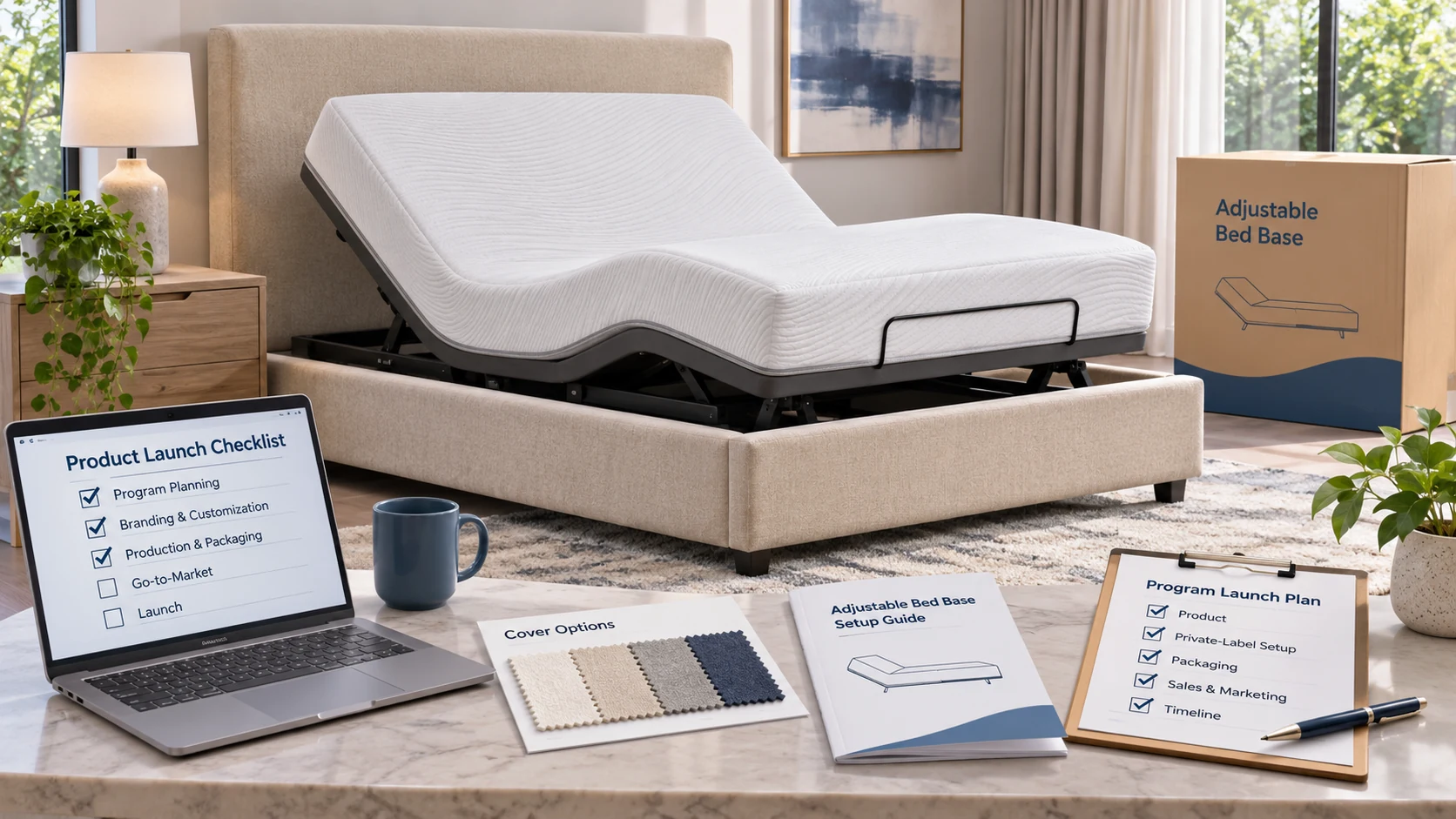
For a mattress brand or furniture retailer, adding an adjustable bed base can seem straightforward: select a model, choose a fabric and place a logo on the carton. But a successful private-label program must connect the product a customer sees online or in-store with the exact base that will be produced, shipped, installed and supported after the sale.
That connection is where many important decisions happen. An attractive sample is not yet a finished brand program. A supplier quotation is not yet a launch-ready SKU. Even an approved logo is not enough unless the remote, specification sheet, carton, user manual, warranty terms and replacement-part records describe the same released configuration.
1. A Private Label Is More Than a Logo on an Adjustable Bed
Private labeling changes whose name appears in front of the customer. It does not remove the need to decide who will answer an installation question, approve a component substitution or provide a replacement remote a year after delivery.
Consider a buyer that already sells a mattress collection. It may want an adjustable base that matches its mattress sizes, complements its retail positioning and carries its own packaging and support identity. Before launch, the brand must be able to answer five buyer-facing questions:
- What is this product? The precise model, size, functions and included accessories—not only the marketing name.
- What makes it different? A credible reason for its place in the brand's range, not a long list of unverified features.
- What will arrive? The carton count, included components, labels and setup instructions for the approved variant.
- Who stands behind it? The named customer-service route, warranty process and component-support plan.
- What happens if something changes? A revision process that keeps product, packaging and customer documentation aligned.
Industry launches offer useful examples of product-line discipline, but not templates that every brand must copy. In March 2026, BedTimes reported that Sinomax USA introduced a five-level adjustable-base program designed to differentiate retail price/feature tiers. In July 2026, it reported that Nisco planned a promotional PM range with multiple models and packaging considerations. These are company-specific examples of commercial assortment decisions, not evidence that a new private-label brand should automatically launch five models. Sources: BedTimes — Sinomax; BedTimes — Nisco.
2. Private Label vs. OEM vs. ODM: Define the Actual Scope
These three terms overlap in commercial conversations but answer different questions.
| Term | Useful B2B interpretation | What the buyer still must specify |
|---|---|---|
| Private label | The finished product is marketed under the buyer's brand. | Brand assets, feature claims, product identity, packaging, instructions and service responsibilities. |
| OEM | A manufacturing arrangement in which a supplier produces an agreed product or configuration for a customer. | Who owns the specifications, which components may change, approvals and production obligations. |
| ODM | An arrangement involving supplier-originated design or development capabilities, potentially adapted for the buyer. | Design ownership, permitted changes, tooling, IP rights, revision approval and commercial terms. |
These are practical sourcing descriptions, not universal legal definitions. A private-label program may use an existing supplier platform, an OEM specification or an ODM development scope. The quotation and contract—not the label alone—must make the arrangement clear.
A buyer should ask whether branding is possible on an existing configuration, whether any tooling or software interface changes are required, and whether those changes affect cost, minimum quantity, lead time, documentation or replacement-part compatibility. Do not assume that a logo-only project includes custom electronics or exclusive design rights.
3. Build a Launch Brief Around the Customer Journey
Before choosing a base, write a one-page Private-Label Launch Brief. It should describe the retail and operational context that the physical product must satisfy:
- Market and channel: e-commerce direct-to-consumer, mattress stores, furniture stores, distributor network or a project channel.
- Customer promise: the one or two verified benefits the brand wants shoppers to understand.
- Target fit: intended mattress sizes, bed-frame environment, installation expectations and any known constraints.
- Product scope: the entry point, differentiator and functions that are mandatory, optional or explicitly excluded.
- Commercial scope: estimated initial and replenishment volume, destination, target cost basis, required delivery arrangement and review schedule.
- Brand support: packaging language, instructions, approved imagery, service contact and warranty owner.
Do not begin with the assumption that the largest function list is the best choice. Different channels have different packaging, showroom demonstration, return-handling and installation needs. A feature that sounds impressive in a catalog can add support complexity if the store team cannot explain it or the exact production configuration has not been verified.
For detailed Good/Better/Best SKU planning, use KFY SMART's separate Adjustable Bed Base Retail Assortment Guide. The launch brief here should record the approved commercial role of each SKU, not recreate the entire assortment strategy.
4. Connect Product Architecture to a Controllable SKU
A mattress company may initially discuss “an entry base and a premium base,” yet production needs a far more exact identity. At a minimum, distinguish three levels:
Commercial SKU: What the customer buys, including the market, bed size, retail name and advertised bundle.
Approved product configuration: What the supplier is authorized to produce—the mechanical platform, control system, confirmed functions, upholstery and accessories for a defined revision.
Finished retail pack: What is shipped under the brand—carton count, external labels, instructions, remote, power components and included hardware for that SKU.
A single platform can produce different saleable variants, but changes should never be hidden behind the same generic label. A different remote, plug type, leg arrangement, manual revision or carton layout may affect the experience or the downstream service record even when the headline product name stays the same.
Illustrative scenario, not a KFY customer case: Imagine a mattress retailer planning one base for stores and online sales. The commercial team wants two fabric colors. Operations discovers that one color's carton artwork and stock plan have not been approved. The safe action is not to release both variants as “ready.” It is to keep the unapproved variant out of the launch list until the exact product and pack reference are signed off.
5. Define Which Elements Are Truly Customizable
Customization is a scope to confirm, not a blanket promise. Possible private-label workstreams include:
| Customization area | What to define | Release risk if vague |
|---|---|---|
| Logo, product name and artwork | Approved master files, usage placement and print color | Wrong artwork or inconsistent branding |
| Upholstery or visible finish | Approved material, color sample and model applicability | Retail photos and delivered product differ |
| Remote control or user interface | Exact control system, permitted key layout, languages and branding feasibility | Unsupported controls or mismatched instructions |
| Mechanical and electronic functions | Exact hardware revision, feature scope and sample evidence | A marketed option is mistaken for a standard function |
| Cartons, labels and inserts | Carton count, artwork, language, codes and accessory list | Unscannable or mislabeled cartons, incomplete packs |
| Manual and warranty documents | Applicable market, model/revision, installation and service contacts | Consumers receive instructions for the wrong version |
Not every platform supports every option. KFY SMART's public product pages describe configurable OEM/ODM possibilities, but feasibility, availability and final scope must be confirmed for each model and project. For example, app control, USB, massage, zero-clearance or special remote features must not be advertised as standard unless they are included and verified in the chosen configuration.
In a private-label project, the buyer should also settle who owns the final artwork and whether logo placement or controller customization requires approvals from additional component suppliers. The purpose is not to create paperwork for its own sake; it is to make sure that the brand's promise can be produced and repeated.
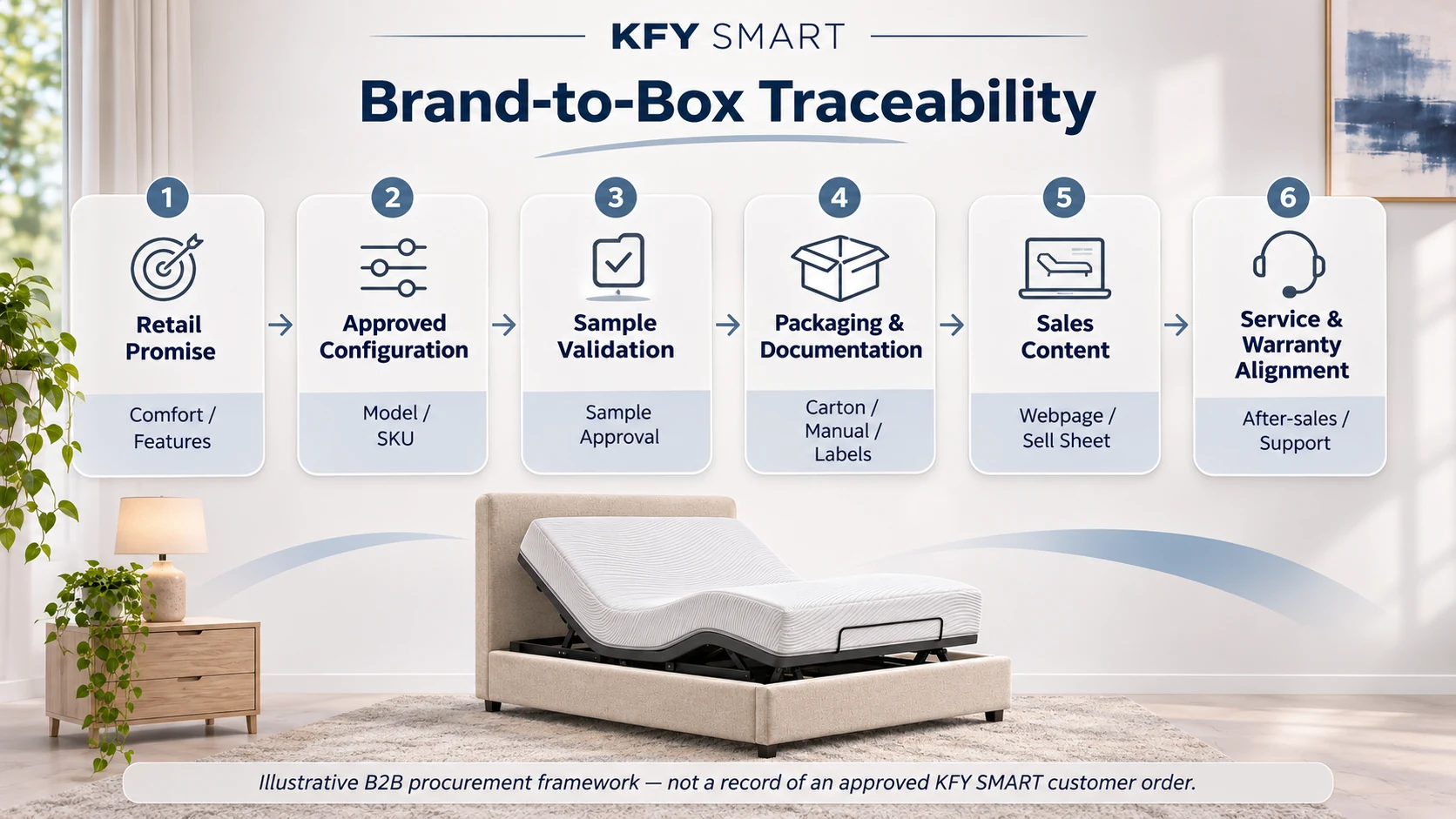
6. KFY SMART's Proposed Brand-to-Box Traceability Matrix
One useful way to manage the handoff is to create a Brand-to-Box Traceability Matrix. This is a proposed procurement decision tool, not a claim that KFY SMART has applied it to a particular customer order or that it is an industry certification.
| Customer-facing promise | Controlled source of truth | Evidence before release | Responsible approval |
|---|---|---|---|
| “Head and foot adjustment” | Approved configuration and controller version | Qualified sample result and matching manual | Product/technical reviewer |
| “Works with our mattress collection” | Specified mattress and base compatibility scope | Documented fit review under agreed conditions | Product/brand owner |
| “Available in brand color A” | Fabric/sample and artwork revision | Approved color reference and product photos | Brand owner |
| “Easy setup” | Released installation and accessory list | Reviewed instruction sequence and packaging check | Operations/support |
| “Includes remote and power supply” | Released BOM/packing reference | Actual pack confirmation against approved sample | Supplier/operations |
| “Supported by our warranty” | Warranty terms and service routing | Written owner/contact/escalation agreement | Brand/service owner |
This matrix reveals a common launch gap: the merchandising team approves the words while the product team approves the hardware, but no one checks whether both approvals refer to the same revision.
For every promised feature, ask: Where is the evidence? Which exact SKU does it cover? Who signs off if the component or artwork changes? A blank answer means the marketing statement remains pending—not that the supplier has failed a test.
7. Evaluate Total Program Economics, Not the Cheapest Base Quote
A quote for a base alone does not equal the landed or supported cost of a brand launch. Compare suppliers only after the scope, quantities, Incoterms, accessory requirements and approved variants have been aligned.
A practical private-label program review separates:
- Unit scope: approved base, size, controls, included accessories and any agreed options.
- One-time scope: design adaptation, tooling if applicable, artwork preparation, translated documentation, sampling or testing if quoted.
- Packaging and distribution: carton design, pack quantities, shipping route, delivery terms and channel-specific requirements.
- Working capital: minimum production lot, mixed-model arrangements if available, inventory holding and reorder timing.
- After-sales obligation: spare components, service materials, warranty handling and returns/replacement process.
Do not quote a universal private-label minimum order quantity or development lead time. KFY SMART's published category pages present general procurement guidance, while the binding MOQ, lead time and price depend on the approved scope. Also avoid assuming that adding a logo has zero setup cost, or that two quotes using different shipping terms are directly comparable.
The Adjustable Bed Base RFQ Checklist covers detailed quote questions. Here the governing question is: Does the commercial offer cover the complete brand-ready SKU and its service obligations, or only a factory base?
8. Treat Sample Approval as a Brand Release Decision
A sample can demonstrate a function but still fail the brand launch requirements. Before a production reference is frozen, review the same identity across the sample, specification, photo, carton and user document.
A practical sign-off package should include the approved sample/reference ID, model and revision, list of included features, remote/control identification, finish/color approval, mattress and frame compatibility scope, accessory list, label/artwork versions, packing reference and documented unresolved items.
The buyer should separately check function and appearance. For example, a base may articulate as intended yet use a remote faceplate or manual inconsistent with the planned private-label listing. That is a launch-documentation issue, not necessarily a mechanical defect. It still needs resolution before a customer-facing claim is released.
Changes after sample approval need a written impact check: Does this change affect the feature description, remote, assembly steps, packaging, label, spare-part compatibility or retail photographs? If yes, the affected approvals must be revisited. See KFY SMART's separate OEM Sampling Guide and Quality Control Guide for deeper acceptance and production-consistency work.
9. Packaging, Labels and Market Documentation Are Launch Assets
A private-label carton is not merely a printed logo. It must transport the correct product, help downstream teams identify it and carry the documentation the end customer expects. Its contents should be traced to the exact saleable configuration.
Before print approval, verify the retail SKU name, size, quantity/carton count, customer-service route, barcode or stock identifier where required, accessory inventory, product photographs, included instructions, market language and any required origin, safety or compliance information. The exact requirements vary by destination and product, so buyers should obtain market-specific regulatory and legal review rather than copying a competitor's carton.
For U.S. marketing, for example, the U.S. Federal Trade Commission says an unqualified “Made in USA” claim needs a substantiated basis meeting its standard; importing and repackaging a product does not automatically support such a claim. This is a narrow example of why origin language and brand artwork must be reviewed—not a substitute for applicable import, labeling or product-safety advice. FTC guidance.
Different distribution routes can also change the packaging question. A wholesale carton moving through a planned distributor chain may face different handling than an individual parcel going directly to a household. The separate Packaging & Shipping B2B Guide provides the route, protection and validation framework. Do not claim an ISTA test result or carton performance that has not been documented for the approved pack.
10. Assign Warranty and After-Sales Responsibilities Before Launch
When a consumer buys a private-label adjustable base, their first service contact is often the selling brand or retailer, regardless of which company built the mechanism. The commercial agreement should identify the support workflow before the listing goes live.
Define who will handle first-contact support, technical triage, approved replacement parts, warranty approval, return logistics, documentation updates and escalation to the production partner. Confirm what the product identification label must show so that a remote, control box or actuator replacement can be matched to its actual revision.
A proposed responsibility map can be simple:
| Workstream | Brand owner / seller | Supplier / coordination team | Agreed evidence |
|---|---|---|---|
| Retail warranty promise | Owns customer-facing terms and disclosure | Confirms feasible supply/service obligations | Signed terms, scope and exclusions |
| Initial customer support | Defines first contact and service hours | Supplies approved product information as agreed | Service guide and contact route |
| Component identification | Collects SKU/serial or batch data | Maintains revision-specific component reference as agreed | Parts-compatibility record |
| Warranty escalation | Applies agreed customer process | Handles supplier-side investigation and corrective actions as agreed | Claim evidence and escalation procedure |
| Future product changes | Updates listing and support materials | Notifies/approves affected product revisions as agreed | Change notice and linked document versions |
This table is a role-assignment proposal, not a claim that any specific warranty terms or stock commitments are already available. KFY SMART's Spare-Parts & After-Sales Guide and Warranty Guide cover the underlying parts and warranty questions.
11. Make Retail and E-Commerce Materials Match the Released Product
A product is not ready simply because a sample, carton and unit price have been approved. The brand also needs a usable handoff to retailers, customer-service teams and e-commerce managers.
Prepare a release-controlled product page and sell sheet, verified imagery, function-by-function feature claims, installation instructions, FAQ, packaging/size details, after-sales contact and retailer training materials. If a feature is optional, label it as optional for the correct SKU. If the images show a different upholstery or remote, disclose that they are illustrative or replace them with approved materials.
A salesperson's demonstration and an e-commerce detail page must not tell different stories about the same item. The final marketing copy should be checked against the Brand-to-Box Traceability Matrix, not only against a competitor's listing.
An industry example can illustrate commercial discipline without implying KFY has reproduced it: in January 2026, Sleep Number announced a simpler mattress and a separate adjustable base as part of a market-positioning change. Its own launch emphasized which functions were included and how products fit the retail proposition. That is Sleep Number's specific product strategy, not evidence that a KFY configuration includes the same features. Source: Sleep Number announcement distributed by Nasdaq.
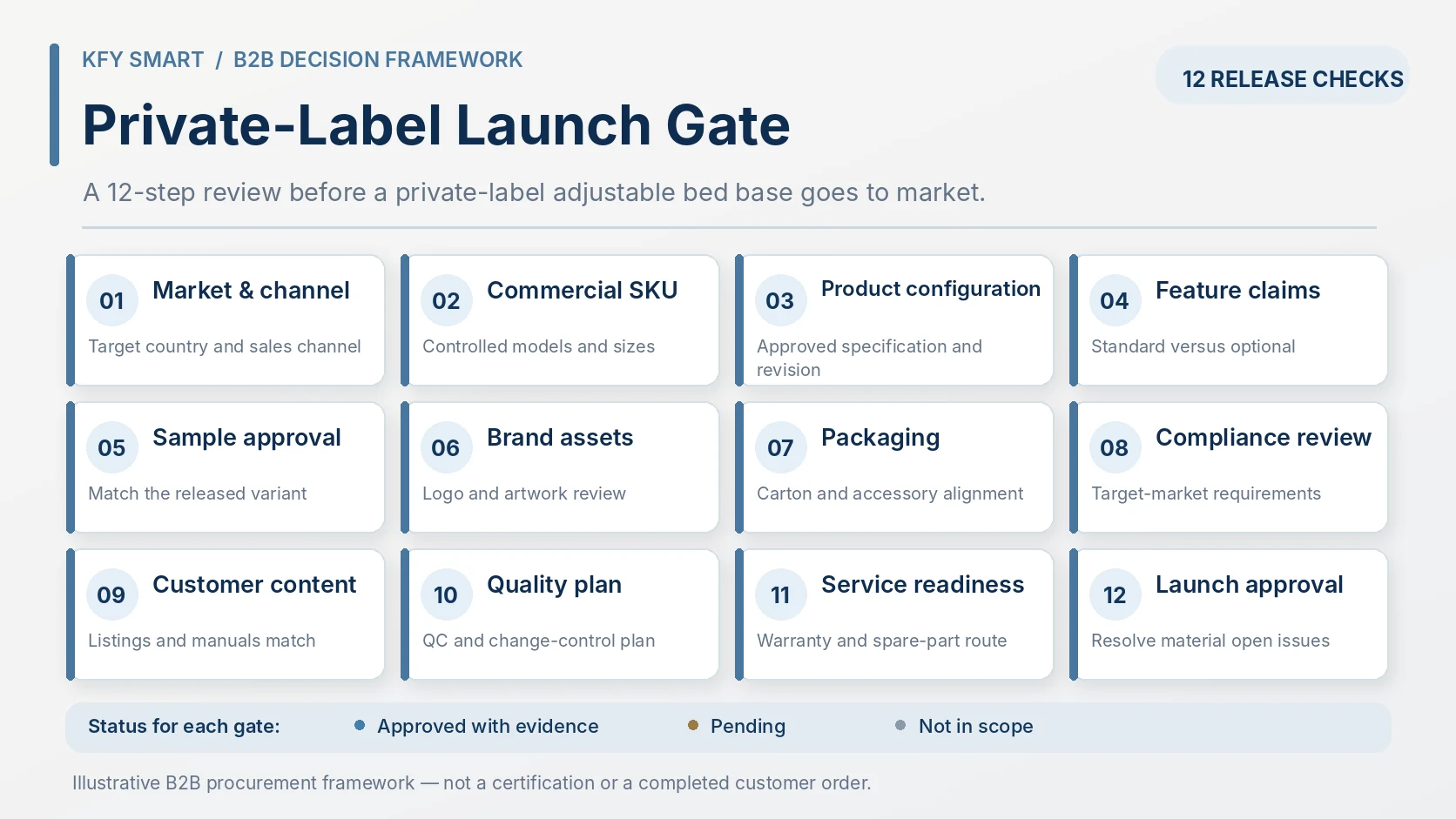
12. KFY SMART's Proposed Private-Label Launch Gate
For a B2B program, the final decision should be more precise than “the sample looks good.” Use a Launch Gate with three possible statuses for every item: Approved with evidence / Pending / Not in scope. An item marked Pending must have a named owner and an agreed resolution date before go-live.
| Gate | Release question | Minimum evidence to request |
|---|---|---|
| 1. Market | Is the target country/channel defined? | Signed launch brief |
| 2. Commercial SKU | Is each saleable variant uniquely named and controlled? | SKU and size matrix |
| 3. Product | Is the exact approved platform/configuration recorded? | Signed specification and revision |
| 4. Features | Are standard versus optional claims unambiguous? | Claim-to-configuration mapping |
| 5. Sample | Does the approved sample match the released variant? | Sample approval record |
| 6. Brand assets | Are logos, finishes and remote artwork approved as applicable? | Artwork revision/sign-off |
| 7. Packaging | Is the actual carton/accessory configuration approved? | Packaging and pack-list reference |
| 8. Compliance | Have destination-market requirements been independently reviewed? | Applicable evidence and approval owner |
| 9. Content | Do listings, photos, manual and retail sheets match? | Final content proof |
| 10. Quality | Is the production reference and revision control established? | Agreed QC/inspection plan |
| 11. Service | Are warranty routing and spare-part identification agreed? | Service responsibility and parts matrix |
| 12. Launch | Are open issues closed and the go-live decision recorded? | Signed release summary |
Decision rule: Do not classify a SKU as launch-ready while a material consumer-facing promise lacks evidence or an unresolved issue affects safety, installation, market documentation, delivery or service. “Not in scope” is acceptable only when the exclusion is explicit and consistent with the sales promise.
The matrix is designed to prevent one team from authorizing a retail release based solely on another team's isolated approval. It can be adapted by brands for their own internal controls; it is not a regulatory certification or a universal checklist mandated by an industry body.
13. Common Private-Label Launch Mistakes
Mistake 1: Approving only the product photo. A photograph may show a color, remote or position not included in the released SKU. Fix the listing to match the approved configuration—or approve the actual variation before marketing it.
Mistake 2: Calling every customizable feature “standard.” Optional app control, lighting, massage, special motions or emergency-power features need specific configuration evidence. Do not carry an option from one model to another by assumption.
Mistake 3: Freezing the hardware but not the manual. A controller or accessory revision can invalidate diagrams, troubleshooting steps or replacement-part references. Release documentation and the product revision together.
Mistake 4: Comparing quotes with incompatible scope. A lower headline price may exclude branding work, packaging changes, sample/test costs or service arrangements. Compare equivalent commitments, not only the base unit.
Mistake 5: Leaving support ownership until after the first claim. A clear contact, evidence requirement and escalation route should exist before customers receive the product.
14. What KFY SMART Can Coordinate—and What Must Be Confirmed
KFY SMART presents adjustable-bed-base platforms and OEM/ODM project coordination for overseas B2B partners. Its published product line includes E1–E4 adjustable-bed-base models; the precise customization, available controls and documentation depend on the selected configuration and project. Manufacturing is coordinated through strategic production partners rather than presented here as proof that KFY owns a specific factory.
For a private-label inquiry, a productive starting point is to map the intended retail promise to an available product platform, then review any proposed branding, controls, finish, packaging, quality and service changes before pricing or release commitments are finalized.
The Brand-to-Box Traceability Matrix and Launch Gate in this guide are KFY SMART's proposed buyer-review tools. They are not claims of an audited factory process, a completed anonymized customer project, an approved certification, or a standard configuration. Specific capabilities and production terms require project-level confirmation.
FAQ: Private Label Adjustable Bed Base Programs
What is a private label adjustable bed base?
It is an adjustable base sold under a buyer's own brand, with agreed product configuration, branding, customer documentation and commercial responsibilities. The arrangement may use an existing platform or an approved customized specification; it does not automatically require a new mechanical design.
Is private label the same as OEM or ODM?
Not exactly. Private label describes the brand arrangement. OEM and ODM describe aspects of manufacturing or product development arrangements. They can overlap, so the agreed scope, rights, specifications and approval obligations should be written down.
Can I put my logo on the remote and carton?
Potentially, depending on the chosen control system, printing process, available artwork areas, supplier permissions and commercial terms. A logo on a carton does not guarantee that a remote, app interface, controller or tooling can be independently customized.
How many adjustable bed models should a new private-label brand launch?
There is no universal number. Start with the target shopper, channel, inventory capacity and meaningful product differences. Avoid creating multiple versions whose consumer benefits and service requirements are indistinguishable.
Is a private-label adjustable base MOQ always the same?
No. The applicable minimum order quantity can change with model, size, finish, mixed-SKU plan, special branding, tooling and packaging requirements. Request project-specific terms rather than assuming a single published figure applies to every variant.
Which approvals should be complete before mass production?
At minimum: the exact configuration and sample, brand artwork, packaging and included accessories, user and service documents, relevant destination-market requirements, production reference, quality plan, and assigned after-sales obligations. Release any unresolved issue explicitly rather than treating it as an approved feature.
Can I claim that an adjustable base works with every mattress?
Do not make a blanket compatibility claim. The intended mattress and frame combination, weight and operating conditions should be reviewed for the specified base. Retail copy should state the verified scope and any limitations.
Who handles warranty claims for a private-label adjustable bed base?
The parties must agree on customer-facing responsibility, first-contact support, troubleshooting, repair/replacement decisions, spare-part supply and escalation. The seller's brand on the carton does not by itself define the supplier's contractual obligations.
Can private-label packaging and documentation support different countries?
They can be planned for target markets, subject to approved translations, electrical/plug configurations where relevant, labeling rules, documentation evidence and supplier feasibility. The requirements vary by jurisdiction and configuration; a generic carton is not proof of compliance.
Planning a Private Label Adjustable Bed Base Launch?
If you are developing an adjustable-base line for a mattress collection, furniture brand or distribution program, start with your target country, sales channel, intended mattress sizes, preferred product level, required versus optional functions, branding/packaging scope, expected launch window and estimated order volume.
KFY SMART can review the project brief, discuss adjustable-bed-base options and identify the product, sample, documentation and production questions that need confirmation before a proposal is finalized.