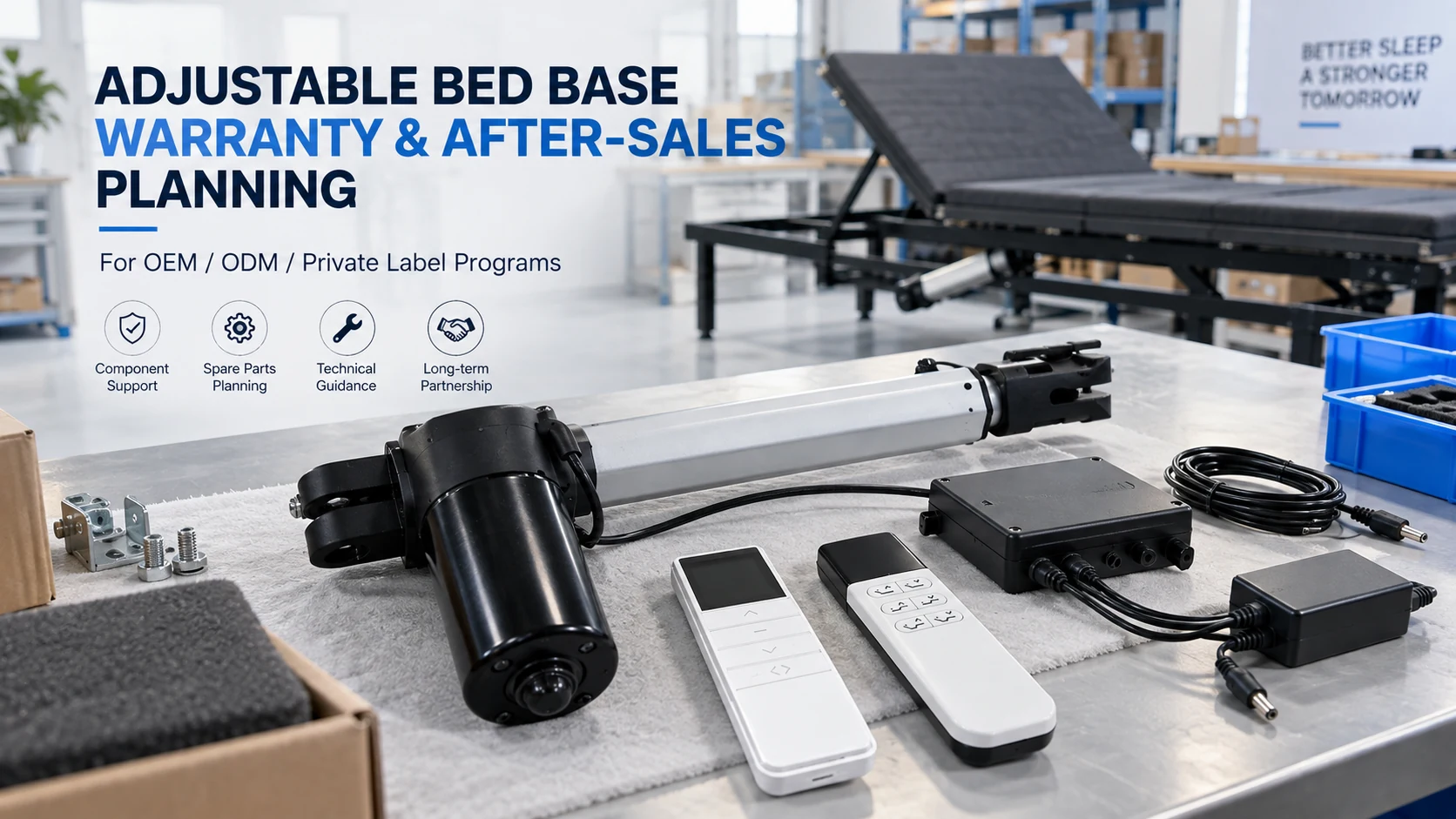
Why Warranty Years Alone Can Be Misleading
Warranty length is one of the easiest specifications to compare—and one of the easiest to misunderstand.
Published adjustable-base warranties commonly separate coverage by time period and component type. For example, Casper’s adjustable-base warranty provides parts-and-labor coverage in the early years while later treatment differs between non-metal parts and defined metal-frame components. BedTech also publishes staged coverage rather than treating every component identically for the entire headline term.
That means two suppliers can display similar warranty lengths while creating very different commercial exposure for the brand selling the product.
For B2B procurement, compare:
Component × Coverage Period × Remedy × Freight × Labor × Responsibility
That is more useful than comparing warranty years alone.
The Five Warranty Layers B2B Buyers Should Separate
1. Structural Frame
The steel structure has a different failure profile from electronics.
Questions should include:
- Which frame components are covered?
- Are welds, brackets, legs and mattress retainers treated separately?
- What exclusions apply to misuse, modification or overload?
- Is the remedy repair, replacement part or complete-base replacement?
- Does the same warranty apply to residential and commercial applications?
Do not assume the longest advertised warranty period applies equally to every component.
2. Actuators / Lift Motors
The actuator is a serviceable electromechanical subsystem, not simply another piece of steel.
A B2B buyer should confirm:
- actuator coverage period;
- replacement procedure;
- compatible model/version identification;
- connector compatibility;
- whether spare actuators are available;
- whether the actuator can be replaced independently rather than replacing the complete base.
3. Control Box and Power Supply
A base that does not move is not automatically suffering from a failed actuator.
The fault may sit elsewhere in the chain:
AC outlet → power supply → control box → remote/control input → actuator → mechanical linkage
Good after-sales support therefore starts with fault isolation.
Sending an actuator when the actual issue is a control box increases cost without solving the claim.
4. Remote / Handset
Remote-related complaints can result from battery, pairing, handset damage, receiver/control issues, power interruption or incorrect operation.
Replacement compatibility also matters. Industry replacement-parts programs show that visually similar remotes are not always interchangeable across production versions.
For an OEM/private-label program, the buyer should know whether a replacement remote can still be identified and supplied after the original production batch is gone.
5. Optional Functions
Massage systems, lighting, USB charging, Bluetooth or app-related components should be treated separately where applicable.
They are configuration-dependent.
KFY SMART does not recommend writing every optional feature into a universal warranty template because not every adjustable-base program contains the same components.
A Better B2B Warranty Matrix
Instead of asking a supplier for one warranty number, build a matrix before approving the program.
| Component | Coverage Period | Parts | Freight | Labor / Local Service | Replacement Method |
|---|---|---|---|---|---|
| Steel frame | Confirm | Confirm | Confirm | Confirm | Part / base |
| Head actuator | Confirm | Confirm | Confirm | Confirm | Component |
| Foot actuator | Confirm | Confirm | Confirm | Confirm | Component |
| Control box | Confirm | Confirm | Confirm | Confirm | Component |
| Power supply | Confirm | Confirm | Confirm | Confirm | Component |
| Remote | Confirm | Confirm | Confirm | Confirm | Component |
| Massage system | If fitted | Confirm | Confirm | Confirm | Component |
| USB / lighting | If fitted | Confirm | Confirm | Confirm | Component |
The word Confirm is intentional.
There is no responsible universal answer for an OEM program until the exact product, component configuration, destination market and commercial agreement are known.
KFY SMART After-Sales Workflow: Evidence First, Then Diagnosis
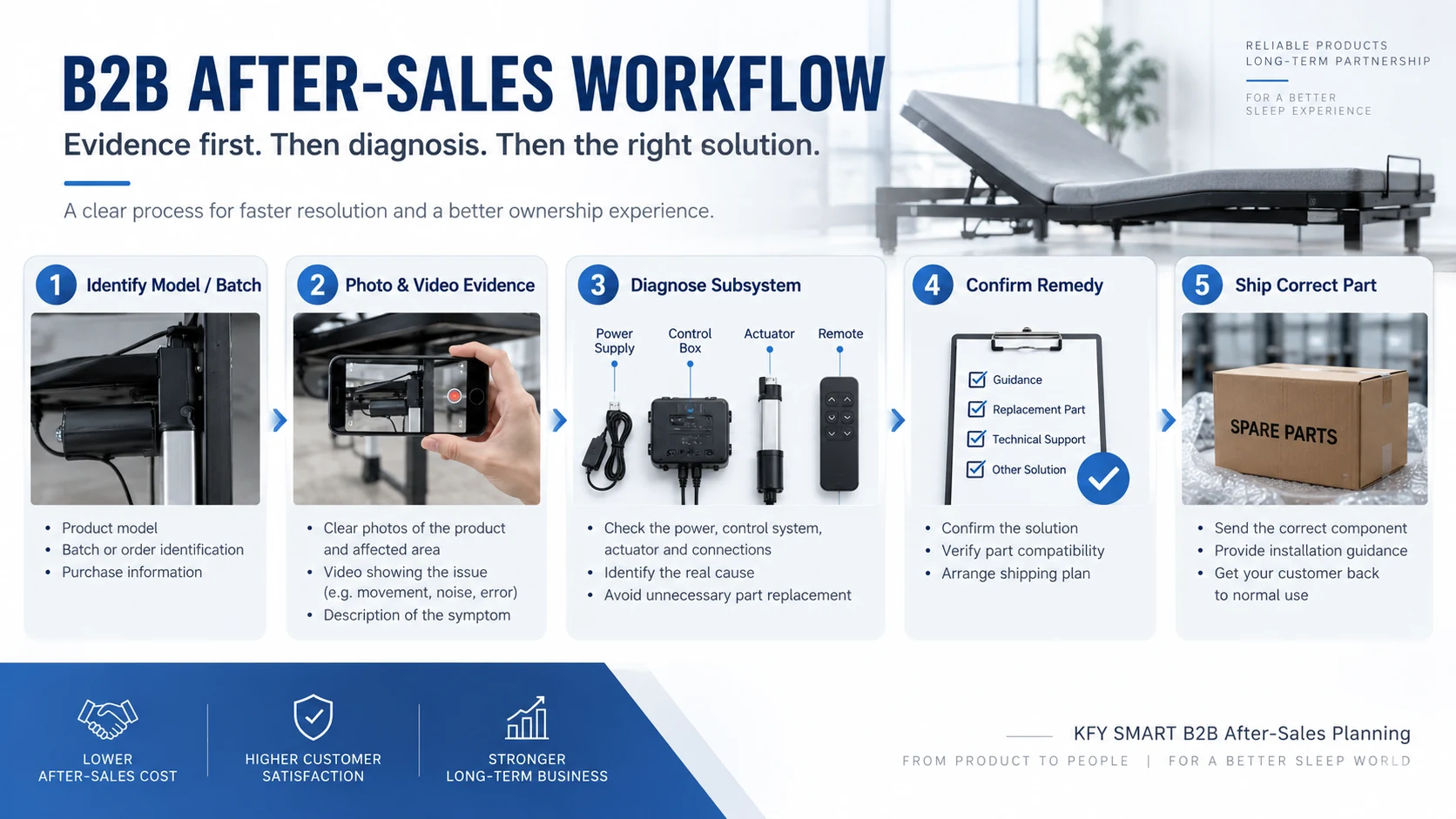
For KFY SMART B2B programs, an after-sales claim does not begin with immediately sending a replacement part.
The first step is to identify the product and understand the symptom.
Our current after-sales process normally requests:
- product model;
- batch or order identification;
- clear photos of the relevant product or component;
- video showing the reported problem when movement, sound or intermittent operation is involved;
- a clear description of the symptom.
This is not paperwork for its own sake.
It helps distinguish between different types of failure before replacement parts are shipped.
For example, “the bed does not move” may involve:
power supply → remote/control input → control box → actuator → mechanical linkage
Sending an actuator before checking the rest of that chain can increase cost and delay the actual solution.
This evidence-first approach is consistent with established adjustable-base warranty processes in the wider industry. Tempur-Pedic, for example, asks for proof of purchase, full-base photos, photos or video of the affected area, and serial-number evidence when reviewing power-base warranty claims.
KFY SMART procurement principle
Identify the unit → document the symptom → isolate the subsystem → confirm the remedy → ship the correct solution.
For B2B buyers, this is more scalable than treating every complaint as a full-product return.
Spare Parts Should Be Planned With the Commercial Order
For KFY SMART B2B projects, selected spare parts can be supplied together with bulk orders.
The quantity and mix are not fixed universally.
They are determined according to project factors such as:
- order quantity;
- product configuration;
- destination market;
- local service capability;
- expected replenishment lead time;
- buyer requirements.
Depending on the approved configuration, the spare-parts package may include items such as:
- remotes;
- control boxes;
- power supplies;
- actuators;
- cables/connectors;
- selected hardware.
This should not be interpreted as a promise that every shipment contains every component.
Instead, KFY SMART can work with the buyer to develop a project-specific spare-parts plan before mass shipment.
A mattress company operating its own service network may need a different spare-parts mix from a distributor without local technicians, while an e-commerce program may place greater emphasis on components that can be replaced remotely.
Why Spare-Parts Planning Should Happen Before Shipment
Waiting until the first complaint occurs is usually the least efficient time to start thinking about parts.
For an international B2B program, an inexpensive component can become expensive once the complete service chain is considered:
replacement part + international courier + customs handling + local delivery + service time + customer waiting time
That is why KFY SMART recommends discussing a practical spare-parts package during product and order planning.
The objective is not to stock every possible component.
It is to identify the parts that are commercially sensible to keep closer to the destination market.
Industry replacement-parts systems also show why compatibility matters. Ergomotion, for example, states that Version 1 and Version 2 remotes for one Rio 4.0 base are not interchangeable and asks buyers to confirm production timing before ordering the replacement remote.
For B2B buyers, that means:
“Do you have spare parts?” is not enough.
A better question is:
“Do you have the correct spare part for this specific product configuration?”
A Real KFY SMART After-Sales Lesson: Replace the Component, Not Automatically the Whole Base
KFY SMART has already handled overseas after-sales cases in which the issue could be resolved through component-level replacement rather than returning or replacing the entire adjustable base.
For confidentiality reasons, customer and order information is not disclosed here.
The important lesson is the service logic.
When a problem can be narrowed down to a replaceable subsystem, the commercial objective should be:
restore product function with the smallest appropriate remedy.
Depending on diagnosis, that may involve:
- troubleshooting guidance;
- remote replacement;
- control-system replacement;
- actuator replacement;
- another configuration-specific component.
This approach can reduce:
- unnecessary international returns;
- freight cost;
- disposal of otherwise functional products;
- customer downtime;
- after-sales friction between buyer and supplier.
However, component replacement should only happen after the fault has been reasonably identified.
A random “send several parts and try them” approach is not a substitute for diagnosis.
KFY SMART's B2B After-Sales Framework
For adjustable-base OEM/ODM and private-label projects, we recommend defining the after-sales system before mass production.
Step 1 — Define the approved product configuration
Document the model, functions and major serviceable components.
Step 2 — Define warranty responsibility
Clarify what the supplier, importer, distributor and retailer are responsible for.
Step 3 — Define claim evidence
KFY SMART currently uses photos/video together with model and batch/order identification as part of the after-sales information-gathering process.
Step 4 — Define serviceable components
Determine which parts can reasonably be replaced independently.
Step 5 — Define the spare-parts plan
KFY SMART can work with B2B customers to plan spare parts for bulk orders. The ratio and component mix vary by project rather than following one universal percentage.
Step 6 — Define the logistics path
Decide whether service parts will be:
- stocked locally;
- supplied with the original order;
- replenished periodically;
- or shipped individually when required.
Step 7 — Review actual after-sales cases
Real service experience should be used to improve future product specifications, spare-parts planning and customer instructions.
The goal is not simply to offer a long warranty.
The goal is to build a system that can identify a problem and restore the customer's product efficiently.
Why Replacement-Part Freight Can Matter More Than Part Cost
Imagine a small electronic component fails after retail sale.
The factory cost of the component may be modest.
But the actual after-sales cost can include:
part + international courier + customs handling + local delivery + technician/service time + customer waiting time
Published adjustable-base warranties demonstrate why this matters. Some programs change parts, transportation, service and labor responsibility as the warranty progresses.
Therefore, B2B buyers should model cost-to-serve, not only replacement-part cost.
Warranty Claims Need Evidence, Not Guesswork
A practical claim workflow can look like this:
Step 1 — Identify the unit
Record model, order/batch information and relevant identifiers.
Step 2 — Describe the symptom
“Bed doesn't work” is not enough.
Is there:
- no power;
- remote not responding;
- one section not moving;
- movement in only one direction;
- abnormal sound;
- uneven lifting;
- intermittent operation?
Step 3 — Perform safe basic checks
Follow the applicable product manual and supplier-approved troubleshooting procedure.
Do not instruct consumers to disassemble electrical/mechanical components unless the service process specifically permits it.
Step 4 — Provide visual evidence
Video can often communicate movement-related faults better than text.
Step 5 — Identify the likely subsystem
Power, control, actuator or structure.
Step 6 — Confirm the remedy
Guidance, replacement component, authorized service or another agreed remedy.
This creates a repeatable process instead of handling every case from zero. For a related movement symptom and its B2B diagnosis path, see Why Does an Adjustable Bed Base Lift Unevenly?.
Warranty Terms Should Match the Sales Channel
Mattress Brands
The adjustable base may carry the mattress brand's name.
That makes after-sales experience part of the mattress brand's reputation even when manufacturing is outsourced.
Private-label buyers should therefore define escalation and replacement-part responsibilities clearly.
Distributors
Distributors need to think about dealer support, local spare stock and component identification across multiple orders or versions.
E-commerce Programs
Remote diagnosis becomes particularly important because the consumer and service team may never meet physically.
Clear manuals, videos and component-level troubleshooting can reduce unnecessary returns.
Hospitality / Project Business
Do not automatically apply residential retail warranty assumptions.
Commercial usage, service access and project responsibilities should be agreed for the specific program. Some consumer warranty programs explicitly distinguish trade/commercial customers from ordinary residential purchasers.
What Should Be Agreed Before the Purchase Order?
Before mass production, B2B buyers should obtain written answers to:
Warranty scope
Which components are covered and for how long?
Exclusions
What usage, modification, handling, overload or installation conditions can affect coverage?
Claim evidence
What documents, photos, video or identifiers are required?
Response path
Who receives the claim: retailer, importer, KFY SMART, manufacturing partner or component provider?
Replacement parts
Who supplies them and how are compatible parts identified?
Freight
Who pays international and local shipping?
Labor
Is technician/service labor covered?
Spare parts
Which components should accompany the initial shipment?
Product changes
How will replacement-part compatibility be handled if components change in future production?
That last question is particularly important for long-running private-label programs.
Warranty Length vs After-Sales Readiness
A long warranty is useful only if the service system behind it works.
For B2B buyers, these questions are more important than the headline number:
- Can the problem be diagnosed remotely?
- Can common service components be replaced individually?
- Can the correct part be matched to the specific product configuration?
- Are responsibilities and freight costs documented?
- Is there a practical spare-parts strategy in the destination market?
A shorter but clearly defined and operational warranty can sometimes be commercially easier to manage than a longer headline warranty with unclear exclusions and responsibilities.
The contract—not the marketing badge—should determine the final comparison.
How KFY SMART Approaches After-Sales Planning
KFY SMART works with B2B adjustable-base programs rather than treating every buyer as a consumer retail transaction.
Product configuration can involve structure, motors/controllers, branding, upholstery, dimensions, packaging and other project-specific options. KFY SMART coordinates product definition, OEM/ODM development, production quality and international delivery with long-term manufacturing partners.
For that reason, warranty and spare-parts planning should be attached to the approved project configuration, not copied blindly from another model.
Before quotation or mass production, the practical objective is to make clear:
what is supplied → what can fail → what can be serviced → who is responsible → how the customer gets back to normal use.
That is the after-sales system a B2B buyer is actually purchasing. Capacity definition also supports clearer program planning; see the Adjustable Bed Base Weight Capacity B2B Guide.
FAQ
How long should an adjustable bed base warranty be?
There is no single correct duration. Compare component-specific coverage, exclusions, freight, labor and remedies rather than warranty years alone.
Are adjustable bed motors covered for the full warranty period?
Not necessarily. Published adjustable-base warranties frequently treat motors/electronics differently from defined structural components. Always check the exact contract.
What spare parts should an adjustable bed distributor keep?
Potential items include remotes, power supplies, control boxes, actuators and selected cables or hardware, depending on the approved configuration. Quantity should be determined by program size, destination, replenishment lead time and actual component/service data—not an arbitrary universal percentage.
Should a faulty adjustable bed base always be replaced completely?
No. Many faults may be component-level. Diagnosis should determine whether guidance, a replacement component, authorized service or another remedy is appropriate.
Who pays shipping for adjustable bed warranty parts?
It depends on the warranty agreement and coverage period. Market examples show that freight and service responsibility can change over time, so B2B buyers should negotiate this explicitly.
Can KFY SMART help plan spare parts for a private-label adjustable bed program?
Yes. KFY SMART can work with B2B customers to develop a project-specific spare-parts plan for bulk orders. The mix and quantity depend on the product configuration, order size, destination market and service requirements.
Can KFY SMART provide a private-label adjustable bed warranty?
Warranty terms for a KFY SMART OEM/ODM program must be confirmed according to the specific product configuration, component suppliers, market and commercial agreement. A universal private-label warranty should not be assumed.
Conclusion
For B2B buyers, an adjustable bed base warranty should be evaluated as an after-sales operating system, not simply a number of years.
The strongest programs clarify:
- component-level coverage;
- claim evidence;
- diagnosis responsibility;
- spare-parts planning;
- freight and labor responsibility;
- replacement-part compatibility;
- and the path for restoring the end customer's product to normal use.
That creates a more practical basis for comparing OEM/ODM suppliers and reduces avoidable after-sales cost after the product reaches the market.
CTA
Planning an Adjustable Base Program?
Discuss product configuration, OEM/private-label requirements, quality-control planning, warranty responsibility and spare-parts strategy with KFY SMART before mass production.