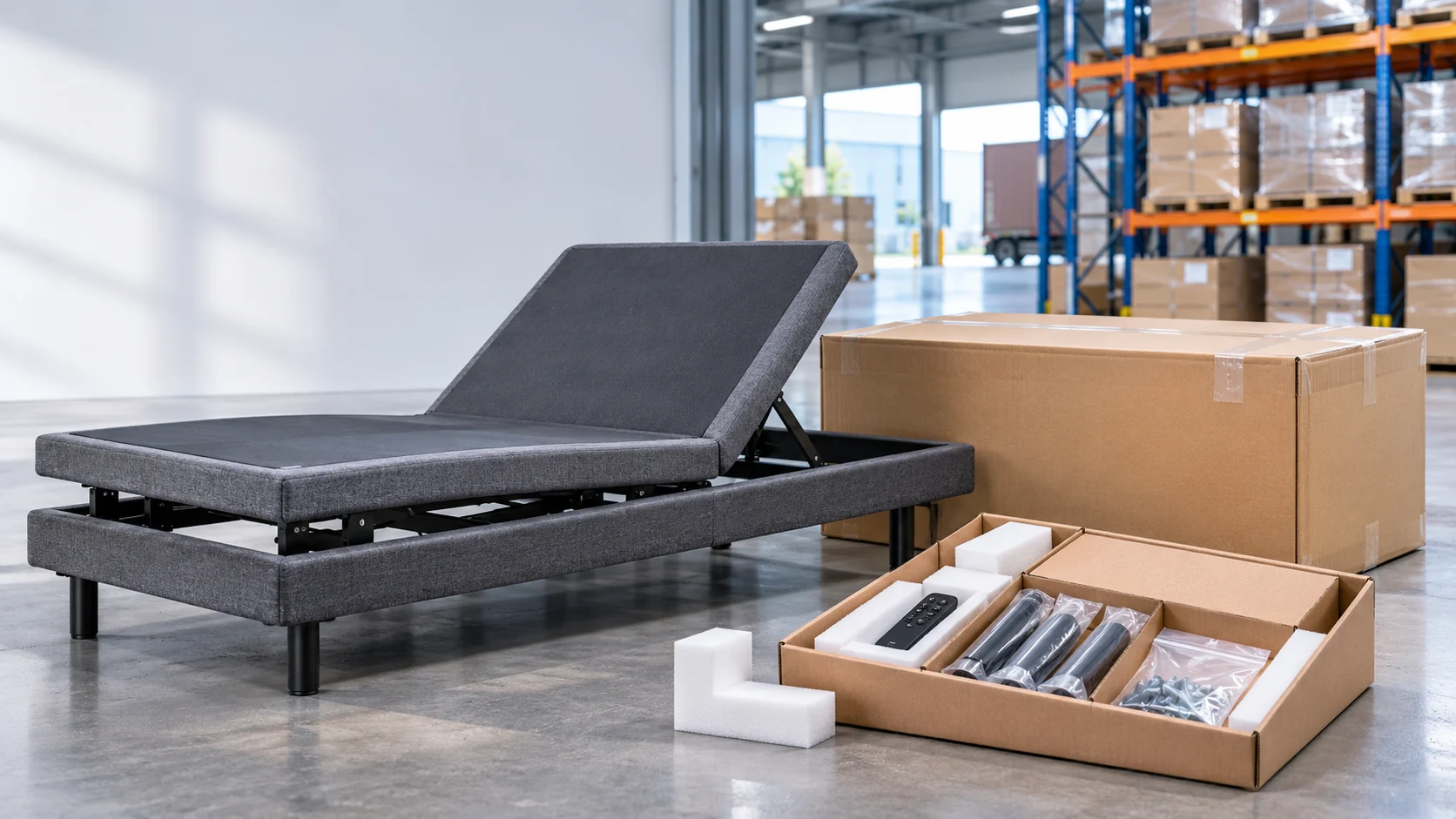
Why packaging belongs in product development
A base may pass a factory movement inspection and still arrive with scratched upholstery, displaced hardware, a damaged control connector, or an accessory missing from its expected location. The packaging problem may be unrelated to the actuator's performance. This is why packaging is a product-system decision: the frame, moving deck, selected electronics, accessories, protection materials, package orientation and downstream handling all interact.
For a mattress brand or furniture distributor, the useful question is not simply, “Can you make the carton stronger?” It is, “Which approved packaged configuration can move through our actual channel and still be identified, unpacked and installed correctly?”
1. Map the route before specifying the carton
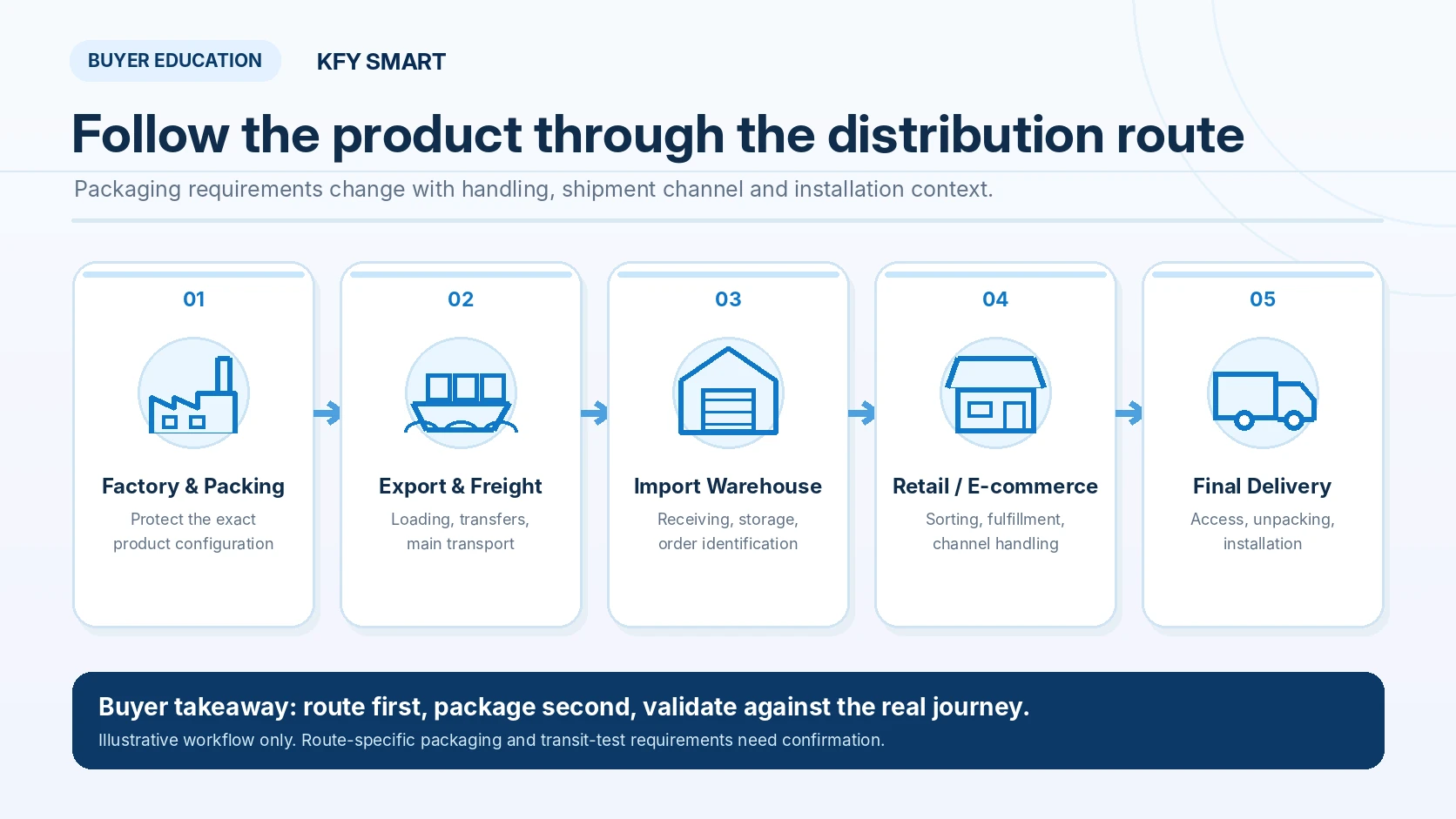
A container shipment to an importer warehouse differs from an individual delivery to a consumer. A hotel project may be unloaded into a project warehouse and then moved room by room. A retailer may add regional distribution, mixed loads and last-mile delivery.
Create a route map: Factory → Export handling → Main freight → Import warehouse → Retail/fulfillment → Final delivery → Installation. Mark where a package may be stacked, transferred, individually handled or opened. The map informs packaging design and testing; it does not by itself prove that any test has been passed.
Wholesale and container programs
Prioritize unit identification, loading plans, protection during transfer, and the receiving warehouse's handling capabilities. Container loading efficiency matters, but it must not be optimized at the expense of product protection.
E-commerce and individual delivery
Check whether the finished package is eligible for the intended carrier or fulfillment channel. Parcel, less-than-truckload and furniture delivery are different distribution environments. Do not assume a carton approved for one is automatically suitable for another.
2. Map protection to the approved component configuration
An adjustable base is not a single rigid object. Depending on its architecture, it may contain a steel frame, moving sections, actuator assemblies, control box, power supply, wiring, upholstery, legs, remote, mattress retainer and hardware. Optional functions should appear in the packaging specification only when selected.
A protection review should ask: Can metal touch finished surfaces? Can a moving section shift? Can a cable be trapped? Can a loose accessory migrate? Is the approved protection still in the correct place when the carton is tilted or handled? The answer should be documented for the actual configuration, not copied from a different model.
3. Treat accessories as a controlled kit
A technically functional base can still create a customer complaint when the remote, legs, fasteners or instructions are difficult to locate. Build an accessory checklist tied to the approved bill of materials. Record each item's quantity, protective method, location in the carton, and identification method. For multi-carton or split configurations, identify which unit contains each accessory.
B2B decision rule: An accessory absent from a selected configuration must not be presented in the manual as a standard included item.
4. Compare packaging efficiency without sacrificing serviceability
Carton length, width, height, packed weight and carton count affect warehouse and freight planning. Folding designs can improve handling for some product architectures, but folding must never be inferred from the term “adjustable bed base.” Ask for the packed dimensions and weight of the exact quoted size and configuration. Compare both freight efficiency and the practical cost of damage, repacking and installation difficulty.
A useful comparison is total delivered and service cost, not simply the lowest carton-material cost. This is a procurement framework, not a claim that KFY has measured a particular damage-rate improvement.
5. Select transit validation by distribution environment
The International Safe Transit Association (ISTA) distinguishes screening, partial simulation and general simulation procedures. ISTA 2C addresses individual packaged furniture products transported in a container; 3A addresses qualifying individual parcel-delivery packages; 3B addresses less-than-truckload shipment; 3L addresses relevant e-commerce fulfillment environments. Applicability depends on the actual packaged product and route. The buyer, carrier and testing laboratory should confirm the procedure and scope.
An “ISTA-tested” claim without the procedure, tested package revision, laboratory/report and result is too vague for an OEM approval record. A supplier's routine packaging inspection should not be represented as formal ISTA testing.
Source: https://www.ista.org/test_procedures.php and https://www.ista.org/getting_started_with_design.php
6. Validate the packaged product, not only the empty carton
The object being shipped is a product-plus-package system. For a production-intent sample, document the carton specification, internal protection, product orientation, accessory positions, labels, closures, packaged dimensions and weight. If the sample uses temporary materials, leave packaging approval open until the final version is evaluated.
After an agreed transit test or shipment trial, inspect the carton, internal protective materials, product finish, frame, controls, wiring, accessory count and applicable functions. An undamaged-looking outer carton does not establish that the internal product is sound.
7. Make private-label packaging operationally useful
Branding artwork is only one layer. Depending on destination and customer requirements, the outer package may also need model/size identification, order or batch reference, carton sequence, handling markings, barcode or buyer-specific labels. Manuals and installation instructions must match the actual selected functions and accessories. Do not assert one universal marking or certification requirement across markets.
8. Check the last mile and installation environment
Before locking packaging, ask who receives it and who opens it. Can the package be moved through the intended delivery access points? Are there limits on individual handling? Is the product delivered curbside, to a room, or with installation? Does the installer have a clear parts list and sequence? These decisions influence packaging count, labeling and documentation.
9. Freeze packaging alongside the approved sample
Packaging is not finished when the buyer approves the bed's movement. A production reference should include the product configuration and its packaging revision. Changes to carton size, cushioning, orientation, closures or accessory location can change transport behavior. ISTA explicitly recommends retesting when product, package or process changes may affect performance. Record what changed, why, and whether revalidation is needed.
Source: https://www.ista.org/getting_started_with_design.php
10. OEM/ODM packaging approval matrix
| Approval item | Evidence to request | Decision |
|---|---|---|
| Product configuration | Exact model, size, selected functions and BOM | Approved / open |
| Distribution route | Wholesale, parcel, LTL, project or mixed route | Approved / open |
| Package specification | Carton count, dimensions, weight, materials, orientation | Approved / open |
| Internal protection | Contact/movement-risk review and sample photos | Approved / open |
| Accessories | Quantity, location, identification and manual consistency | Approved / open |
| Labels/private label | Artwork and market/buyer requirements | Approved / open |
| Validation | Test/trial method, applicable scope, report and results | Approved / open |
| Receiving/installation | Handling and unpacking instructions | Approved / open |
| Revision control | Packaging version tied to approved product | Approved / open |
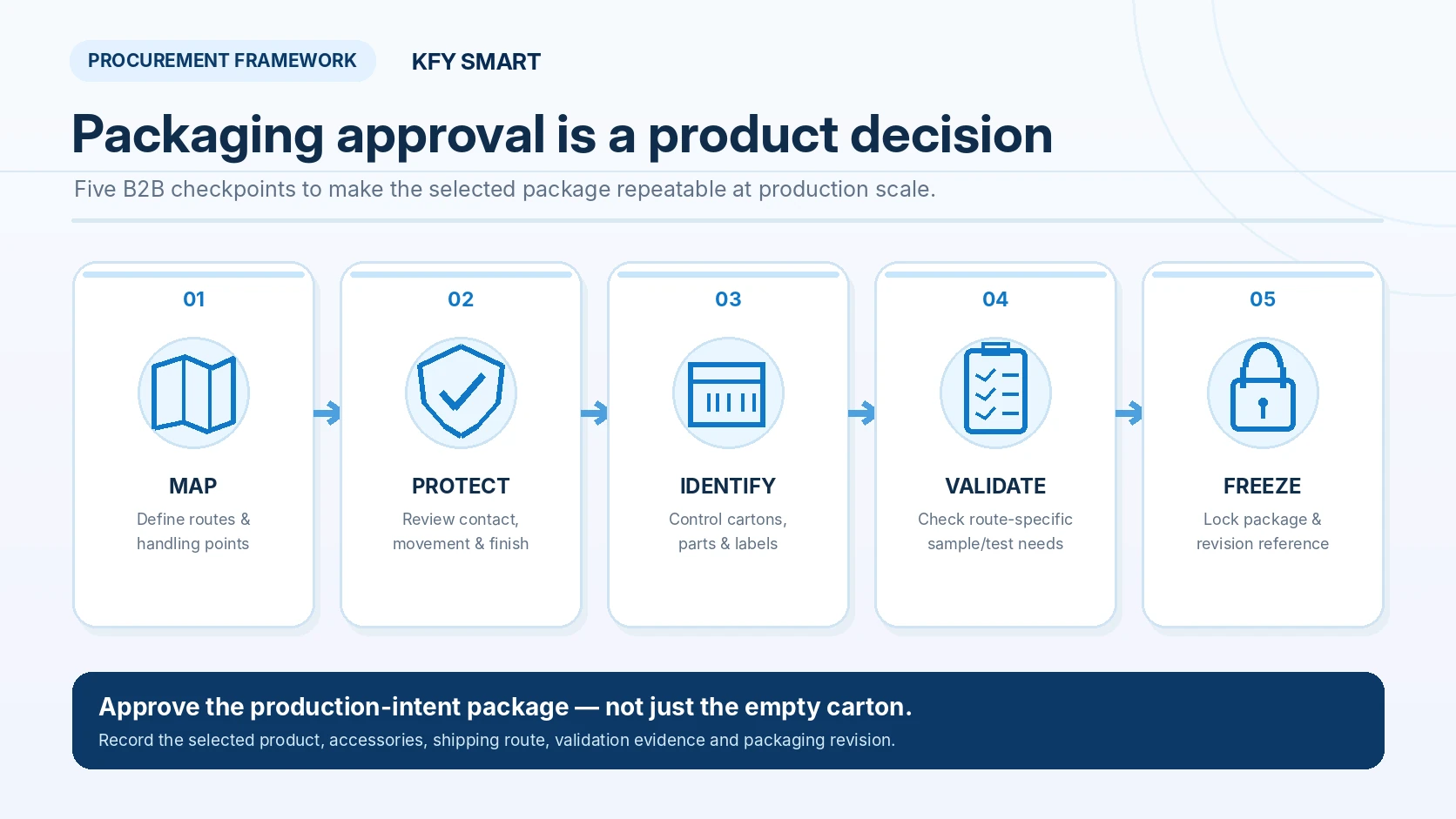
11. KFY SMART's B2B packaging decision framework
Use Map → Protect → Identify → Validate → Freeze.
Map: Define the actual distribution route and handling points. Protect: Identify the components and surfaces at risk. Identify: Control cartons, accessories and private-label information. Validate: Test or trial the production-intent packaged configuration against the relevant requirements. Freeze: Record the approved packaging revision alongside the production reference.
This framework is an editorial procurement method proposed for KFY SMART, not a claim that every KFY project already uses a formal five-stage packaging SOP. It extends the site's existing OEM sampling principle that packaging and documentation should be approved before mass production.
FAQ
How are adjustable bed bases packaged for export?
There is no universal format. Package count, protection, orientation and dimensions depend on product architecture, size, accessories and shipping route. Buyers should approve the actual production-intent packaging.
Is ISTA 3A required for every adjustable bed shipment?
No. ISTA 3A applies to qualifying individual parcel-delivery packages. Other routes may call for different procedures or buyer-specific validation. Confirm scope before specifying a test.
Does ISTA testing guarantee no shipping damage?
No. A test is evidence under a defined procedure and sample configuration; it cannot guarantee every real-world shipment will be damage-free.
Is foldable packaging standard for adjustable bases?
No. Folding is a model-specific structural design choice and must be confirmed for the quoted product.
Should the remote and power components be inside the same carton?
That depends on the approved product and packaging design. The critical controls are protection, identification, accessory completeness and clear installation documentation.
Should packaging be approved during OEM sampling?
Yes, once a production-intent package is available. Temporary sample packaging should not be mistaken for final packaging approval.
Can private-label carton artwork be customized?
KFY SMART describes packaging as a potential OEM/ODM customization area, subject to project requirements. Artwork, labels, minimum quantities, documentation and final specification require project confirmation.
Planning an Adjustable Bed Base OEM/ODM Program?
Share your target market, product configuration, sales channel, order volume, private-label requirements and expected distribution route. KFY SMART can review packaging requirements, sample-validation priorities and shipment coordination for the proposed program.