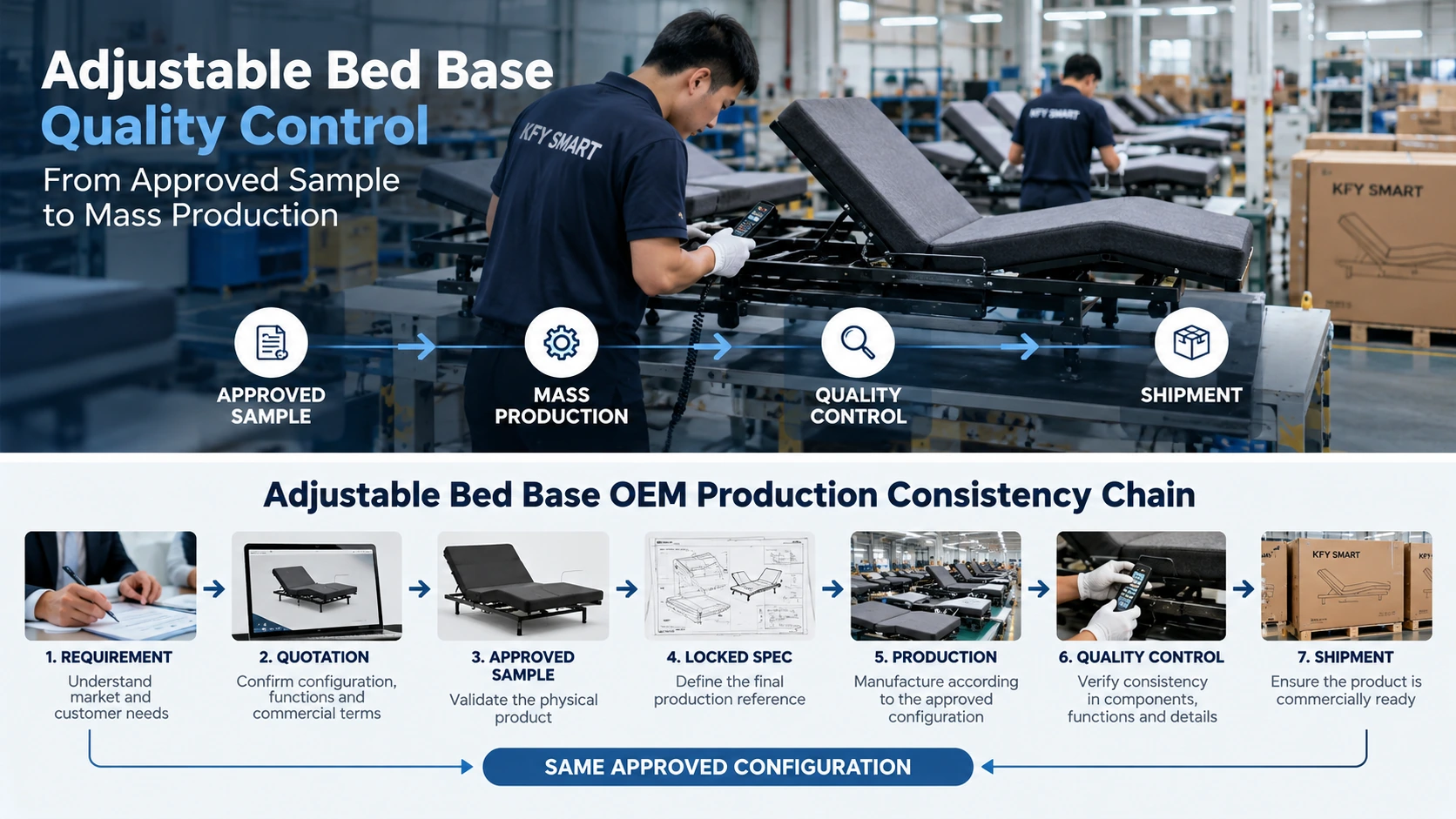
Why Quality Control Starts After Sample Approval
An approved sample answers an important question:
Is this the product we want to buy?
Mass-production quality control answers a different question:
Is the factory continuing to build that approved product consistently?
That distinction matters because mass production introduces variables that are less visible during sampling.
Components may arrive in different batches. Production teams may work from different document versions. Private-label artwork may be updated. Packaging may change. Optional functions can be confused between SKUs. A component substitution may appear minor but affect serviceability later.
For this reason, the approved sample should become the beginning of production control—not the end of the sourcing process.
If you are still evaluating the pre-production sample itself, see our Adjustable Bed Base OEM Sampling Guide before moving into mass-production quality control.
1. Convert the Approved Sample Into a Locked Production Reference
A physical sample alone is not enough.
The approved product should be connected to a controlled written reference.
Depending on the project, that reference may include:
| Area | Production Reference |
|---|---|
| Product | Model, SKU and revision |
| Size | Approved dimensions |
| Structure | Frame and platform configuration |
| Motors | Approved actuator or motor configuration |
| Controls | Control box, power supply and remote |
| Functions | Exact included functions |
| Appearance | Upholstery, finish and legs |
| Accessories | Retainer, cables and hardware |
| Branding | Logo, labels and artwork |
| Documentation | Approved manual and instructions |
| Packaging | Approved carton and protection approach |
The exact document structure can vary by supplier.
The principle should not:
Production should reproduce an identifiable approved configuration—not a general catalog description.
This becomes especially important in OEM and private-label programs, where two buyers may use a similar basic platform but approve different functions, finishes, control systems or packaging.
2. Control Product Revisions Before Production
One of the most common OEM risks is not an obvious manufacturing defect.
It is revision drift.
For example, a buyer may approve a second sample after changing:
- remote layout;
- upholstery;
- leg design;
- label content;
- carton artwork.
If one production document still refers to the previous version, the factory could manufacture each component correctly while still producing the wrong final configuration.
A practical project therefore needs to distinguish, where relevant:
Product Revision
Which physical product version is approved?
Component Revision
Have any key motors, controllers, remotes or structural components changed?
Artwork Revision
Which labels, carton graphics and branding files are current?
Documentation Revision
Which manual and instructions belong to the shipment?
For KFY SMART projects, a useful principle is:
If a change cannot be clearly traced, it becomes difficult to control.
3. Verify Critical Components Against the Approved Configuration
An adjustable bed base is a system made from several mechanical and electrical layers.
Depending on the selected configuration, this can include:
Frame + Moving Mechanism + Actuators + Control Box + Power Components + Remote + Accessories + Upholstery + Packaging
That means a production inspection should not rely only on the finished appearance.
Critical components should correspond to the approved configuration.
Mechanical Components
Depending on the model, buyers may need to verify:
- frame structure;
- brackets;
- pivots and moving joints;
- fasteners;
- legs;
- mattress-retention components;
- relevant platform sections.
Electrical and Control Components
Where applicable:
- actuator or motor;
- control box;
- power supply;
- remote;
- wiring and connectors;
- synchronization components.
Optional Functions
Only inspect options that are actually included in the approved product.
Massage, USB charging, lighting, memory positions, Bluetooth and app functions should never be assumed to be universal across an adjustable-bed range.
The QC checklist should come from the approved specification—not from the supplier's entire catalog.
4. Use Incoming Component Control to Prevent Problems Earlier
Final inspection is important, but finding every problem at the end of production is inefficient.
Where a component is critical to the finished configuration, earlier verification can reduce downstream risk.
Depending on the manufacturing process, this may involve confirming:
- correct component identity;
- correct quantity;
- approved revision;
- visible condition;
- labeling;
- compatibility with the intended production configuration.
The objective is not to create unnecessary inspection steps.
It is to prevent the wrong part from becoming hundreds of finished products before anyone notices.
For B2B buyers, this is especially relevant when the finished product contains components that may look similar externally but are not interchangeable in after-sales service.
5. In-Process QC Should Focus on Reproducibility
Once mass production begins, QC should ask whether the assembly process is repeatedly producing the approved condition.
This is different from evaluating the original sample again.
Characteristics such as structure, movement, appearance and functions have already been validated during sampling.
Production QC now asks:
Are those approved characteristics being reproduced consistently?
Depending on the production setup, in-process observations may include:
- frame alignment;
- fastening and assembly condition;
- moving-part clearance;
- cable routing;
- component placement;
- upholstery installation;
- accessory installation;
- model identification.
Exact tolerances should come from the approved engineering or production specification.
They should not be invented as universal adjustable-bed standards.
6. Finished-Product Functional QC Is More Than “The Bed Moves”
A common shortcut is:
Press the remote → head section moves → PASS
For a B2B program, that is too limited.
The functional check should reflect the actual approved configuration.
Depending on the product, this may include:
- expected head movement;
- expected foot movement;
- control response;
- return operation where applicable;
- approved preset functions;
- approved accessory functions;
- visible interference;
- abnormal behavior.
The key word is approved.
If a product does not include massage, there is no reason for a massage inspection step.
If another SKU includes massage, its checklist should reflect that.
This creates a simple but valuable rule:
Quotation → Approved Sample → Production Specification → QC Checklist should describe the same product.
7. Separate Product Performance From Production Consistency
Some adjustable-bed characteristics require deeper engineering validation.
Examples include:
- weight capacity;
- uneven movement;
- structural behavior;
- noise;
- stability;
- mattress interaction.
Those subjects should be validated during product development and sample approval under appropriate conditions.
Mass-production QC has a narrower purpose.
It should verify that the production product continues to match the approved result and specification.
For example:
Sample stage:
Is this movement behavior acceptable for the intended system?
Production stage:
Does this production unit reproduce the approved movement condition?
Keeping those questions separate prevents QC from becoming an attempt to redesign the product at the end of the production line.
8. Verify Accessories Before the Carton Is Closed
A mechanically correct adjustable base can still create an immediate customer complaint if one small component is missing.
Depending on configuration, required items may include:
- remote;
- legs;
- power components;
- mattress retainer;
- synchronization cable;
- brackets;
- hardware;
- instructions.
Accessory completeness is therefore part of finished-product quality.
From the end customer's perspective, there is little difference between:
“A component failed.”
and
“The component was never in the carton.”
Both become an after-sales case.
For private-label and distribution programs, accessory verification should therefore connect directly with the approved packing list.
9. Match Labels and Documentation to the Physical Product
OEM/private-label quality control is not limited to mechanical hardware.
A shipment can be physically correct and still be commercially wrong.
Before shipment, the applicable documentation should match the real product:
- model label;
- carton label;
- warning labels;
- owner's manual;
- remote instructions;
- branding;
- product function descriptions;
- destination-market documentation.
For example, a manual that describes a function the product does not have creates confusion even if the bed itself works correctly.
Likewise, incorrect private-label artwork is still a production-quality issue.
The hardware, documents and packaging should describe the same finished product.
10. Packaging Is Part of Production Quality
A product is not commercially complete when it leaves the assembly line.
It still needs to move through:
Factory → Export Logistics → Warehouse → Distributor / Retailer → Customer
That means packaging should be checked against the approved project requirements.
Depending on the product, this can include:
- carton type;
- internal protection;
- accessory location;
- product orientation;
- labels;
- documentation;
- closure method.
Any formal packaging or transport certification should be confirmed for the specific configuration.
A supplier should not transfer a test result from another product or packaging design to a new OEM program without evidence.
11. Use Pre-Shipment Inspection as a Shipment Decision
Pre-shipment inspection should not be treated as the entire QC system.
It is the final decision point in a longer chain.
By the time the shipment reaches this stage, the buyer should already have:
- an approved configuration;
- controlled revisions;
- production requirements;
- QC criteria;
- packaging requirements.
The final inspection then asks:
Is the Shipment Commercially Ready?
That can include reviewing:
- finished-product condition;
- agreed configuration;
- workmanship;
- specified functions;
- quantity;
- accessories;
- labels;
- documents;
- packaging.
The actual sampling level and acceptance criteria should be defined by the project's quality plan.
They should not be copied from a generic blog post.
12. Keep a Traceable Production Record
Traceability becomes more valuable after the product has been in the market for months or years.
Imagine a retailer receives an after-sales complaint two years after shipment.
If the only information available is:
“Queen Adjustable Base”
the service team may struggle to identify:
- which production version it was;
- which controller was installed;
- which remote belongs to it;
- which packaging revision was used;
- which batch it came from.
A better system connects:
Finished SKU → Production Version → Batch / Shipment → Critical Component References
The required level of detail depends on the project.
But the commercial principle is strong:
The more installed products a brand has in the market, the more valuable product traceability becomes.
KFY SMART B2B Framework: The Production Consistency Chain
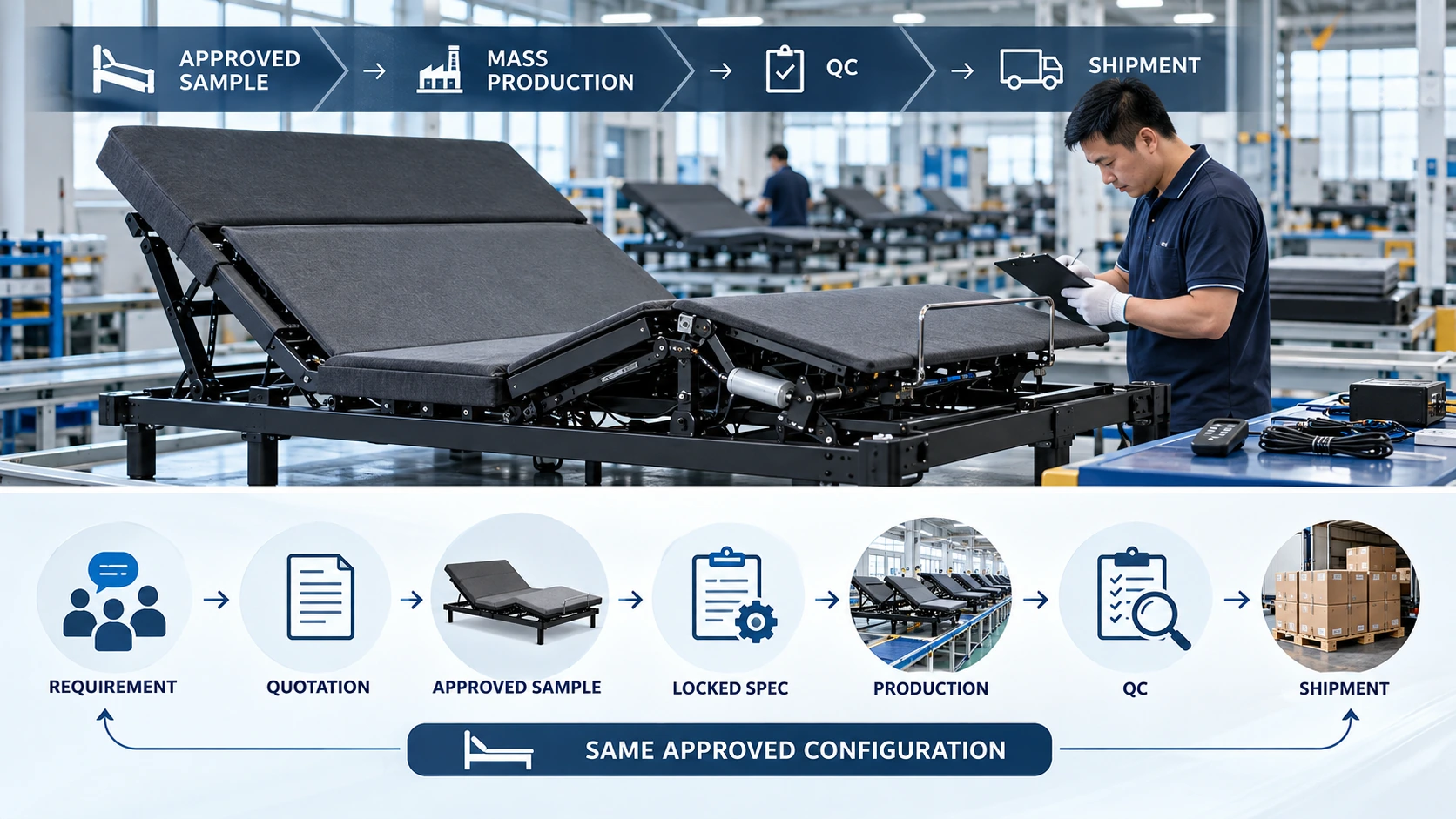
For OEM/private-label projects, KFY SMART recommends viewing production quality as one continuous chain:
Buyer Requirement
What does the buyer actually need?
↓
Commercial Configuration
What exactly is included in the quotation?
↓
Approved Sample
What physical product was approved?
↓
Locked Production Reference
What specification defines that approval?
↓
Mass Production
Is the approved configuration being reproduced?
↓
Quality Control
Are production results consistent with that reference?
↓
Pre-Shipment Inspection
Is the shipment ready for commercial release?
↓
Batch Traceability
Can the shipped configuration be identified later?
The key relationship is:
Requirement = Quotation = Approved Sample = Production Reference = Inspection Reference
When those references stay aligned, disagreements become easier to prevent and easier to resolve.
This is more useful than simply asking a supplier:
“Do you have QC?”
Most suppliers will say yes.
A stronger sourcing question is:
“What exactly is your QC checking against?”
What Should Be Checked on Every Unit vs. by Sampling?
There is no single inspection frequency that should automatically be applied to every adjustable bed base.
The appropriate quality plan depends on:
- product risk;
- production process;
- component criticality;
- agreed specifications;
- order size;
- destination-market requirements;
- buyer requirements.
Inspection activities may be divided into areas such as:
Functional Checks
Operation of the finished product according to the approved configuration.
Visual and Workmanship Checks
Appearance, assembly condition and finishing.
Dimensional Checks
Selected dimensions linked to the approved specification.
Component Verification
Identity and configuration of important components.
Packaging Checks
Pack-out, accessories, labeling and protection.
Documentation Checks
Correct manuals, labels and product/version information.
A mature quality plan defines which characteristics require 100% checking and which can be evaluated through an agreed sampling method.
Ten Questions B2B Buyers Should Ask Before Mass Production
Before releasing an adjustable-bed order for production, ask:
- What is the final approved production reference?
- How are product and artwork revisions controlled?
- Which components are critical to the approved configuration?
- What changes require buyer approval before substitution?
- Which characteristics are checked during production?
- Which functions are checked on finished products?
- How are accessories and packaging verified?
- What is included in the pre-shipment inspection?
- What production or inspection records are retained?
- How can a shipped batch or product version be identified later?
These questions usually reveal more about an OEM quality system than a generic statement such as:
“We have strict quality control.”
FAQ
What should be checked during adjustable bed base quality control?
The exact checklist should come from the approved product specification. Common areas can include component configuration, assembly, movement, selected functions, appearance, accessories, labels, documentation and packaging.
Is approving one adjustable bed sample enough?
No. Sample approval defines the intended product. Mass-production quality control verifies whether subsequent production continues to match the approved configuration.
What is the difference between sample inspection and production quality control?
Sample inspection asks whether the product is suitable for approval. Production QC asks whether manufacturing continues to reproduce the approved product consistently.
What is a pre-shipment inspection?
It is an inspection performed near the end of production to determine whether the shipment meets agreed requirements before release. It should support—not replace—quality control performed earlier in the process.
Should every adjustable bed base receive functional testing?
The correct inspection method depends on the specific manufacturing process and quality plan. Some established adjustable-base manufacturers publicly describe 100% finished-product functional validation, but buyers should confirm the actual process used for their own supplier and project rather than assume it is universal.
Why is version control important in OEM adjustable beds?
Because components, artwork, documentation and packaging can change over time. Version control helps ensure that production and replacement parts remain connected to the configuration the buyer actually approved.
Are optional adjustable-bed functions part of QC?
Only when they are included in the approved configuration. Optional features should not be treated as standard functions across an entire product range.
Is packaging part of adjustable bed quality control?
Yes. Packaging, accessories, labels and documentation are part of the finished commercial product and can directly affect logistics and after-sales performance.
Conclusion
Adjustable bed base quality control should not be reduced to:
“Inspect the finished bed before shipping.”
A stronger OEM/private-label process connects:
Approved Sample → Production Reference → Component Control → Manufacturing → QC → Pre-Shipment Inspection → Traceability
The physical product, functions, components, accessories, documents and packaging should all point back to the same approved configuration.
For B2B buyers, the strongest quality-control question is therefore not:
“Does the factory inspect the product?”
It is:
“Can the supplier and inspection team verify that mass production is still reproducing the product we approved?”
That is the difference between checking individual units and managing a repeatable adjustable-bed OEM program.
Planning an Adjustable Bed Base OEM Project?
If you are developing an adjustable bed base for a mattress company, furniture brand, distributor or private-label program, share your target market, required configuration, current sample status and expected order quantity with KFY SMART.
KFY SMART coordinates product development, OEM/ODM requirements, quality control and inspection with long-term strategic manufacturing partners.
Production is carried out through long-term strategic manufacturing partners.