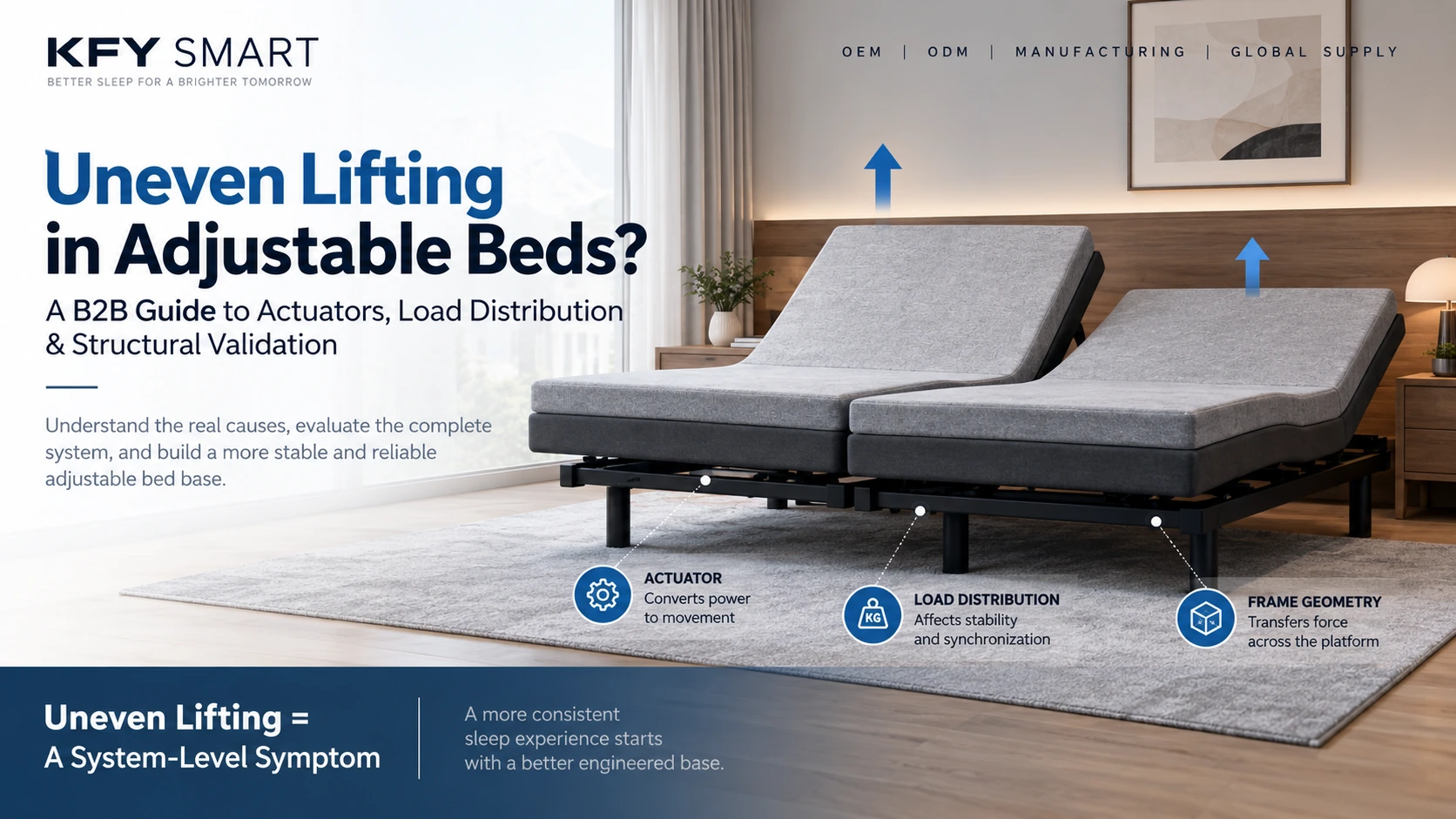
An adjustable bed base can look perfectly normal when flat and still behave differently once the head or foot section starts moving. One side may appear to start later, one edge may rise faster, the platform may twist slightly during articulation and then become level again, or the difference may become more noticeable after months of use.
For an end user, the complaint is simple: “One side of my adjustable bed lifts slower than the other.” For mattress brands, furniture companies, retailers, distributors, hotels and senior-care buyers, the more useful question is: Is the uneven movement coming from the actuator, the linkage, the frame, the load, the mattress—or the installation?
That distinction matters because uneven lifting is not automatically a motor failure.
What Does “Uneven Lifting” Actually Look Like?
Not every uneven movement pattern means the same thing. These differences matter during diagnosis, so the first step should be to describe the movement pattern, not immediately replace a component.
Delayed Start
One side or section appears to begin moving slightly later before catching up.
Different Travel Speed
Movement starts together, but one side appears to move more slowly.
Temporary Platform Twist
The platform looks slightly asymmetric during travel but becomes level when it reaches the target position.
Permanent Uneven Position
One side remains visibly higher or lower after the movement stops.
Progressive Unevenness
The base initially operated evenly but develops more noticeable asymmetric behavior over time.
Uneven Lifting Is a Symptom, Not a Component Diagnosis
A useful mistake to avoid is Uneven movement → motor failure. That conclusion is too narrow. The actuator is only one part of the load path:
Actuator → Mounting Point → Linkage / Pivot → Cross Member → Moving Platform → Mattress → User Load
If any part of that system behaves differently on one side, the finished platform may appear uneven. The useful OEM/ODM principle is: Diagnose the load path, not only the motor.
Does a Queen Adjustable Base Have a “Left Motor” and a “Right Motor”?
Not necessarily. Depending on the architecture, a head section may be driven by one actuator acting through a transverse linkage or structural mechanism that raises the platform across its width; other systems may use different actuator and synchronization architectures.
When one side of a Queen platform appears to lift later than the other, it does not automatically mean “the left motor is weaker than the right motor.” There may not even be separate left and right lift actuators for that motion. Structural twist, linkage play, mounting-point movement, platform deflection, loose fasteners, asymmetric load and uneven support can all matter.
For B2B buyers, ask: How is force transferred from the actuator to both sides of the moving platform?
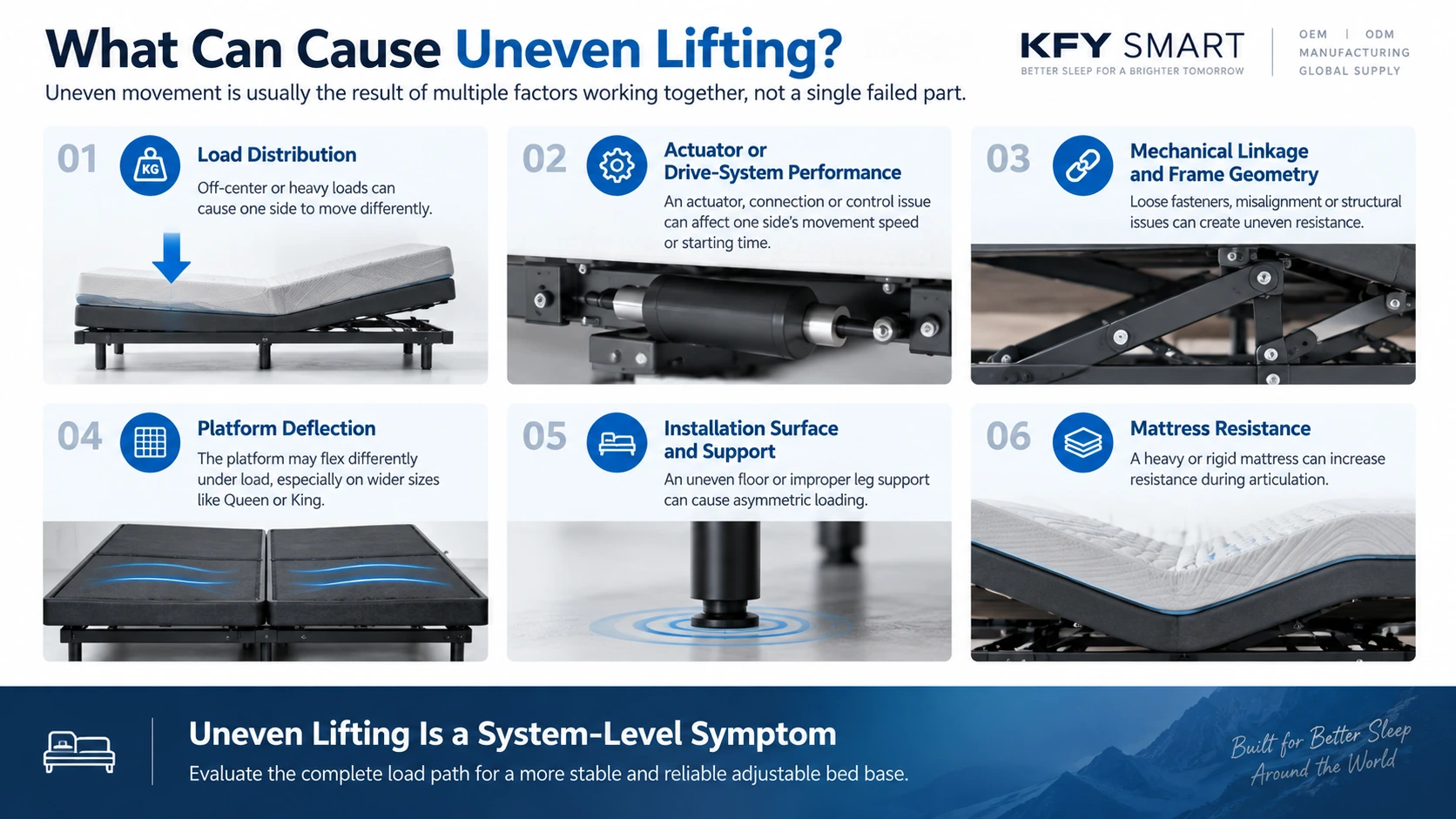
Cause 1: Uneven Load Distribution
Weight capacity is frequently quoted, but the headline number alone does not describe every real-world loading condition. Established manufacturers distinguish total rated capacity from how permitted load is distributed across the platform.
Rated Load Capacity ≠ Unlimited Point-Load Capacity.
The same total kilograms distributed across the sleep surface or concentrated toward one side create different mechanical conditions. That difference affects structural deflection, pivot loading, actuator force, frame torsion and leg loading. OEM validation should treat total capacity and load distribution as separate questions.
Cause 2: Actuator or Drive-System Performance
An actuator converts electrical input into controlled linear movement. Possible actuator-related symptoms include hesitation, reduced travel speed, intermittent operation, incomplete movement and abnormal sound.
When one movement zone becomes stuck or uneven while other functions continue operating, an actuator, motor connection or zone-specific control issue becomes relevant. Before replacement, consider whether the actuator is correctly mounted, receiving the intended command, moving against abnormal resistance and operating under an appropriate load. A motor that appears weak may be working against a structural or installation problem.
Cause 3: Mechanical Linkage and Frame Geometry
The drive system does not move the mattress directly. Force passes through pivots, brackets, shafts, cross members, hinges, moving frame sections and mounting points. KFY SMART’s structural guide explains why frame rails, cross members, articulation points, hinges and motor mounting positions experience forces while the platform moves.
If one of these areas changes geometry, develops excessive play or becomes loose, movement can become asymmetric. Actuator quality and frame quality are one mechanical system, not unrelated specifications.
Cause 4: Platform Deflection
The moving platform contributes to perceived alignment. A wider Queen or King platform may experience different structural forces across its width. Under load, one side may flex more if the structure is insufficiently stiff, load is concentrated, connection points move or the platform is damaged.
Actuator Travel ≠ Platform Alignment. Both need to be checked.
Cause 5: Installation Surface and Support
The base itself is not always the only source of asymmetric behavior. Reverie recommends checking floor support because a base that is not level can experience uneven loading, noise and inconsistent movement. KFY SMART’s bed-frame compatibility guide also emphasizes level support, appropriate load paths and full-range movement checks for platforms, slats and furniture structures.
Floor → Legs / Supporting Furniture → Main Frame → Articulation Structure → Mattress
A small support difference at the bottom of the system can affect movement higher up, particularly for furniture-integrated beds, hotels, serviced apartments, senior-care projects and platform installations.
Cause 6: Mattress Resistance
The mattress is part of the moving load. An adjustable-friendly mattress must bend with the moving platform rather than strongly resist articulation. Flexibility, construction, thickness and weight can all influence its behavior.
KFY SMART’s mattress compatibility guide reaches the same B2B conclusion: test mattress and base together because flexibility, weight, construction and retention affect real behavior. The factory reference mattress is not always an adequate substitute for the production mattress.
Static Load Capacity Is Not Dynamic Articulation Performance
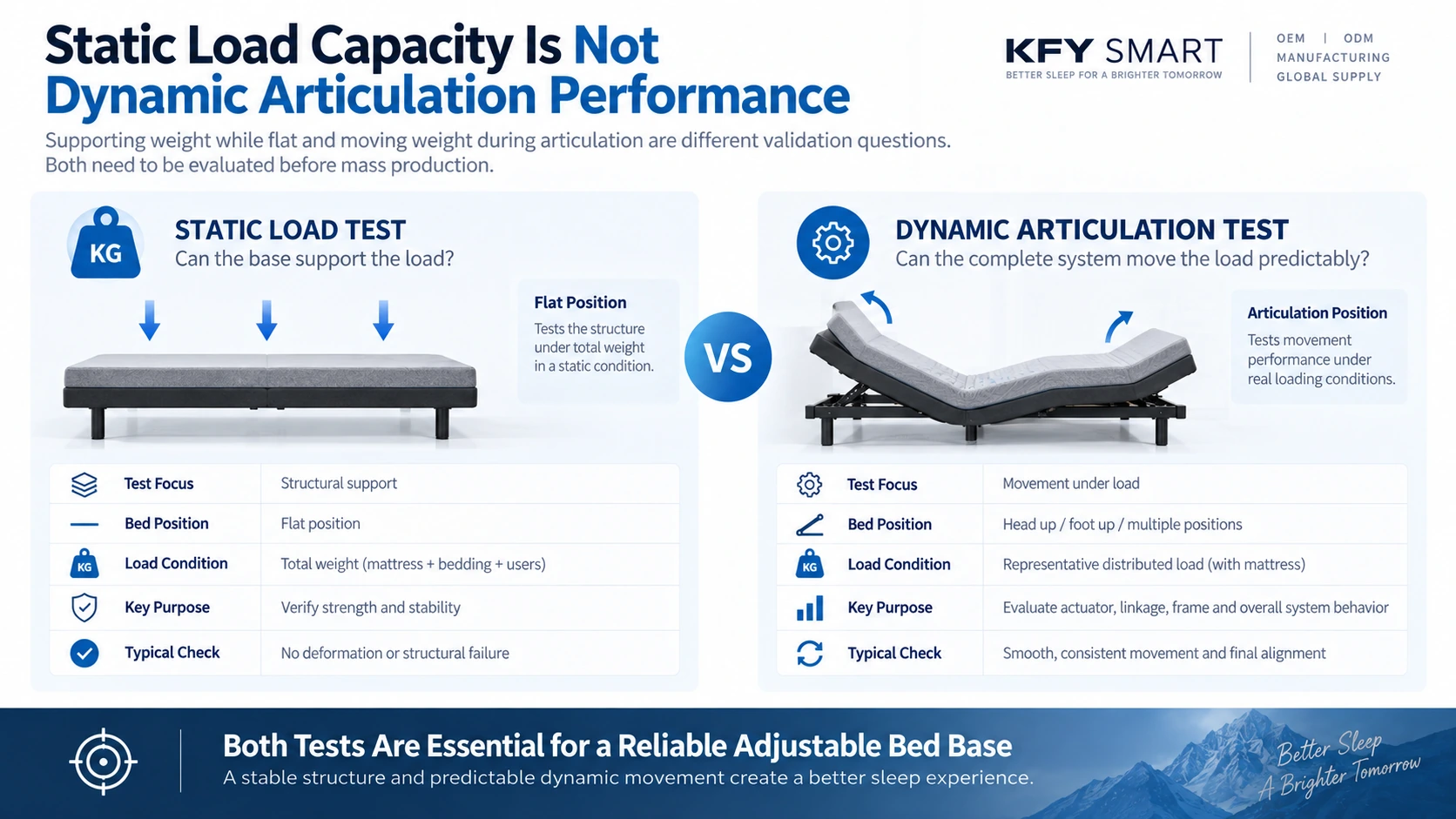
A static load test asks: Can the structure support the specified load? A dynamic articulation test asks: Can the complete system move that intended load predictably through its operating range?
Once the head section rises, the frame, mechanism and motor system are no longer simply carrying a flat vertical load—they are working together to move part of the sleeping surface. Static Load Capacity ≠ Dynamic Articulation Performance. Both matter before mass production.
Weight Capacity Should Not Be Reduced to One Number
An RFQ may say “Load Capacity: 750 lb” and receive “Yes,” but that leaves unanswered whether mattress and bedding are included, how load should be distributed, whether the rating is structural or dynamic, whether it applies during head articulation, and whether edge loads are restricted.
A better question is: Under what loading and articulation conditions has the selected base configuration been validated?
A Practical B2B Uneven-Lifting Validation Process
Instead of recording only Motor Function — PASS, separate operating conditions.
Stage 1 — No-Load Baseline
Operate the approved unloaded configuration and observe movement start, travel, left/right platform appearance, abnormal noise and final position.
Stage 2 — Mattress Installed
Install the actual or representative production mattress, repeat the sequence and observe whether mattress weight or resistance changes behavior.
Stage 3 — Representative Distributed Load
Apply the appropriate representative load according to the approved procedure; check movement initiation, articulation, platform alignment and return to flat.
Stage 4 — Representative Asymmetric Condition
Where appropriate, evaluate realistic off-center loading—not to exceed the rating, but to understand whether common asymmetric loading changes movement.
Stage 5 — Repeated Articulation
Repeat the approved sequence and observe hesitation, alignment change, noise, fastener settling and consistency.
Stage 6 — Finished-Bed Validation
Finally evaluate production mattress + adjustable base + intended furniture / installation, because that is the product the customer experiences.
Create a Movement Profile Instead of One PASS/FAIL Result
For an OEM/ODM project, record a movement profile so the team learns under which condition behavior first appears.
| Test Condition | What to Observe |
|---|---|
| No load | Baseline movement and alignment |
| Mattress installed | Mattress influence |
| Distributed load | Loaded articulation behavior |
| Off-center condition | Asymmetric response |
| Head up / down | Start, travel and final position |
| Foot up / down | Zone-specific behavior |
| Return to flat | Final platform alignment |
| Repeated articulation | Progressive change |
| Furniture installed | Installation influence |
Measure Movement, Not Just Motor Operation
Higher-specification OEM validation can go beyond checking whether a remote activates the motor. Useful observations include start timing, relative platform position, final alignment, movement repeatability and visible asymmetric deflection.
“Motor runs” is not the same as “finished platform moves correctly.”
Why Mattress Brands Should Care
When mattress and base are sold as one sleep solution, uneven movement becomes a complaint against the overall brand. Provide the supplier with mattress dimensions, weight, thickness, construction and flexibility, and test the intended mattress whenever practical.
Why Furniture Brands Should Care
Furniture adds another load path. An adjustable base may be free-standing inside decorative rails, platform-supported, integrated into upholstery or installed above storage furniture. Confirm that furniture supports both sides consistently; a perfect base in a distorted or uneven supporting structure can still produce a poor finished result.
Why Retailers, Hotels and Senior-Care Projects Should Care
Retail and distribution teams need to distinguish installation, connection, actuator, structural and mattress-interaction issues. A useful support form records affected movement, symptom condition, load, mattress type, furniture configuration and whether the final position becomes level.
Hotels need repeatable floor level, furniture support, mattress specification, installation sequence, leg contact and service access across rooms. Senior-care and home-care projects should also consider actuator replacement, affected-zone isolation, accessible connections, replacement components and clear component identification.
Split King Requires a Different Diagnosis
Two Twin XL bases in a Split King are separate moving systems. Different positions between two bases and left-right twisting within one Queen base are not the same problem. First establish whether the bases are intended to move independently, in synchronization or in both modes. See Split King vs. King Adjustable Bed Bases for the format comparison.
What Should an OEM/ODM RFQ Include?
Describe the complete operating system, not only “Queen / Dual Motor / 750 lb.” Include mattress size, dimensions, thickness, weight and construction; base articulation and control architecture; intended combined load and use environment; installation and furniture drawings; target market; and service expectations for actuators, control-box access, spare parts, documentation and warranty.
What Should Buyers Check Before Mass Production?
Confirm unloaded movement, mattress-only behavior, intended loaded articulation, representative asymmetric loading where appropriate, final alignment, frame and linkage condition, level support, repeated consistency, furniture integration and component serviceability. Exact procedures, loads and tolerances should come from the selected product’s validated engineering specification—not invented universal numbers.
KFY SMART’s B2B Approach: Validate the Complete Movement System
KFY SMART develops adjustable bed bases for mattress brands, furniture companies, hospitality projects and global distributors, with different structures and configurable options across its B2B range.
Actuator + Linkage + Frame + Platform + Mattress + Load + Installation + Serviceability
Do not approve the motor alone. Approve the movement of the complete bed. A reliable program is one where the intended mattress, frame and drive system move predictably under the conditions the finished product is designed to experience.
FAQ
Why does one side of my adjustable bed lift slower than the other?
Possible causes include actuator or connection problems, mechanical resistance, frame or platform deflection, uneven loading and uneven support beneath the base. Isolate the movement pattern before assuming the motor has failed.
Can uneven weight make an adjustable bed lift unevenly?
Yes. Uneven distribution can place different forces on the frame, joints and actuator system. Evaluate both rated capacity and intended distribution.
Does a higher weight-capacity rating guarantee even lifting?
No. Capacity is only one specification; stiffness, mattress resistance, installation and articulation geometry also influence dynamic movement.
Can the mattress affect adjustable-bed movement?
Yes. Mattress flexibility, construction, thickness and weight can change resistance during articulation.
Can an uneven floor affect adjustable-bed operation?
Yes. Uneven support can introduce asymmetric loading, movement inconsistency and noise.
Is “dual motor” the same as left-right synchronized lifting?
No. Dual motor may describe different powered functions, such as head and foot articulation, rather than separate left and right lifting.
Should adjustable bases be tested under load?
For B2B approval, unloaded function alone does not represent intended use. Validate with the intended mattress and appropriate representative loading according to the engineering specification.
What should OEM buyers ask about adjustable-bed actuators?
Ask about architecture, load conditions, mounting, control compatibility, replacement access, spare parts and complete-platform validation.
Can an actuator be replaced without replacing the whole adjustable base?
On many modular designs, individual actuators or electrical components can be serviced separately, but availability and procedures depend on manufacturer and model.
Sources & References
- Reverie Sleep — Adjustable Bed Troubleshooting: Easy Fixes for Bases That Won’t Move
- Ergomotion — Knowledge Articles
- Ergomotion Europe — FAQ
- KFY SMART — Why Are Adjustable Bed Bases So Heavy?
- KFY SMART — Can Any Mattress Be Used on an Adjustable Bed Base?
- KFY SMART — Adjustable Bed Base & Bed Frame Compatibility
- KFY SMART — Split King vs. King Adjustable Bed Bases
Explore the Right Adjustable Bed Base Program
Send KFY SMART your mattress specification, intended load requirements, furniture drawings, target market and required functions. Our B2B team can coordinate selected configuration, structural requirements, installation conditions and sample-validation requirements before mass production.