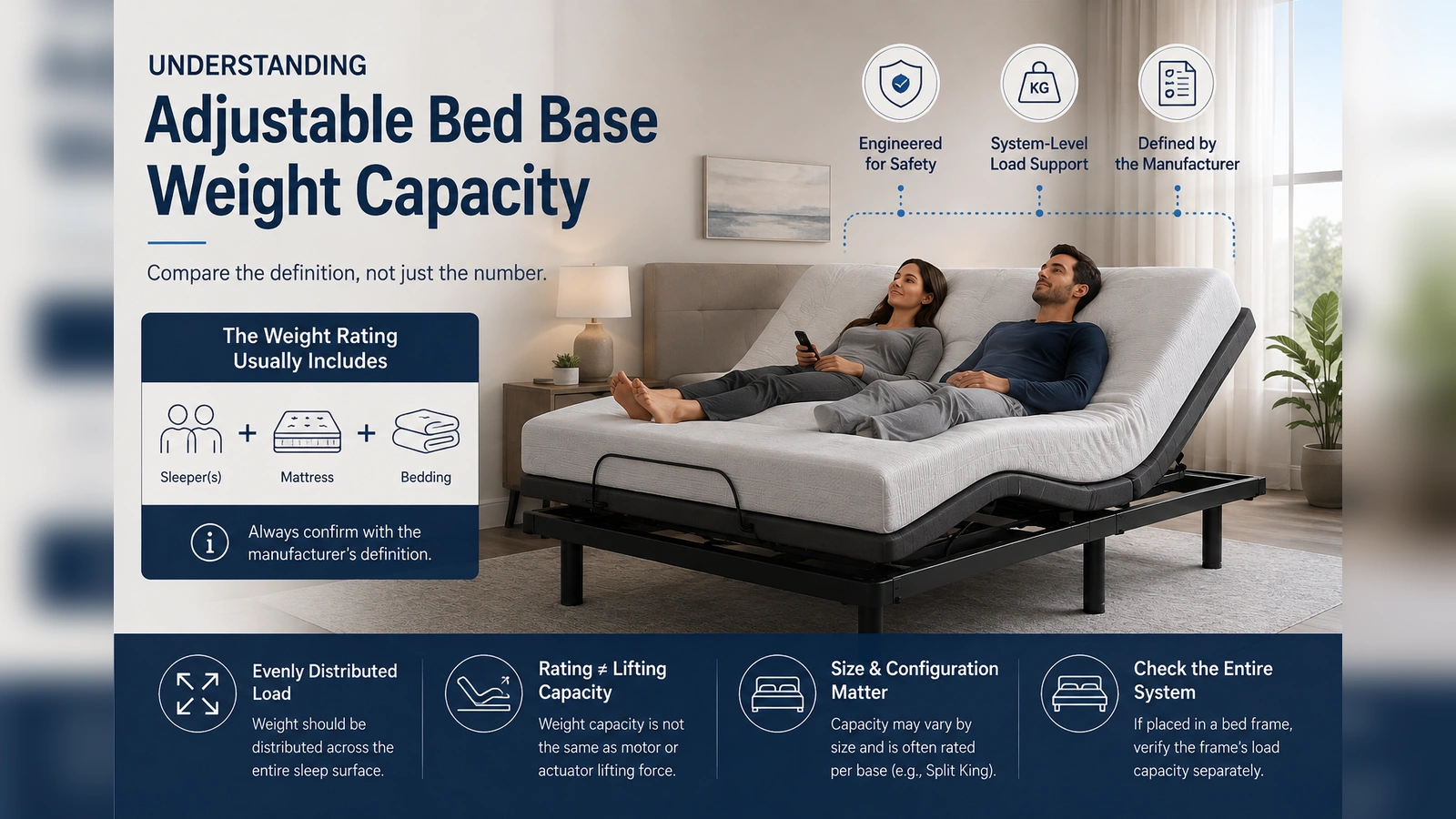
For mattress companies, furniture brands, distributors, retailers, hospitality projects, and other B2B buyers, the better question is not simply:
“How much weight can this adjustable bed base hold?”
It is:
“What does the stated capacity mean for this exact configuration, and how should we validate it for our product program?”
That distinction matters because an adjustable bed base is not a stationary platform. It must support the sleep system while also moving selected sections of the platform through repeated articulation.
Why One Weight-Capacity Number Is Not Enough
Weight capacity is often presented as a single headline specification. That number can be useful, but only after the buyer understands the conditions behind it.
Official adjustable-base guidance from major manufacturers commonly adds conditions such as:
- the load should be distributed across the base;
- the stated limit can include the mattress and bedding;
- the full structural rating does not necessarily mean the head or foot section is intended to lift that same amount independently.
These qualifications are important because they show that structural support and powered articulation are related, but not identical, engineering questions.
For B2B sourcing, a capacity claim should therefore be treated as a specification that needs context—not as a stand-alone proof of product quality.
What Does Adjustable Bed Base Weight Capacity Include?
The first question in an RFQ should be:
What is included in the stated load rating?
Depending on the manufacturer and product, the complete load can include:
- user or users;
- mattress;
- bedding;
- approved accessories or other loads.
This is why two projects using the same bed size can create different mechanical conditions.
A lightweight foam mattress and a heavier hybrid mattress may be placed on the same nominal Queen-size base, but the finished system starts with a different load before the user is added.
For a B2B product program, the safer approach is to define:
Users + Mattress + Bedding + Other Approved Loads = Complete System Load
The exact rating still needs to come from the supplier's documented specification for the exact model and configuration.
Why Mattress Weight Should Be Included in the Sourcing Conversation
Mattress companies sometimes evaluate the adjustable base and mattress as two separate product categories. Mechanically, however, they operate as one system.
The mattress contributes:
- weight;
- bending resistance;
- pressure on different platform zones;
- interaction with the retainer and moving deck;
- resistance during head and foot articulation.
For this reason, KFY SMART recommends providing the intended mattress specification during adjustable-base development whenever possible.
Useful inputs include:
- mattress size;
- finished mattress weight;
- thickness;
- foam, hybrid, spring, or other construction;
- approximate flexibility;
- edge construction.
The goal is not to create unnecessary complexity. It is to reduce the gap between a supplier's generic specification and the buyer's real finished product.
Static Structural Support Is Not the Same as Dynamic Articulation
This is one of the most important distinctions in adjustable-bed sourcing.
Static Support
Static support asks:
Can the complete structure support the intended load while the base is stationary?
The answer depends on the complete supporting structure, including:
- main steel frame;
- moving deck;
- cross members;
- joints and fasteners;
- legs or support points;
- the surrounding furniture, if the base is not freestanding.
Dynamic Articulation
Dynamic articulation asks:
How does the system behave while the head or foot section is moving under representative load?
Now additional factors become important:
- actuator arrangement;
- linkage geometry;
- pivot position;
- moving-deck stiffness;
- mattress resistance;
- load location;
- alignment;
- control behavior.
A base may be able to support a specified load while flat without that fact alone proving how every moving section performs under the same condition.
Major adjustable-base manufacturers explicitly distinguish between total structural support and the amount of weight that should be concentrated or lifted by an individual head or foot section. That is why B2B buyers should ask for both the capacity definition and the articulation conditions used to support it.
When reviewing an OEM sample, weight-capacity claims should be evaluated together with frame structure, movement and the approved production configuration; use the OEM sample validation process to document those checks before mass production.
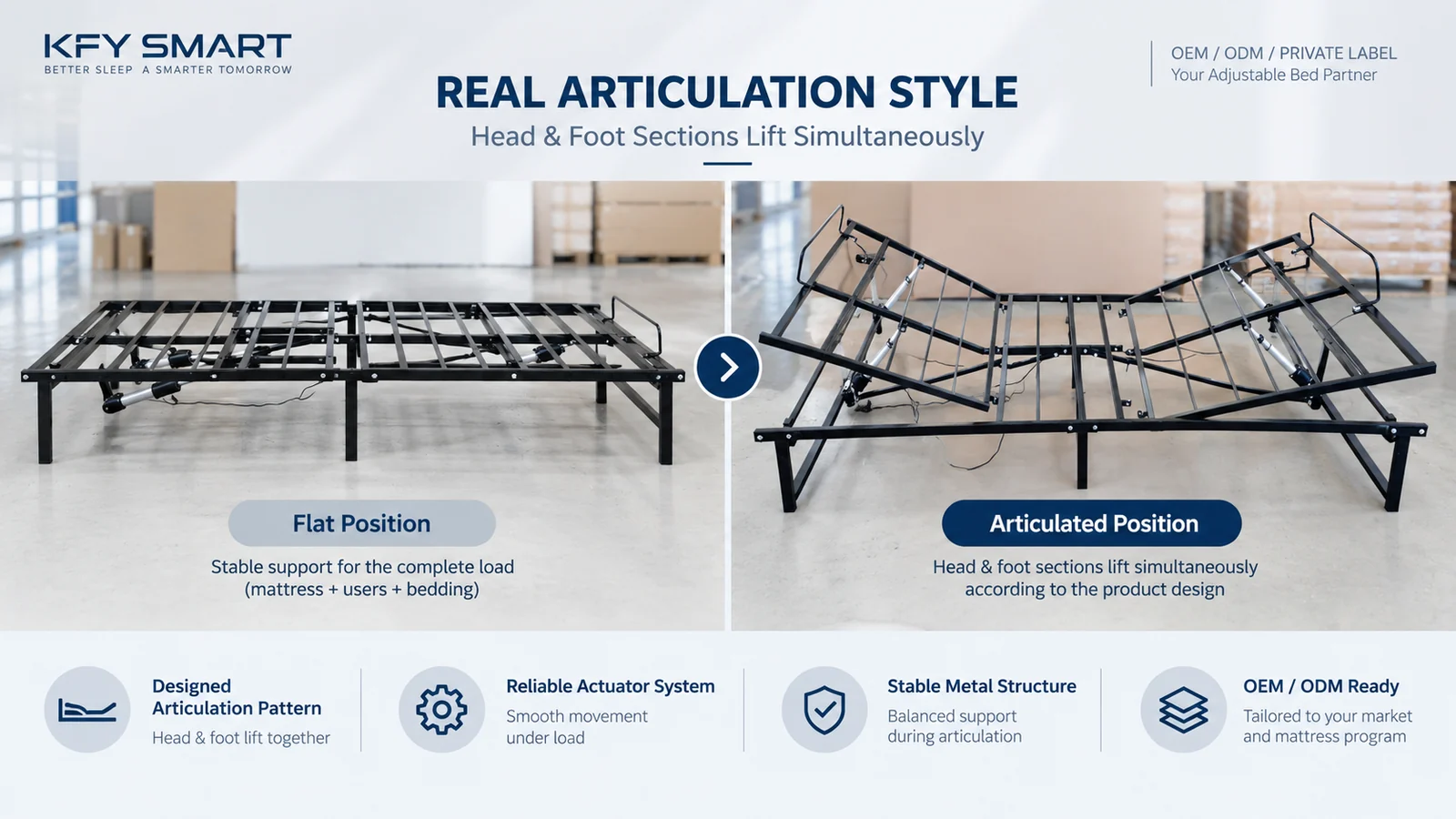
A KFY SMART Factory Observation: Capacity Is a System Question
The adjustable-bed frame photographed for this article provides a useful real-world example.
The open-frame sample clearly shows:
- a steel support structure;
- separate head and foot articulation zones;
- one actuator serving the head-side mechanism and another serving the foot-side mechanism;
- multiple pivot and linkage points;
- several legs and support locations transferring load into the floor.
This observation does not establish a specific kg or lb capacity by itself.
What it does show is why a buyer should avoid thinking of weight capacity as “motor strength” alone.
The finished load is transferred through several components and interfaces:
Mattress and users → moving deck → linkage and frame → support points → floor or supporting furniture
If one part of that system changes, the finished application can change as well.
That is especially important in OEM/ODM development, where frame geometry, mattress construction, size, controls, accessories, packaging requirements, or installation method may differ between programs.
Why Load Distribution Matters
Two adjustable beds can carry the same total weight while experiencing very different mechanical conditions.
For example:
- one load may be distributed across the full sleep surface;
- another may be concentrated near one side;
- a person may sit on an edge before entering the bed;
- a split system may have very different loading on the left and right bases.
The total number is the same, but the force is not reaching the structure in the same way.
This is why official adjustable-base instructions often emphasize even load distribution.
For B2B buyers, the procurement question should therefore be:
“Under what load-distribution condition was the stated capacity defined or evaluated?”
That question is more useful than simply comparing the highest advertised number.
Mattress Flexibility Matters as Well as Mattress Weight
Weight is only one mattress variable.
Two mattresses with similar finished weight can behave differently on the same adjustable bed base if their bending characteristics are different.
Relevant factors can include:
- overall thickness;
- foam density and layer construction;
- spring or hybrid architecture;
- edge reinforcement;
- quilting and cover construction;
- overall flexibility.
A mattress that follows the moving deck easily creates a different articulation condition from a more rigid mattress that resists bending.
For a mattress brand developing an adjustable-base program, the base should therefore be evaluated with a representative mattress—not only as an empty mechanical frame. For related fit guidance, see Can Any Mattress Be Used on an Adjustable Bed Base?.
Does Bed Size Change the Capacity Question?
Yes, because bed size can change the geometry of the complete system.
A wider platform changes:
- span length;
- cross-member requirements;
- load paths;
- deck deflection;
- support-point relationships.
Split systems create another distinction.
With a Split King or other split configuration, two individual bases normally form one finished sleep system. Buyers should therefore confirm whether a stated capacity applies:
- per individual base;
- per side;
- or to another defined system configuration.
Do not automatically transfer a specification from one size to every other size unless the supplier has confirmed that it applies. See Split King vs. King Adjustable Bed Bases for configuration context.
Zero-Clearance and Furniture-Integrated Installations Need a Second Check
A zero-clearance or furniture-integrated installation adds another load-bearing structure beneath the adjustable base.
This creates two separate questions:
1. Can the adjustable base support the intended sleep-system load?
2. Can the bed frame, platform, or furniture beneath it support the adjustable base plus the sleep-system load?
A compatible fit does not automatically prove sufficient structural capacity.
For furniture brands, retailers, and project buyers, this means the supporting furniture should have its own confirmed structural suitability.
This point is especially important because adjustable bases themselves can be relatively heavy before the mattress and occupants are added. Review adjustable bed base and bed frame compatibility and the Zero-Clearance Adjustable Bed Base B2B Guide for the supporting-furniture side of the decision.
Why “Higher Capacity” Does Not Automatically Mean “Better Base”
Suppose Supplier A publishes one number and Supplier B publishes a larger number.
Without context, the comparison is incomplete.
Before using capacity as a supplier-selection metric, ask:
1. What does the rating include?
Does it include the mattress and bedding, or is the definition different?
2. Is the load assumed to be evenly distributed?
A distributed load and a concentrated load are not the same condition.
3. Which bed size does the rating apply to?
Confirm that the number applies to the model and size you are buying.
4. Is the figure a structural support rating or an operating recommendation?
The terminology matters.
5. What articulation condition was considered?
Ask how the system is expected to perform when head and foot sections move.
6. What mattress was used?
A representative mattress makes the validation more relevant to the final product program.
7. What installation method was used?
Freestanding, zero-clearance, furniture-integrated, and split configurations can create different support conditions.
8. Does production match the approved sample?
For OEM/ODM programs, the approved frame, actuator/control configuration, mounting points, and other critical components should be controlled through the production specification.
A Practical B2B Capacity-Validation Framework
KFY SMART recommends treating weight capacity as part of product definition rather than a number added at the end of a specification sheet.
A practical workflow is:
Step 1: Define the Target Market
Clarify whether the program is for:
- mattress retail;
- furniture retail;
- distribution;
- hospitality;
- residential comfort;
- another clearly defined application.
The use scenario affects how the finished system should be specified.
Step 2: Define the Mattress
Provide:
- size;
- dimensions;
- construction;
- weight;
- thickness;
- approximate flexibility.
Step 3: Define the Intended Complete Load
Consider the whole sleep system rather than user weight alone.
Step 4: Define the Installation
Confirm whether the base will be:
- freestanding;
- installed inside existing furniture;
- used in a zero-clearance arrangement;
- supplied as a split system.
Step 5: Confirm Static Structural Requirements
Ask how the frame, deck, legs, support points, and relevant joints are specified for the intended load.
Step 6: Confirm Articulation Requirements
Clarify how the head and foot mechanisms are expected to move under representative conditions.
Step 7: Review Alignment and Stability
During sample evaluation, observe for:
- unexpected frame deflection;
- uneven movement;
- interference;
- abnormal noise;
- instability;
- mattress movement;
- control inconsistency.
For a related symptom-focused review, see Adjustable Bed Base Lifting Unevenly.
Step 8: Freeze the Approved Production Configuration
Once the sample is approved, document the critical production configuration.
For OEM/private-label programs, this can include:
- frame design;
- actuator/control configuration;
- dimensions;
- mattress retainer;
- legs;
- accessories;
- packaging;
- labels;
- market-specific documentation.
The exact list should be adapted to the project.
What Different B2B Buyers Should Focus On
Mattress Companies
Provide the real mattress specification early. Weight and flexibility directly affect the finished adjustable sleep system.
Furniture Brands
Evaluate both the adjustable base and the furniture that supports or surrounds it.
Distributors and Retailers
Make sure the published capacity language is clear enough for sales and after-sales teams to explain accurately.
Hotels and Apartments
Focus on repeatable configuration, installation consistency, serviceability, and project requirements rather than chasing the largest headline number.
Senior-Care and Home-Care Buyers
Define the intended comfort application carefully and confirm applicable market, product, and compliance requirements. A consumer adjustable sleep base should not be represented as a medical device or medical bed unless the specific product is designed and qualified for that purpose.
B2B RFQ Checklist: Weight Capacity
Before approving an adjustable bed base for sourcing, ask the supplier to confirm:
- exact model and size;
- capacity definition;
- whether mattress and bedding are included;
- assumed load distribution;
- intended mattress specification;
- installation method;
- static structural requirements;
- articulation conditions;
- actuator/control configuration;
- support-point arrangement;
- relevant test or validation documentation available for the configuration;
- whether the production BOM matches the approved sample.
A supplier that can answer these questions clearly is giving you more useful information than a supplier that provides only a large load number.
FAQ
What is the typical weight capacity of an adjustable bed base?
There is no single universal capacity. Ratings differ by manufacturer, model, size, structure, and intended use. Always use the documented specification for the exact product configuration.
Does adjustable bed weight capacity include the mattress?
It depends on the manufacturer’s definition. Some major adjustable-base manufacturers explicitly include the mattress and bedding in their published limits. B2B buyers should confirm the definition instead of assuming.
Can an adjustable bed lift its full stated capacity at the head or foot?
Not necessarily. Total structural support and the amount of load intended to be lifted by one articulated section are different questions. Check the product manual or supplier documentation for the exact model.
Why does even load distribution matter?
Because concentrated loading can place greater stress on one area of the deck, frame, linkage, actuator, or support system even when total weight remains unchanged.
Does a heavier mattress require a different adjustable base?
Not automatically, but mattress weight and flexibility should be considered in the complete-system evaluation.
Is a higher weight-capacity number always better?
No. A larger number is meaningful only when the buyer understands the definition, configuration, load distribution, installation method, and operating conditions behind it.
What should I send an OEM adjustable-bed supplier before requesting a recommendation?
At minimum: target market, bed size, mattress dimensions and construction, mattress weight if known, intended load range, installation method, required functions, and destination market.
Conclusion
Adjustable bed base weight capacity should be treated as a system specification, not a marketing number.
For B2B buyers, the strongest sourcing decision comes from understanding:
- what the rating includes;
- how the load is distributed;
- how the mattress interacts with the moving deck;
- how the system behaves during articulation;
- how the base is supported in the final installation;
- and whether the approved configuration is controlled in production.
A clear capacity definition makes supplier comparison more meaningful and reduces avoidable problems later in sampling, installation, product claims, and after-sales support.
CTA
Define the Right Adjustable Bed Base for Your Product Program
Share your target market, mattress specification, bed size, installation method, required functions, and private-label requirements with KFY SMART.
We can help coordinate product definition, OEM/ODM configuration, sample evaluation, production quality, and international delivery for adjustable-bed programs.