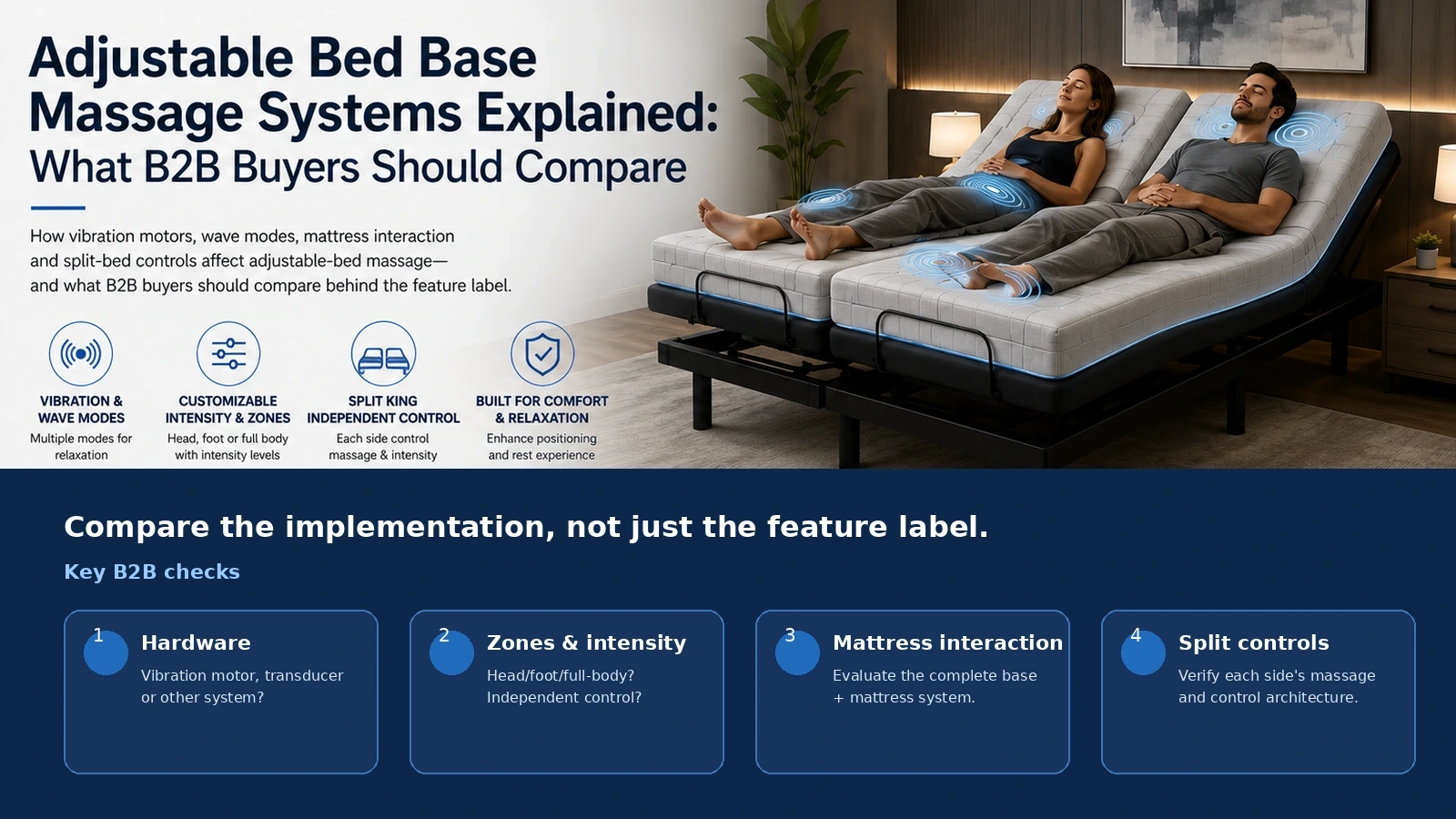
“Massage” has become a common feature on mid-range and premium adjustable bed bases. But the word itself does not tell a buyer very much.
One adjustable base may use simple vibration motors. Another may offer separate head and foot zones, multiple intensity settings and programmed wave patterns. More advanced systems may use transducers or sound-based technology to transmit vibration through the mattress.
For mattress brands, furniture companies, retailers and distributors, the important question is therefore not simply: Does this adjustable bed have massage? It is: How is the massage function actually implemented?
That distinction matters because two products carrying the same “massage” label can deliver very different hardware configurations, control options and user experiences.
What Does “Massage” Mean on an Adjustable Bed Base?
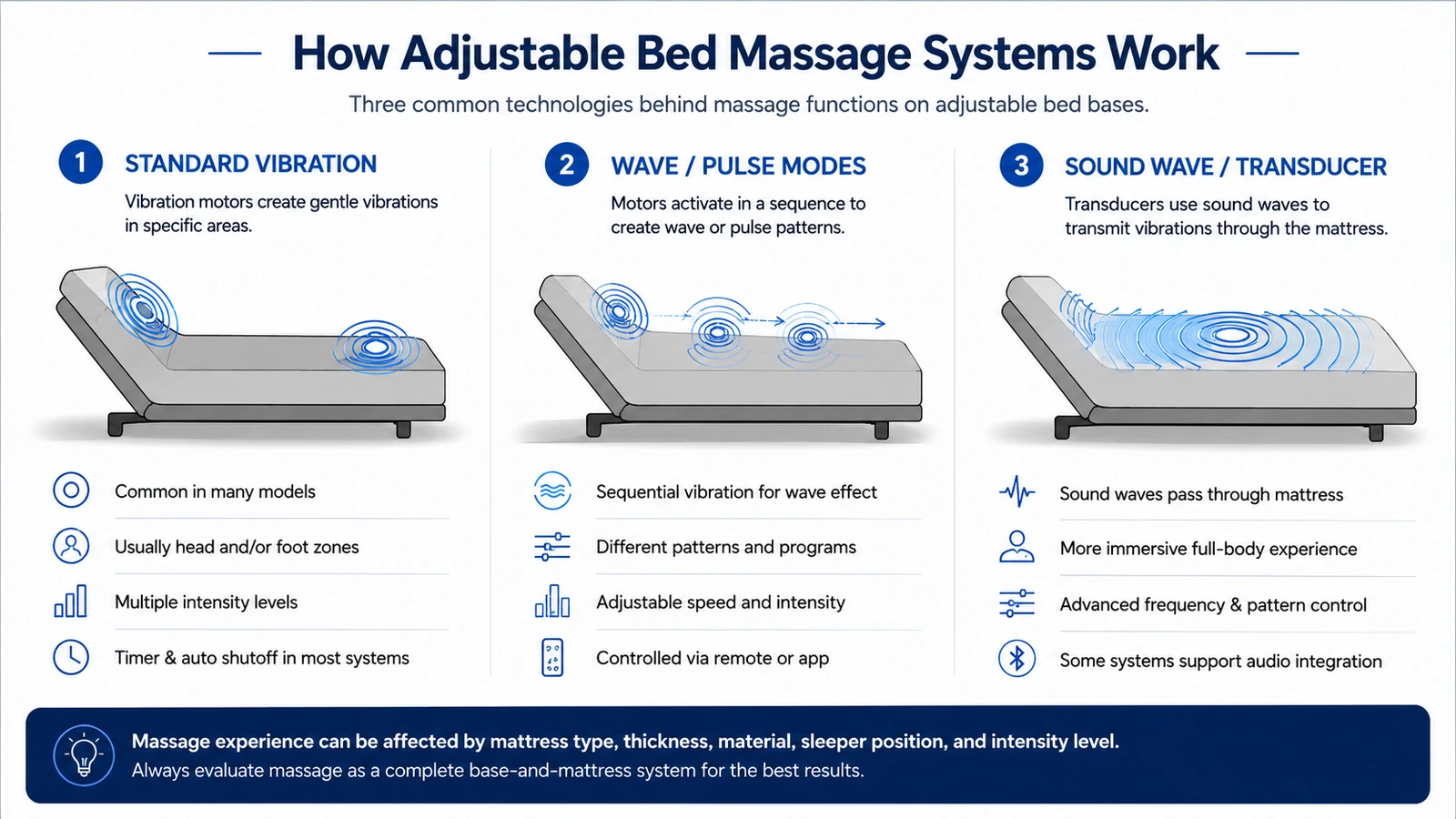
In many adjustable bed bases, massage is created by vibration units mounted within or underneath the base structure. The vibration travels through the platform and mattress before reaching the sleeper.
Ergomotion currently lists adjustable-base massage features with selectable intensities on selected Rio models. Saatva’s current Adjustable Base Plus describes head, full-body wave and foot/leg massage as forms of vibrating massage, with three intensity settings.
An adjustable bed base typically does not contain the mechanical rollers, kneading heads or pressure mechanisms found in dedicated massage chairs. For adjustable sleep products, massage is generally positioned as a comfort and relaxation feature that adds another sensory experience to the adjustable-base platform.
For retailers and private-label brands, that difference should be communicated clearly. Calling every vibration system simply “full-body massage” without explaining the implementation can create unrealistic customer expectations.
Vibration Massage: The Most Common Adjustable-Base System
A standard vibration massage system is relatively straightforward in concept. One or more vibration units are integrated into the adjustable base. Depending on the product design, the system may allow vibration in the upper-body area, lower-body area or both.
The more useful B2B comparison is not whether the specification sheet contains the word “massage,” but how the system is configured.
| Specification | What to Verify |
|---|---|
| Hardware | Number and type of vibration units |
| Zones | Head, foot, full body or independently controlled zones |
| Intensity | Number of selectable intensity levels |
| Control | Remote, app, timer and independent-zone controls |
For example, Saatva currently offers three intensities for head massage, full-body wave massage and foot/leg massage, with an automatic 15-minute shutoff. Those details provide much more useful information than the single word “massage.”
For a retailer, they influence how the feature is demonstrated. For an OEM/ODM buyer, they influence the control architecture, remote layout, electronics and product positioning.
What Does “Wave Massage” Actually Mean?
“Wave” is one of the most easily misunderstood terms in adjustable-bed marketing. It should not automatically be interpreted as a completely different massage technology.
On some products, wave massage describes a programmed vibration sequence in which vibration moves or alternates between different areas of the bed. Leggett & Platt currently markets adjustable-base products using terms such as “massage with wave” and “dual massage with wave.”
This demonstrates why a buyer should not assume that the word “wave” describes the underlying hardware. A useful sourcing question is: Is the wave effect created by different hardware, or is it a programmed pattern using the same vibration system?
Two suppliers may both write “Massage with Wave” while offering different motor arrangements, zone layouts, control logic, intensity settings, timers and remote functions. The feature name alone does not provide enough information to conclude that the systems are equivalent.
Vibration Motors vs. Sound-Based Massage Systems
Some premium adjustable sleep systems use a more differentiated implementation. Tempur-Pedic’s TEMPUR-Ergo ProSmart Base is one useful market example. The company currently describes WaveForm Massage as using sound waves to transmit vibrations from the base throughout the mattress.
Tempur-Pedic separately describes SoundScape Mode as an immersive function that allows compatible sound from a Bluetooth-connected device to be both heard and felt through the mattress.
The important B2B lesson is not that one technology is automatically better. “Massage” is a feature category, not one standardized technical architecture. A basic vibration system and a sound-based system may both appear under the massage section of a product comparison, yet their hardware, control logic, cost and user experience can be very different.
Does the Mattress Affect the Massage Experience?
Yes, the mattress can influence the perceived experience, but there is no universal rule that a particular mattress thickness or material will always make massage stronger or weaker. The vibration must travel from the adjustable base through the mattress before it reaches the sleeper.
The final sensation can be influenced by mattress thickness, material density, foam construction, coil structure, comfort-layer design, location of the vibration units, frequency and intensity, and sleeper position.
B2B buyers should avoid universal claims such as “A 14-inch mattress blocks massage” or “Memory foam always transfers vibration better.” A better principle is to evaluate massage as a base-and-mattress system, not as a base-only specification.
For mattress brands developing a complete adjustable sleep program, the intended mattress should ideally be evaluated with the actual base configuration. Read the KFY SMART mattress compatibility guide for related base-and-mattress considerations.
How Does Massage Work on a Split King Adjustable Base?
Massage becomes more complex in Split King configurations. A typical Split King combines two Twin XL mattresses with two Twin XL adjustable bases. Each side may have its own motors, control box and remote, depending on the system.
Buyers should ask whether the left and right sides run massage independently, whether each sleeper can select a different intensity, whether synchronization of base movement also synchronizes massage, whether zones can be controlled separately, how many remotes are used and whether vibration from one side is noticeable on the other.
The answers depend on the specific control architecture. Tempur-Pedic’s current Split Head documentation provides a market example in which WaveForm Massage can operate independently on either side in the specified Split Head configuration. That does not mean every Split King or Split Head adjustable base works in the same way. The buyer must verify the exact configuration.
For the underlying bed-format comparison, read Split King vs. King Adjustable Bed Bases. Never assume two bases behave as one complete control system simply because they are placed next to each other.
Is More Massage Hardware Always Better?
Not necessarily. More vibration units, more modes and more buttons can create a stronger feature list, but they do not automatically create a better product program. The commercial value depends on how well the feature fits the target customer and price tier.
A product developed for price-sensitive e-commerce may benefit more from simple controls and a clear value proposition than from a complicated massage interface. A mainstream retail model may justify separate massage zones, several intensity levels and a timer. A premium smart-sleep platform may use more advanced programs, independent controls or app integration to create stronger differentiation.
For B2B product planning, feature count should not replace market positioning.
8 Massage Specifications B2B Buyers Should Compare
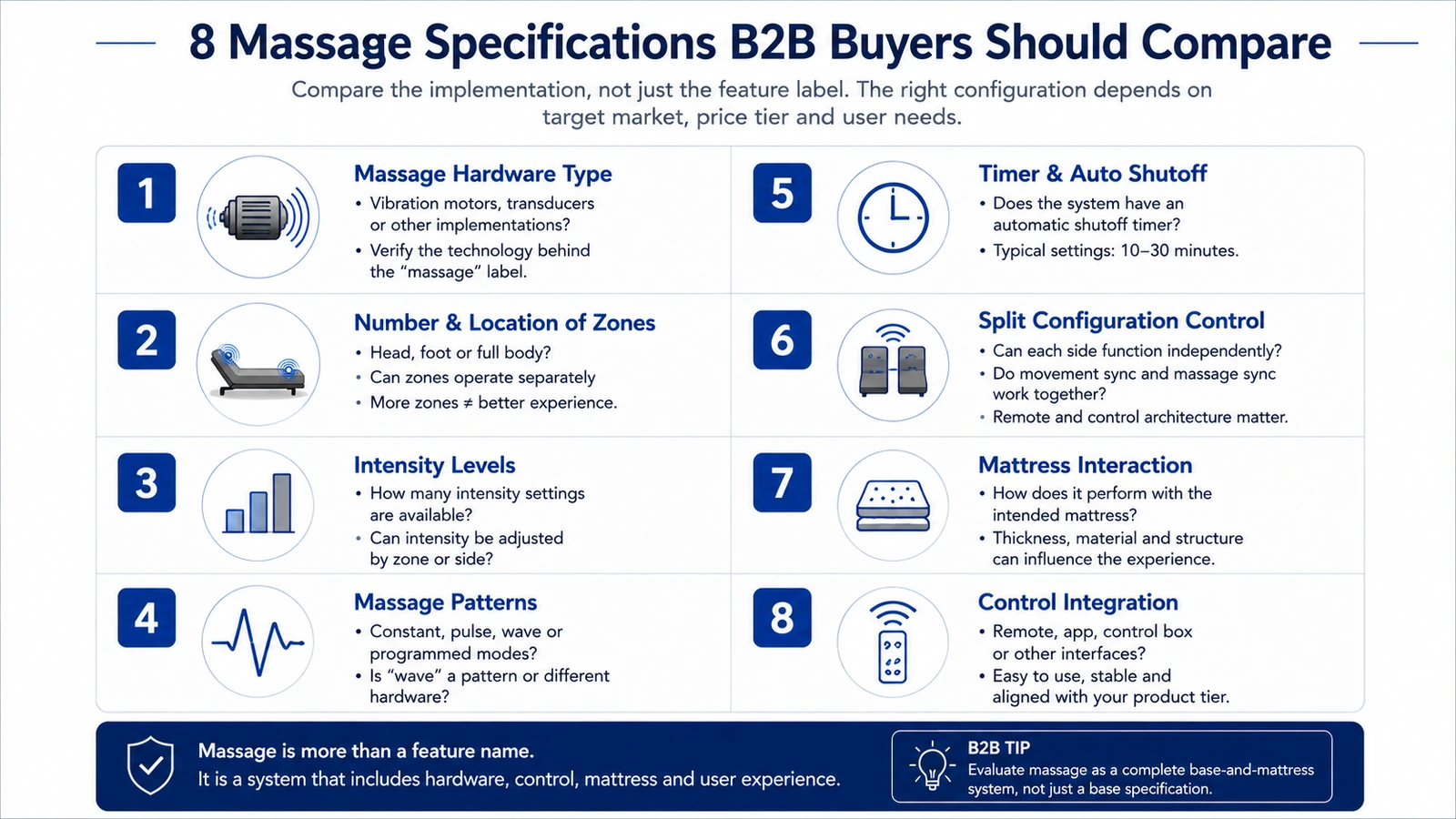
1. Massage Hardware Type
Is the system based on vibration motors, transducers or another implementation? The word “massage” alone does not answer this question.
2. Number and Location of Massage Zones
Is massage available at the head area, foot area, both areas or the full-body area? Can zones operate separately?
3. Intensity Levels
How many selectable intensity levels are available? Also confirm whether intensity can be adjusted independently by zone.
4. Massage Patterns
Does the system provide constant vibration, pulse, wave, alternating sequences or programmed modes? Do not assume that a “wave” label automatically represents different hardware.
5. Timer and Auto Shutoff
Does massage stop automatically after a specified period? This affects both user experience and control design.
6. Split Configuration Control
For Split King or other dual-base systems, can each side use massage independently? Does synchronization affect massage or only bed movement? How many remotes or control channels are required?
7. Mattress Interaction
Has the intended mattress-and-base combination been evaluated together? The perceived massage experience may change with mattress construction, thickness, materials, comfort layers and intensity setting.
8. Control Integration
How are massage functions controlled? Possible interfaces may include a wireless remote, wired remote, app, control box or connected functions. The important issue is whether the control solution fits the intended product and user experience.
Massage Features for Different Retail Product Tiers
Entry-Level Adjustable Base
An entry-level product may omit massage completely, use a simple vibration function, prioritize basic head and foot articulation and minimize electronic complexity. This can be appropriate for price-sensitive retail or e-commerce programs.
Mid-Range Adjustable Base
A mid-range product may add head and foot massage zones, several intensity settings, a timer, wave or pulse programs and an upgraded wireless remote. This can create a clearer step-up from a basic adjustable-base offer.
Premium Adjustable Base
A premium product may combine massage with advanced zone control, programmed experiences, app integration, lumbar adjustment, premium presets, smart functions and additional sensory features. The correct configuration depends on the target market, target customer, retail price, sales channel, mattress program and competitive positioning.
The goal is not to maximize the specification list. It is to create a product configuration that makes commercial sense.
What This Means for Mattress Brands, Retailers and Distributors
For a mattress company, the most important question is how the massage experience works through the mattress that will actually be sold with the base. For a furniture brand, the massage system should be considered together with the overall bed structure, controls and target product tier.
For a retailer, expectation management is critical. Product pages and sales teams should help customers understand whether “massage” means vibration, zoned vibration, programmed wave modes or another defined system.
For a distributor, massage configuration affects SKU planning, technical documentation, remote/control matching, product training and after-sales support. For a private-label brand, massage can become part of product-tier differentiation only when the feature creates a meaningful difference between products.
The purchasing process should move beyond Massage: Yes / No and toward Massage system: How does it work, how is it controlled, and how does it fit the complete product program?
Adjustable Bed Base Solutions from KFY SMART
KFY SMART develops adjustable bed base solutions for mattress brands, furniture companies, distributors, retailers and project-based buyers. Different configurations can vary by product model and project requirements.
Product planning may include motor and drive configuration, remote-control functions, app control, bed size, frame structure, foldable or standard construction, lighting, USB and Bluetooth options, furniture compatibility, packaging, plug and voltage standards, and private-label requirements.
KFY SMART’s current platform treats motor, remote, app and integration options as project-dependent configurations rather than universal features across every model. Massage should be evaluated in the same way. The objective is not to add the maximum number of functions; it is to choose the appropriate combination of product structure, user experience, control system, target price and market positioning.
FAQ
Is adjustable bed massage real massage or just vibration?
Most conventional adjustable-bed massage systems are vibration-based. Vibration units integrated into the base transmit movement through the platform and mattress. This differs from the mechanical kneading or rolling mechanisms commonly associated with dedicated massage chairs. Some advanced systems may use other implementations, such as sound-based transducers, so buyers should check the manufacturer’s technical description.
What is wave massage on an adjustable bed?
“Wave massage” can refer to a programmed vibration pattern that moves or alternates across different zones. It does not automatically mean that the product uses a different type of hardware. Some advanced products use other technologies, so the exact implementation should always be confirmed.
Does mattress thickness affect adjustable bed massage?
It can affect the perceived sensation, but thickness alone does not determine performance. Mattress density, internal construction, foam layers, coil structure, vibration frequency, hardware location, intensity and sleeper position can all influence the final experience.
Is adjustable bed massage worth it?
There is no universal answer. The value depends on the target consumer, implementation quality, mattress combination, retail price and how frequently the customer expects to use it. For B2B product planning, massage should be evaluated as part of the product’s overall positioning rather than simply added to increase the feature count.
Can each side of a Split King use massage independently?
Some systems support independent massage control while others use a different control architecture. Do not assume independent operation. The exact Split King or Split Head configuration should be verified with the manufacturer.
Is a massage motor the same as an adjustable-bed lift motor?
No. Lift motors or actuators move the head and foot sections of the adjustable base. Massage hardware creates vibration or another defined sensory effect. They perform different functions and should not be treated as the same specification.
Compare the Implementation, Not Just the Feature Label
“Massage” may occupy only one line on an adjustable-bed specification sheet. But behind that one word can be very different combinations of hardware, zones, intensity, patterns, timers, control systems, mattress interaction and split-bed functionality.
B2B buyers should not compare adjustable bed bases using a simple Massage: Yes / No checklist. Instead, ask what creates the massage sensation, how many zones are available, how intensity is controlled, what “wave” actually means, how the system performs with the intended mattress and how it behaves in Split King configurations.
The better sourcing decision is not necessarily the base with the longest feature list. It is the base whose feature implementation best matches the mattress program, target customer, price tier and retail strategy.
Sources & References
- Ergomotion — Product Solutions / Rio adjustable-base features
- Saatva — Adjustable Base Plus
- Leggett & Platt — Adjustable Beds / massage with wave
- Tempur-Pedic — What is WaveForm Massage in my TEMPUR-Ergo ProSmart Base?
- Tempur-Pedic — Which TEMPUR-Ergo ProSmart Base features can I independently control?
- KFY SMART — Split King vs. King Adjustable Bed Bases
- KFY SMART — Mattress and Adjustable Base Compatibility Guide
Discuss Your Adjustable Bed Program
For mattress brands, furniture companies, retailers and distributors, massage should be evaluated together with mattress selection, control architecture, product positioning and target-market requirements.
KFY SMART supports B2B adjustable bed programs with configurable product structures and OEM/ODM coordination for different markets.