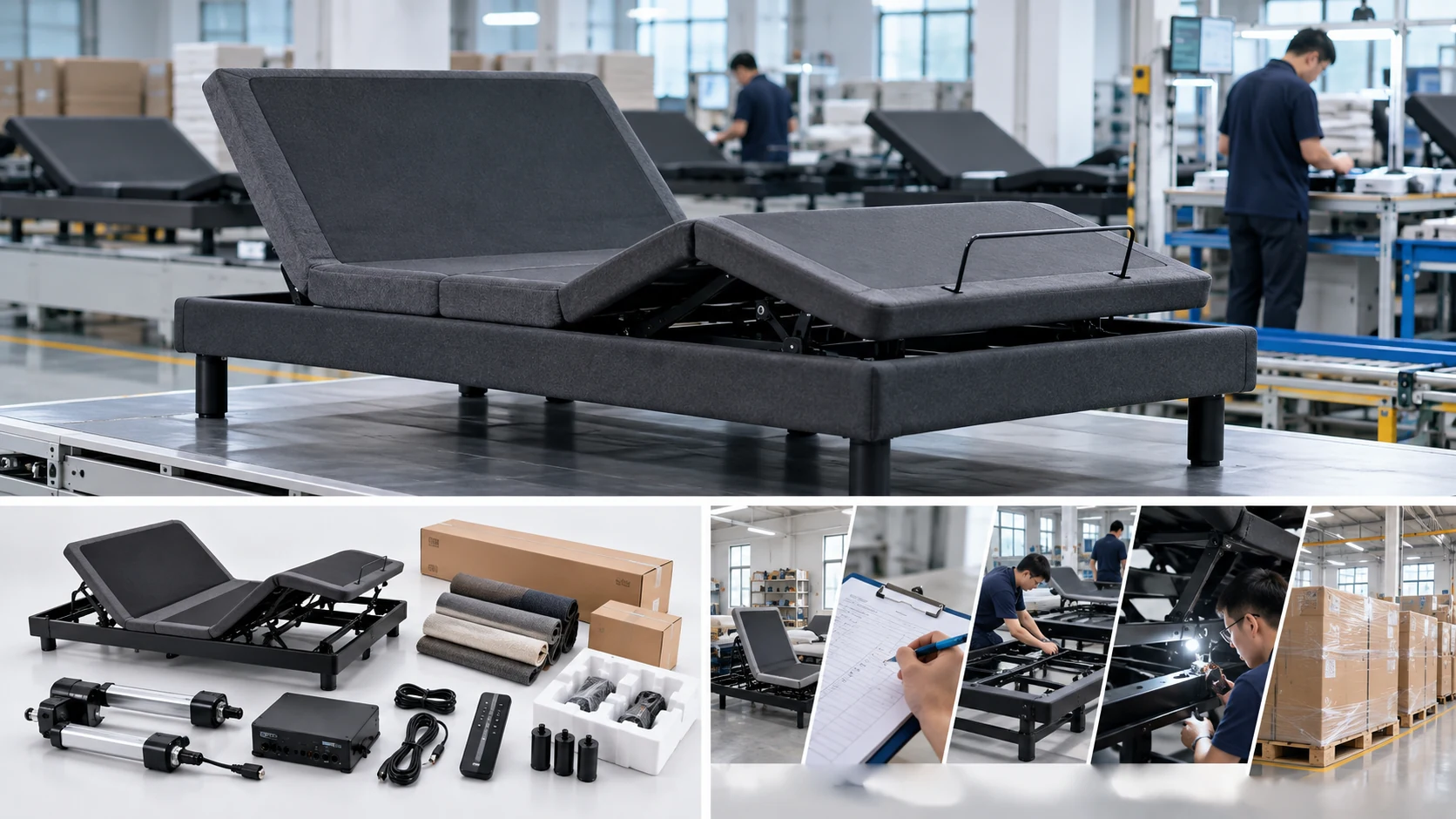
What Should B2B Buyers Check Before Choosing a Supplier?
| Validation Area | Key Question |
|---|---|
| Product Fit | Can the supplier configure the base for your market and channel? |
| OEM/ODM | What can actually be customized? |
| Motor & Controls | Are components clearly specified and serviceable? |
| Structure | How are load, stability and movement validated? |
| Compatibility | Will it work with your mattress and bed-frame program? |
| Compliance | Does documentation match the actual configuration and market? |
| Sampling | Can the approved sample become a production reference? |
| Quality Control | How is consistency controlled during mass production? |
| After-Sales | Are replacement parts identifiable and available? |
| Commercial Terms | Are MOQ and lead time based on the final configuration? |
Introduction
For mattress companies, furniture brands, distributors, and retailers, sourcing an adjustable bed base from China is not simply a matter of comparing prices and selecting a model from a catalog.
The real question is whether a supplier can consistently deliver the right product configuration, quality level, documentation, packaging, and after-sales support for your target market.
This becomes especially important when adjustable bases are sold under a private label or integrated into a broader mattress or smart sleep program. Once motors, control systems, moving structures, upholstery, packaging, and market-specific requirements are involved, a small specification difference can become a much larger issue during mass production.
Before requesting samples or comparing quotations, B2B buyers should evaluate potential suppliers across several areas.
1. Start With Your Product Program, Not the Supplier’s Catalog
A common sourcing mistake is to begin by asking: “What adjustable beds do you have?”
A better starting point is to define what your market actually needs. Before approaching a manufacturer or sourcing partner, clarify:
- Target market and sales channel
- Target retail or wholesale positioning
- Required sizes and expected weight capacity
- Head and foot adjustment requirements
- Motor and control preferences
- Massage, zero-clearance, wall-hugger, USB, lighting, app or other optional functions
- Mattress compatibility and packaging requirements
- Expected order quantity and private-label requirements
A distributor building an entry-level adjustable-base range has very different requirements from a mattress brand developing a premium sleep system. The right supplier should therefore help convert commercial requirements into a workable product configuration rather than simply send a long catalog. Buyers can start that evaluation by reviewing the available adjustable bed base product range.
2. Verify What “OEM/ODM” Actually Means
Many suppliers use OEM/ODM as a general sales term, but the actual level of customization can vary significantly. For one supplier, OEM may mean adding your logo to an existing product. For another, the program may allow changes to product dimensions, frame structure, upholstery, motor and control system, remote-control functions, preset positions, massage configuration, USB or lighting options, legs, accessories, packaging, instruction manuals, labels and branding.
Before requesting a sample, identify which elements are genuinely configurable and which require new engineering, tooling, testing, or higher order quantities. Every additional customization can affect MOQ, cost, sampling time, lead time, documentation, and production consistency. A mature OEM/ODM discussion should therefore begin with a configuration sheet, not just a product photo.
3. Evaluate the Motor and Control System as a System
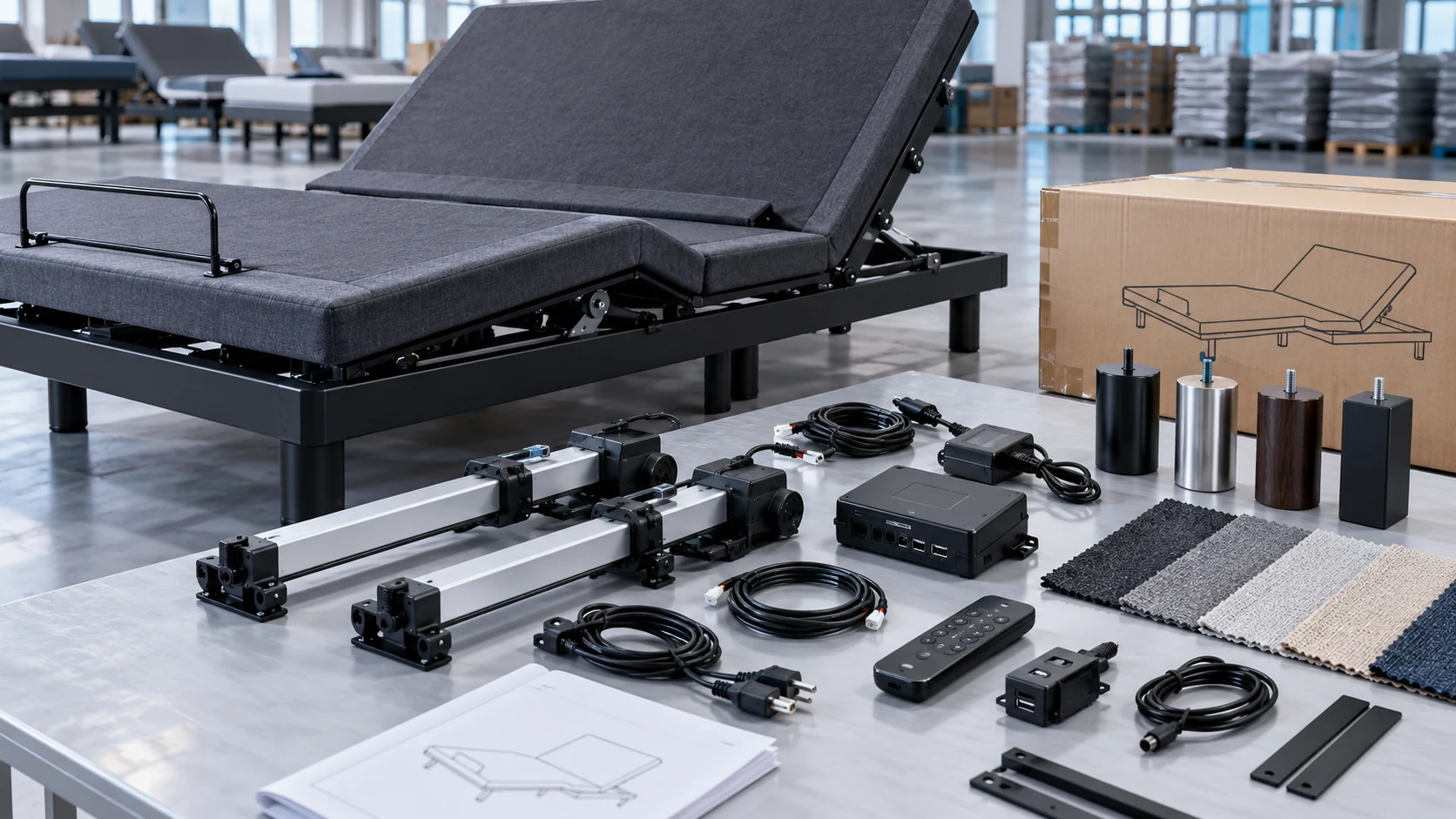
The motor is one of the most visible specifications in an adjustable bed quotation, but buyers should not evaluate it in isolation. The complete motion system can include motors, a control box, power supply, remote control, wiring, synchronization components, massage components, and sensors or smart-control modules.
Ask which components are used in the quoted configuration and whether alternative options are available. Two adjustable bases may look almost identical in photos while using different motor, controller, wiring, or mechanical configurations. That difference can influence noise, movement consistency, available functions, serviceability, replacement-part planning, and overall cost.
For private-label programs, buyers should also clarify how replacement motors, remotes, control boxes, and other electrical components will be identified and supplied after the initial order.
4. Do Not Compare Weight Capacity Without Understanding the Structure
A high weight-capacity number can look attractive on a specification sheet, but the number alone does not explain how an adjustable base performs. Buyers should understand how capacity is defined, whether the stated load is static or related to operation, how the frame distributes load, how moving sections behave under load, whether the mattress and sleepers are included, and what test method or internal validation supports the specification.
Frame geometry, steel structure, joints, brackets, motors, linkage points, and support layout all contribute to final performance. Review weight capacity together with the complete mechanical structure, not as an isolated marketing number. The adjustable bed base weight-capacity guide explains the checks that should sit behind a quoted number.
5. Check Mattress and Bed Frame Compatibility Before Sampling
Mattress compatibility
Confirm whether the intended mattress construction can flex repeatedly with the adjustable platform. Relevant factors may include mattress construction, thickness, foam or spring configuration, edge design, and overall flexibility. This is especially important for mattress companies planning to sell the adjustable base as part of a complete sleep package. Review the existing mattress compatibility considerations for adjustable bases before approving a sample.
Bed frame compatibility
If customers are expected to place the adjustable base inside an existing decorative bed frame, check external dimensions, internal clearance, leg configuration, platform height, cross-support interference, and headboard or footboard clearance. The bed-frame compatibility guide details the static and moving clearances to validate.
If the program requires a zero-clearance installation, confirm that the selected base is specifically designed for that installation method. Never assume that every adjustable base will fit every existing bed frame simply because both products use the same nominal mattress size.
6. Decide Whether Wall-Hugger Functionality Is Commercially Necessary
Wall-hugger designs move the sleeping platform toward the head of the bed as the upper section rises. For certain premium retail, hospitality, or bedroom configurations, this can help users remain closer to bedside furniture.
However, wall-hugger functionality should not automatically be specified for every product program. It can introduce additional mechanical complexity and may affect product structure, weight, cost, packaging, assembly, and service requirements. Buyers should therefore ask a commercial question first: Does the target customer value this feature enough to justify the additional product complexity and cost? The wall-hugger adjustable bed base guide helps frame that decision.
7. Match Compliance Documentation to the Exact Product and Market
“Do you have CE?” is usually not enough as a compliance question. The documentation required for an adjustable bed base can depend on destination market, product configuration, electrical components, wireless functions, intended use, and customer requirements.
Provide the target market and final configuration before asking the supplier to confirm applicable documentation. More importantly, verify whether the documents provided correspond to the components and configuration being quoted. If motors, control boxes, wireless modules, power supplies, or other electrical components change, the relevant documentation may also need review.
Products intended for medical or healthcare use require a separate level of regulatory evaluation and should not be treated as ordinary consumer adjustable furniture. The correct sourcing sequence is Market → Intended Use → Final Configuration → Applicable Requirements → Supporting Documentation—not simply Supplier → Certificate List.
8. Review the Sample as a Pre-Production Reference
A sample should not be treated only as a demonstration product. For B2B sourcing, it should help establish what mass production is expected to reproduce.
Structure
Check frame rigidity, moving joints, welding or fastening points, platform alignment, legs, brackets, and overall stability.
Motion and controls
Operate the head and foot sections repeatedly. Observe smoothness, synchronization, unusual vibration, mechanical interference, and noise changes under load. Test all remote functions, presets, massage modes, lighting, USB functions, app control, or other selected features.
Mattress interface, appearance and packaging
Place the intended mattress construction on the base and evaluate movement throughout the full adjustment range. Check upholstery, stitching, visible hardware, surface finish, labels, and other details that affect retail presentation. Do not ignore the carton: for international B2B programs, packaging affects freight efficiency, warehouse handling, installation, e-commerce suitability, and damage rates. Document agreed changes after sample evaluation before mass production begins.
9. Ask How Quality Is Controlled During Mass Production
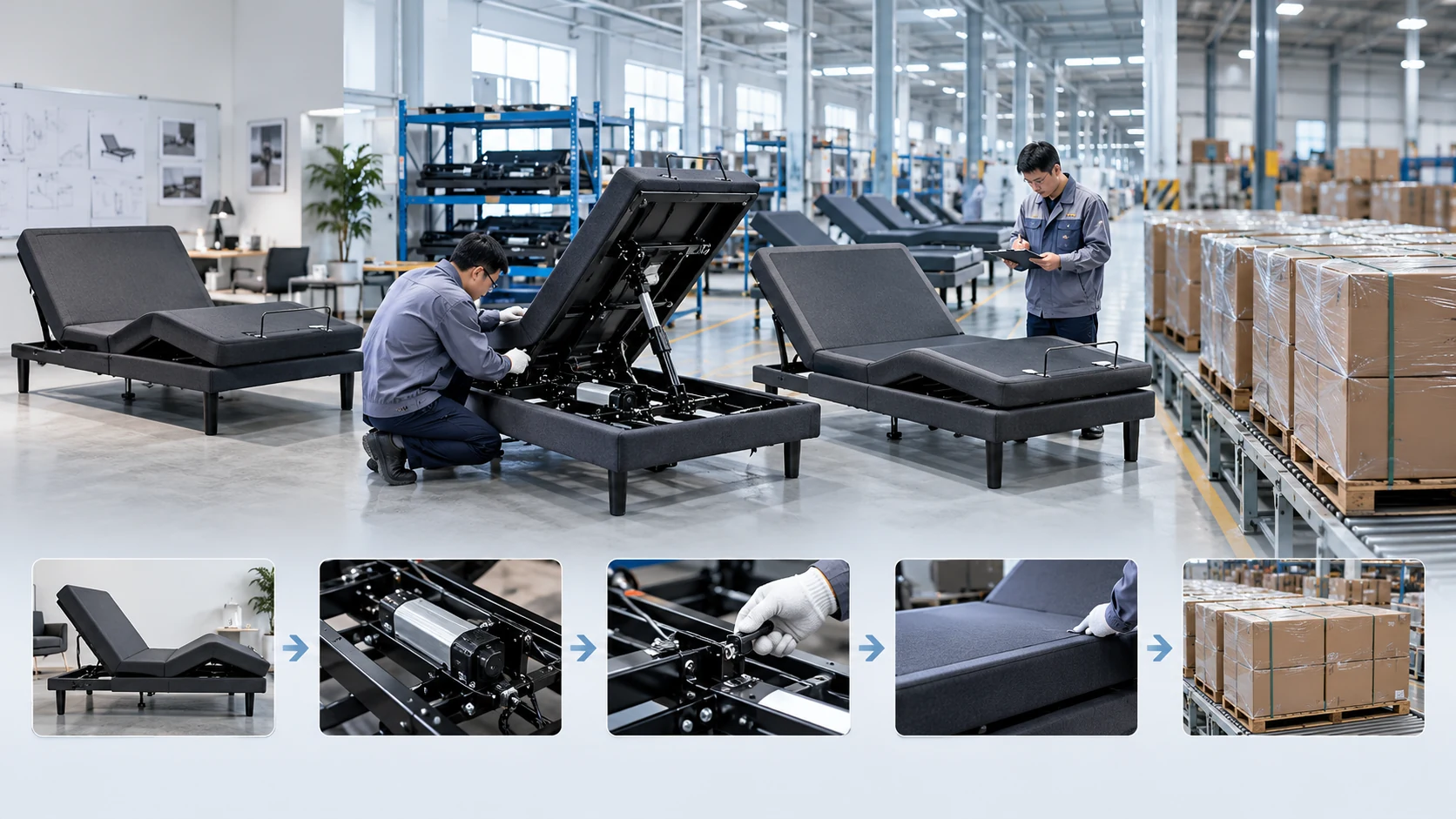
A good sample does not automatically guarantee a good production order. The more important question is: How will the approved configuration be reproduced consistently?
Ask the supplier or sourcing partner how they control incoming components, frame and structural production, motor and control-system matching, assembly, functional testing, appearance inspection, packaging, and final inspection. For customized programs, maintain a clear approved specification covering critical components and functions. This reduces the risk of unauthorized substitutions or misunderstandings during production. For larger orders, pre-shipment inspection or third-party inspection may also be appropriate depending on the project.
10. Evaluate After-Sales Support Before You Need It
Adjustable bases contain more serviceable components than conventional bed frames. Typical replacement items can include remote controls, power supplies, control boxes, motors, cables, massage components, and hardware.
Before placing an order, clarify warranty terms, spare-parts availability, replacement-part identification, troubleshooting support, installation documentation, and the response process for quality claims. For distributors and retailers, this matters because after-sales problems ultimately affect the relationship with the end customer. A slightly lower purchase price may not be an advantage if replacement parts are difficult to identify or obtain.
11. Compare MOQ and Lead Time Only After the Configuration Is Defined
MOQ and lead time are important, but they should not be evaluated separately from the product specification. An existing adjustable-base configuration may support a relatively small trial order, while a customized project involving new upholstery, controls, packaging, tooling, or structural changes may require different commercial terms.
Before comparing quotations, make sure suppliers are quoting against the same model, size, motor configuration, functions, upholstery, accessories, packaging, branding requirements, and quantity. Otherwise, two apparently different prices may actually represent two different products.
Adjustable Bed Base Supplier Evaluation Checklist
| Area | What to Validate |
|---|---|
| Target Market | Country, channel and intended customer |
| Product Positioning | Entry, mid-range or premium |
| Structure | Frame design, adjustment mechanism and installation |
| Sizes | Required market-specific dimensions |
| Weight Capacity | Definition and supporting validation |
| Motor System | Motor, control box, power supply and wiring |
| Controls | Remote, presets, app and optional functions |
| Mattress Compatibility | Intended mattress construction and thickness |
| Bed Frame Compatibility | Dimensions, clearance and installation |
| OEM Scope | Branding, upholstery, functions, structure and packaging |
| Compliance | Documentation matched to market and configuration |
| Sample | Approved specification and functional validation |
| Quality Control | Production and final inspection process |
| Packaging | Export, retail, warehouse or e-commerce requirements |
| MOQ | Based on final configuration |
| Lead Time | Sampling and mass-production schedule |
| Spare Parts | Motors, remotes, controllers and other service components |
| Warranty | Scope, duration and claim process |
| Logistics | Packing dimensions, loading and shipping coordination |
The objective is not to find the supplier with the longest feature list. It is to identify a supply program that can deliver the same approved product consistently from sample to repeat order.
How KFY SMART Supports Adjustable Bed Base Programs
KFY SMART works with mattress companies, furniture brands, distributors, retailers, and other B2B partners developing adjustable-bed and smart-sleep product programs.
Rather than treating sourcing as a catalog-selection process, we help buyers define the product around their target market and commercial requirements. Depending on the project, support can include:
- Product and configuration selection
- OEM/ODM coordination
- Branding and private-label requirements
- Motor and control options
- Structure and upholstery coordination
- Packaging requirements
- Quality-control and inspection coordination
- Compliance-documentation review by configuration and market
- International delivery coordination
Production is carried out through our long-term strategic manufacturing partners, while KFY SMART coordinates product development, quality control, inspection, and export support.
Our adjustable bed base range includes multiple product levels that can be evaluated according to market positioning and project requirements.
Standard MOQ can start from 20 pieces, with typical lead times around 45 days, but final MOQ, production schedule, customization scope, and documentation depend on the selected product configuration and project requirements.
Before You Request a Quote
A useful B2B quotation starts with a useful sourcing brief. Before contacting an adjustable bed base supplier, prepare at least:
- Target market
- Buyer type or sales channel
- Required size
- Target product level
- Required functions
- Estimated order quantity
- OEM/private-label requirements
- Packaging requirements
- Expected launch or delivery schedule
The more clearly these requirements are defined, the easier it becomes to compare suppliers on product fit, engineering capability, quality control, commercial terms, and long-term support—rather than price alone.
Plan Your Adjustable Bed Base Program
Planning an adjustable bed base program? Send us your target market, required size, functions, estimated quantity and private-label requirements. We can help review the configuration before sampling and quotation.