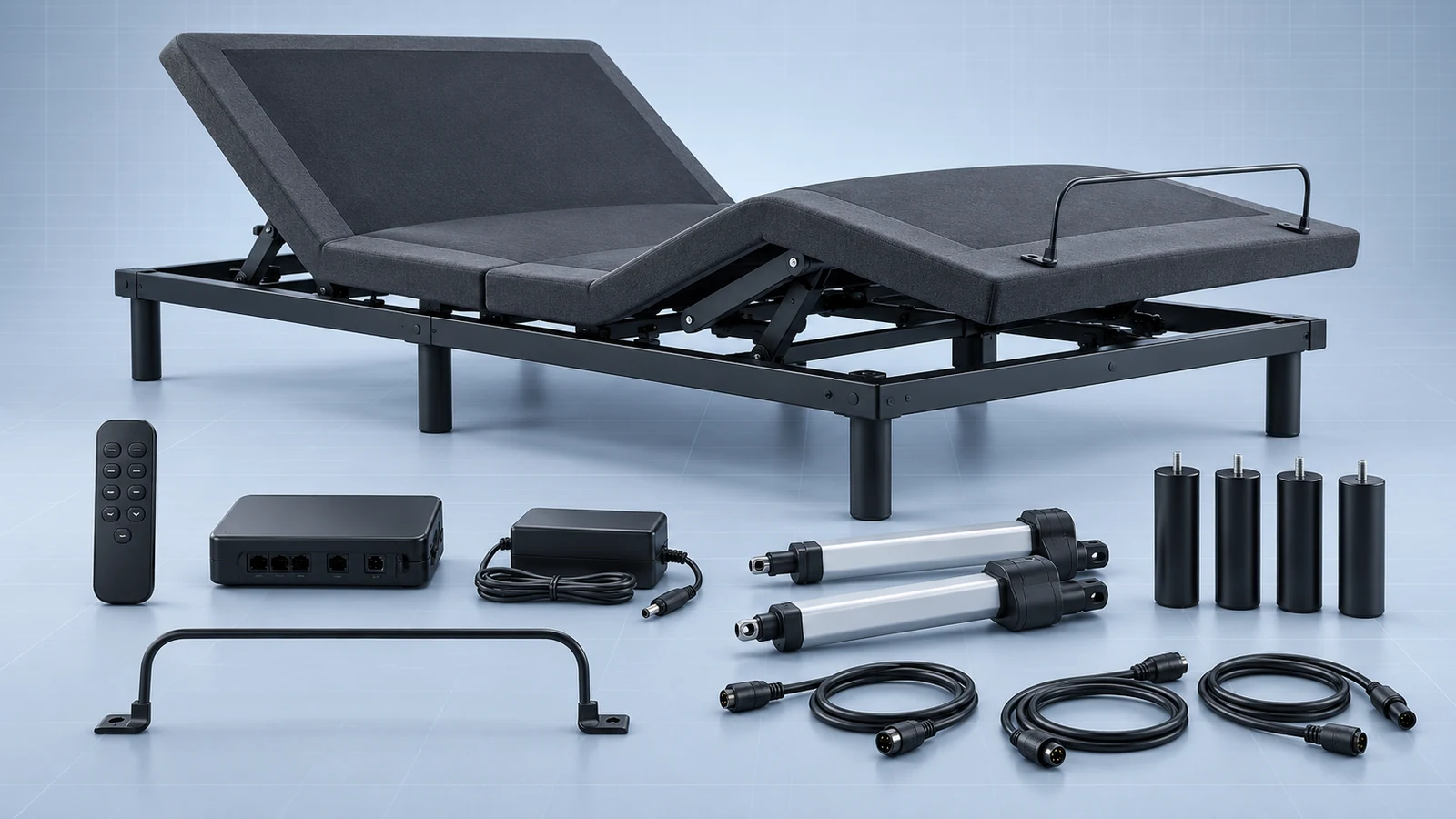
For a mattress brand, furniture company, importer or retailer, after-sales planning should begin during sourcing—not after the first field failure. An adjustable base may combine mechanical, electrical and control components, and a replacement decision is only useful when the part can be matched to the exact product configuration.
The B2B principle is straightforward: manage adjustable bed base replacement parts by finished-product identity, component identity and revision compatibility—not by appearance alone. Before mass production and the first bulk shipment, define what can be serviced, how a part will be identified and who will support the replacement process.
Why Spare-Parts Planning Starts Before the First Bulk Order
After-sales responsibility can affect product architecture. The way a base is assembled, how accessible its control components are, and whether a module is serviceable independently all influence how a brand will handle support after delivery.
Planning early gives an OEM/ODM buyer and supplier a chance to agree on a service BOM, identification records, evidence needed for a claim, replacement approval and logistics. It also helps a retailer or distributor identify whether a reported issue relates to the base, a control accessory or an installation condition before the wrong item is shipped.
Replacement lead time can affect the end-customer experience, but there is no single lead-time or stock rule that applies to every program. The right plan depends on product complexity, destination market, local service capability, replenishment arrangements and the responsibilities agreed in the commercial documents.
Common Adjustable Bed Base Replacement Parts
The table below is a planning checklist, not a promise that each base contains every category. Confirm serviceability and part identity against the approved model documentation.
| Component | Typical role | What buyers should record | Compatibility check |
|---|---|---|---|
| Remote control | Provides the user input for base movement and available features. | Remote part number and revision; paired base model; supported functions. | Confirm the exact control system, pairing method and approved remote version. |
| Control box / electronic module | Routes control input to the supported base functions and connected components. | Module part number and revision; firmware or configuration identifier where used; connector map. | Match the base generation, lift components, remote and required channels/functions. |
| Lift motor / actuator | Creates head or foot movement where the design has separately serviceable actuators. | Part number and revision; assigned movement section; interface details from the service BOM. | Confirm it is intended for that model and control architecture; do not infer interchangeability from a similar housing. |
| Power supply / power cord | Supplies electrical power to the approved system. | Approved supply identifier, electrical specification, plug and cable details. | Verify the specified power component and connection for the exact model; connector fit alone is not enough. |
| Leg / leg extension | Supports the base and, for some designs, changes its installed height. | Part number, attachment style and documented dimensions. | Check the frame interface and configuration; do not assume similar threads or shapes are equivalent. |
| Mattress retainer | Helps limit mattress movement at the foot end when included in the design. | Retainer type, attachment points, orientation and part number. | Match the retainer and frame interface to the specific base. See the B2B guide to adjustable-base mattress retention. |
| Sync / connection cable | Connects designated components or synchronizes split configurations when supported. | Cable part number, end type, length or routing requirement if specified. | Confirm the intended port, function and configuration in the model documentation. |
| Brackets / hardware | Attaches or supports components according to the frame design. | Part number, drawing/revision and assembly location. | Validate against the current assembly drawing and approved frame revision. |
| Feature-specific module | Supports a selected feature, such as an optional light or massage function, where fitted. | Option code, module identifier and revision. | Confirm the feature set and control architecture on the shipped SKU. |
Use this table to start a model-specific service BOM. Some components may be integrated, supplier-service-only or not separately replaceable.
Why Similar-Looking Parts May Not Be Interchangeable
Two parts can look similar and still differ in ways that matter to fit, control or operation. Depending on the component and product, the difference may relate to a product generation, production revision, firmware or control architecture, connector format, electrical specification, supported function, pairing protocol, base size or regional version.
Not every difference applies to every part. The practical rule is that visual similarity is not sufficient evidence of interchangeability. Before approving a replacement, match it to the finished-product model and revision, then ask the supplier to confirm the exact compatibility basis.
This is particularly important when an OEM/ODM program changes a component while retaining the same retail model name. A revision history and documented approved substitutions help a distributor avoid mixing stock that only appears equivalent.
Part Number, Revision and Serial Number Management
Set up an identification record that connects each service part to the finished base it supports. A recommended record can include:
- finished-product model and size/configuration;
- production batch or date and base serial number, where assigned;
- component part number and revision;
- supplier or component manufacturer identifier, where available;
- connector type and relevant electrical specification;
- supported functions and control-system relationship;
- approved replacement or substitution history.
Manufacturers do not all use the same serial-number format or location. Confirm the identifying fields and label location in the supplier’s documentation. As one example, Leggett & Platt’s customer FAQ directs owners to have the adjustable-base serial number ready when requesting a replacement remote; split configurations may have separate base serials.
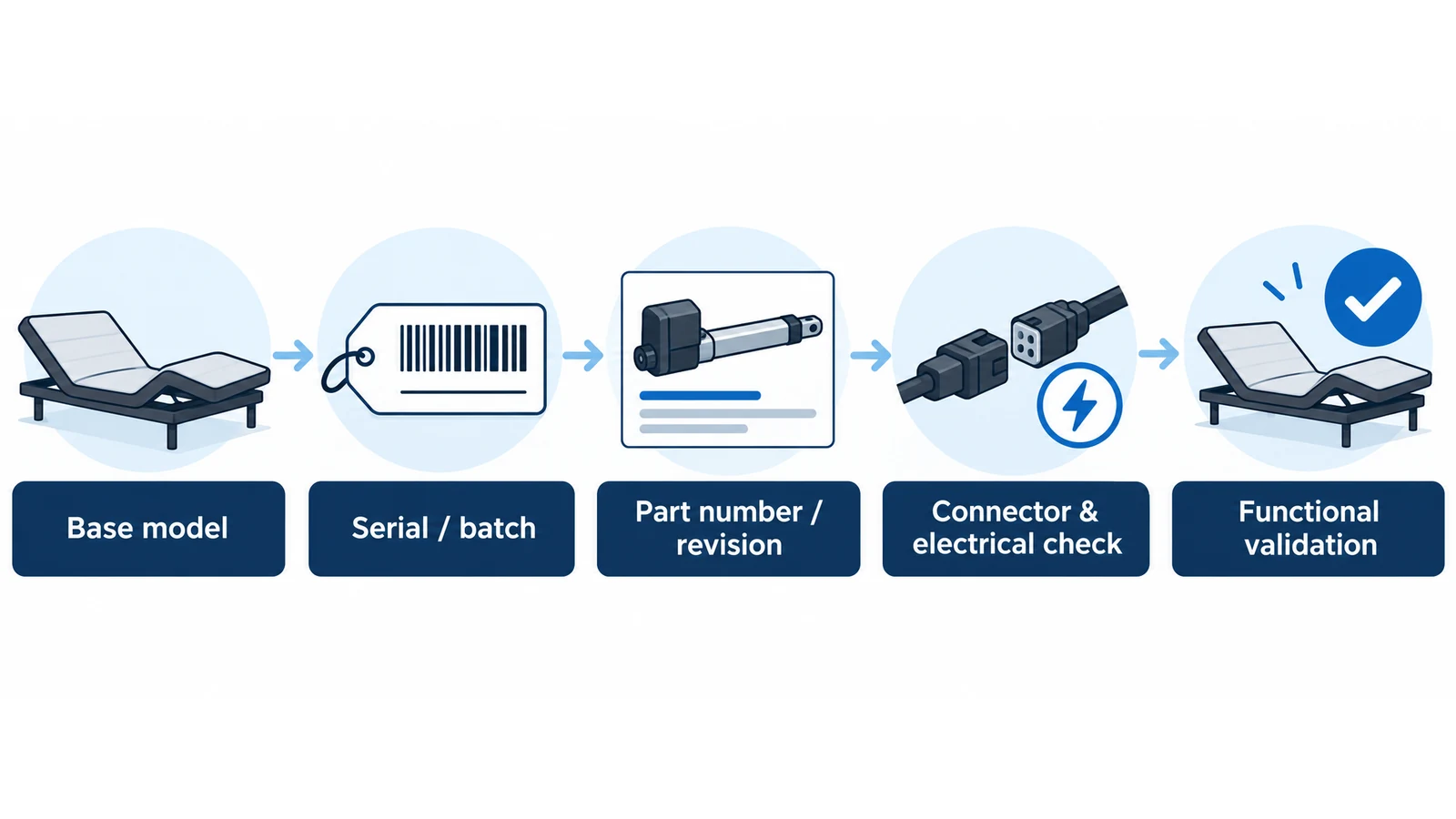
For broader configuration records, see the adjustable bed base weight-capacity validation guide; record the approved base model and configuration alongside its service components.
Replacement Remote Compatibility
Do not treat adjustable-bed replacement remotes as universal accessories. A remote may be tied to a specific base model, control system, generation, revision, supported feature set or pairing process. A keypad that looks familiar does not establish that it will communicate with another control box.
As one manufacturer example, Ergomotion’s Rio 4.0 replacement-remote listing distinguishes Version 1 and Version 2 remotes, states that they are not interchangeable and asks buyers to confirm the bed’s production timing and remote version. Leggett & Platt likewise advises customers to have the base serial number ready to help identify the correct replacement remote.
For a B2B program, record the base and remote identifiers together, confirm the approved pairing method with the supplier and validate a replacement sample before releasing stock for service. Follow the applicable manufacturer instructions; this guide does not provide bypass or pairing-circumvention steps.
Control Box and Motor Compatibility
A control box and lift motor should be treated as a matched system unless the supplier documents a compatible alternate. Before approving either part, confirm the system architecture, connector interfaces, supported movement channels, electrical requirements and relationship between the motor and control-box revisions.
Diagnosis also matters. A base symptom does not, by itself, prove which component needs replacement. Follow the model’s approved service process to identify the likely subsystem, then verify the replacement against the service BOM or supplier documentation. Do not claim universal motor or control-box interchangeability.
Where a module is difficult to access or replace, discuss the service approach during sampling. The OEM sampling guide covers why buyers should validate configuration and operation before mass production.
Power Supply and Cable Compatibility
For a power component, check the approved electrical specification as well as connector fit. Record the specified supply, cable and connection details for the model; check routing, strain relief and service access against the assembly documentation.
A connector that physically mates does not automatically prove that a power supply, cable or control interface is suitable. Confirm the complete replacement combination with the supplier. The official Ergomotion parts catalogue, for example, presents power components, remotes, sync cords and other accessories as identified products rather than as generic interchangeable items.
For physical assembly context, use the relevant model instructions and the site’s adjustable bed base assembly guide; video or general assembly content should not replace model-specific service directions.
What Spare Parts Should Be Defined With the First Order?
There is no universal spare-parts ratio suitable for every program. A percentage chosen without model and service context can overstock the wrong revision while leaving the needed component unavailable.
Build the initial plan around the program’s actual operating conditions:
- order quantity and the number of active SKUs;
- product complexity and the number of serviceable modules;
- destination market and local service capability;
- expected replenishment lead time confirmed for the program;
- warranty policy, claim evidence and responsibility split;
- modularity and access to replaceable components;
- component commonality across SKUs, verified by the supplier.
Then choose which parts should ship with the initial bulk order, which can sit in a local service pool and which should be ordered only after diagnosis. The component mix and quantity should be confirmed for the specific project—not represented as a standard KFY SMART kit or fixed percentage.
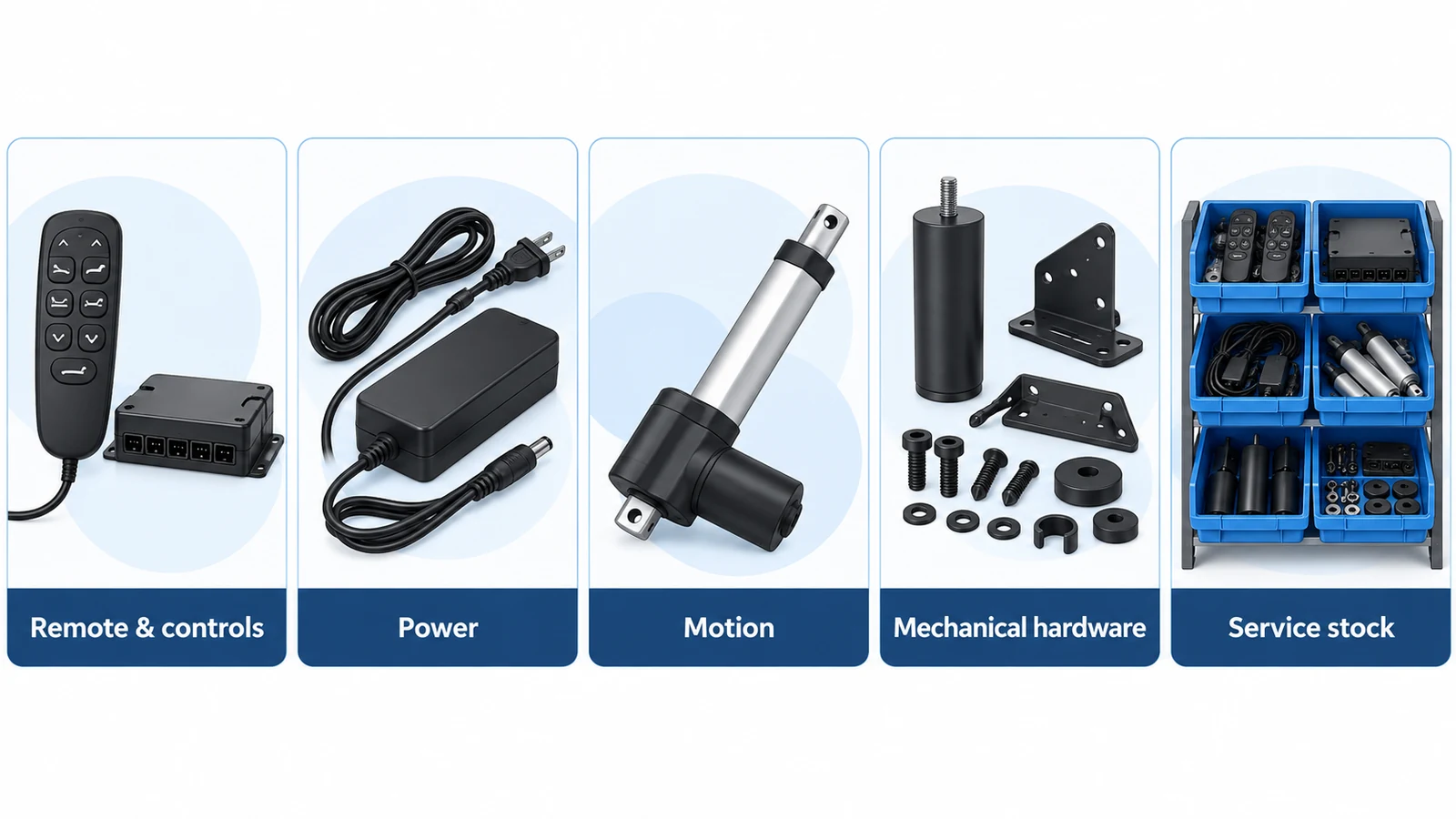
Service Stock: One Common Pool or SKU-Specific?
A common service pool may be practical when the service BOM confirms that a component is shared across the relevant SKUs and revisions. Buyers should document the shared part number, approved substitutions and applicable models so the pool remains traceable.
SKU-specific stock is safer when products differ in revision, connector system, electronics, control functions, remote pairing or mechanical interface. If those details are not verified, keep stock separate until the supplier confirms the relationship. Do not infer compatibility because components share an appearance, name or retail family.
Replacement Parts vs. Complete Module Replacement
There is no single service remedy that fits every fault or product. B2B buyers and suppliers should consider diagnostic certainty, field-service difficulty, component access, labor complexity, shipping cost, customer downtime and warranty responsibility.
A component-level part can be appropriate when the issue is isolated and the replacement is approved. A complete module may be more practical when servicing individual internals is not supported by the design or instructions. In other cases, authorized service, troubleshooting guidance or another contractual remedy may be appropriate. Define the decision path before launch and follow the model’s service documentation.
Warranty Parts vs. Paid After-Sales Parts
Document the warranty replacement process separately from non-warranty parts support. Agree what evidence is required, who reviews it, who authorizes a replacement, how logistics are handled, and which service instructions apply. For paid spares, define ordering, pricing, payment, shipping and revision confirmation in the project terms.
Also agree a project-specific replacement-part availability period and a discontinued-revision strategy; neither should be assumed to be universal. For the broader allocation of warranty and after-sales responsibilities, review the adjustable bed base warranty B2B guide.
B2B Replacement-Parts Checklist
Before production approval or the first bulk shipment, confirm the following for each active configuration:
- Final product model, size and feature configuration.
- Approved component BOM and service BOM.
- Part numbers and revision tracking for serviceable items.
- Remote and control-box compatibility, including pairing or programming instructions.
- Connector details and electrical specifications where relevant.
- Serial-number, production-batch or order traceability fields and label locations.
- Which components are shared across SKUs—and written evidence of compatibility.
- Project-specific service-stock strategy and the basis for selecting parts.
- Packaging and identification for spare parts shipped with an order.
- Supplier-approved service instructions and required evidence for claims.
- Replenishment lead-time expectations confirmed for the project.
- Warranty responsibility, logistics and labor handling.
- Paid spare-parts ordering policy and project-specific availability period.
- Discontinued-revision and approved-substitution strategy.
- Sample replacement validation before bulk-order release.
How to Build a Spare-Parts Plan With an OEM/ODM Supplier
- Freeze the product configuration. Identify the approved model, sizes, control system and feature options.
- Identify serviceable modules. Confirm what the service process permits to be replaced separately.
- Create a service BOM. Link components and revisions to each finished-product configuration.
- Define identification fields. Decide which model, serial, batch and part details will appear in service records.
- Validate a sample replacement. Check the proposed part and the approved service process against a sample base.
- Agree initial stock. Use order, market, service and replenishment factors instead of a universal ratio.
- Document the warranty workflow. Agree evidence, decision ownership and logistics.
- Record revision changes. Keep approved substitutions and model relationships current.
- Review field feedback. Update service planning when project evidence supports a change.
When comparing the underlying OEM/ODM capability, begin with the adjustable bed base product range and confirm each project detail with the supplier rather than assuming one service architecture covers every model.
Planning Spare Parts for an Adjustable Bed Program?
Share your target model, expected order volume and after-sales requirements. KFY SMART can help review which components should be included in the spare-parts plan before mass production.
FAQ
What are the most common adjustable bed base replacement parts?
Depending on the model and service design, common categories can include remotes, control modules, lift actuators, power components, legs, mattress retainers, sync cables and selected hardware. Confirm the actual service BOM for the approved base.
Are adjustable bed remotes universal?
No universal compatibility should be assumed. Remote compatibility can depend on the base model, control system, production revision, pairing method and supported functions. Match the remote to the service BOM or model documentation.
How do I identify the correct replacement remote for an adjustable base?
Record the base model, serial or batch details, existing remote part number and revision, and control-system version. Ask the supplier to confirm compatibility and pairing before issuing a replacement.
Can a control box be replaced with a different model?
Only when the supplier confirms that the alternate control box is compatible with the base revision, motors, connectors, remote and required functions. A similar enclosure or connector alone does not establish compatibility.
Should B2B buyers order spare parts with the first bulk shipment?
Plan the question before the first shipment, then set a project-specific stock mix using order size, configuration complexity, destination service capacity, replenishment lead time and warranty responsibilities. There is no universal spare-parts ratio for every program.
How should OEM buyers manage replacement-part revisions?
Link each part number and revision to the finished-product model and production batch, document approved substitutions, and validate replacement samples when components change. Do not pool revisions unless the supplier confirms compatibility.
Plan Compatibility Before the Service Call
For B2B buyers, an adjustable bed base spare-parts plan is part of the product program—not an afterthought. Identify the model, component and revision; confirm compatibility using approved documentation; and agree stock and service responsibilities in the context of the target market.
That preparation helps brands, importers, distributors and OEM/ODM partners respond with the right part or remedy instead of relying on appearance, generic assumptions or an arbitrary stock percentage.
Sources & References
- Ergomotion — Parts & Accessories
- Ergomotion — Replacement Remotes & Electronics
- Ergomotion — Rio 4.0 Replacement Remote (version information)
- Leggett & Platt Adjustable Beds — Frequently Asked Questions (serial number and replacement remote guidance)
- Leggett & Platt Adjustable Beds — Adjustable Base Setup Guide