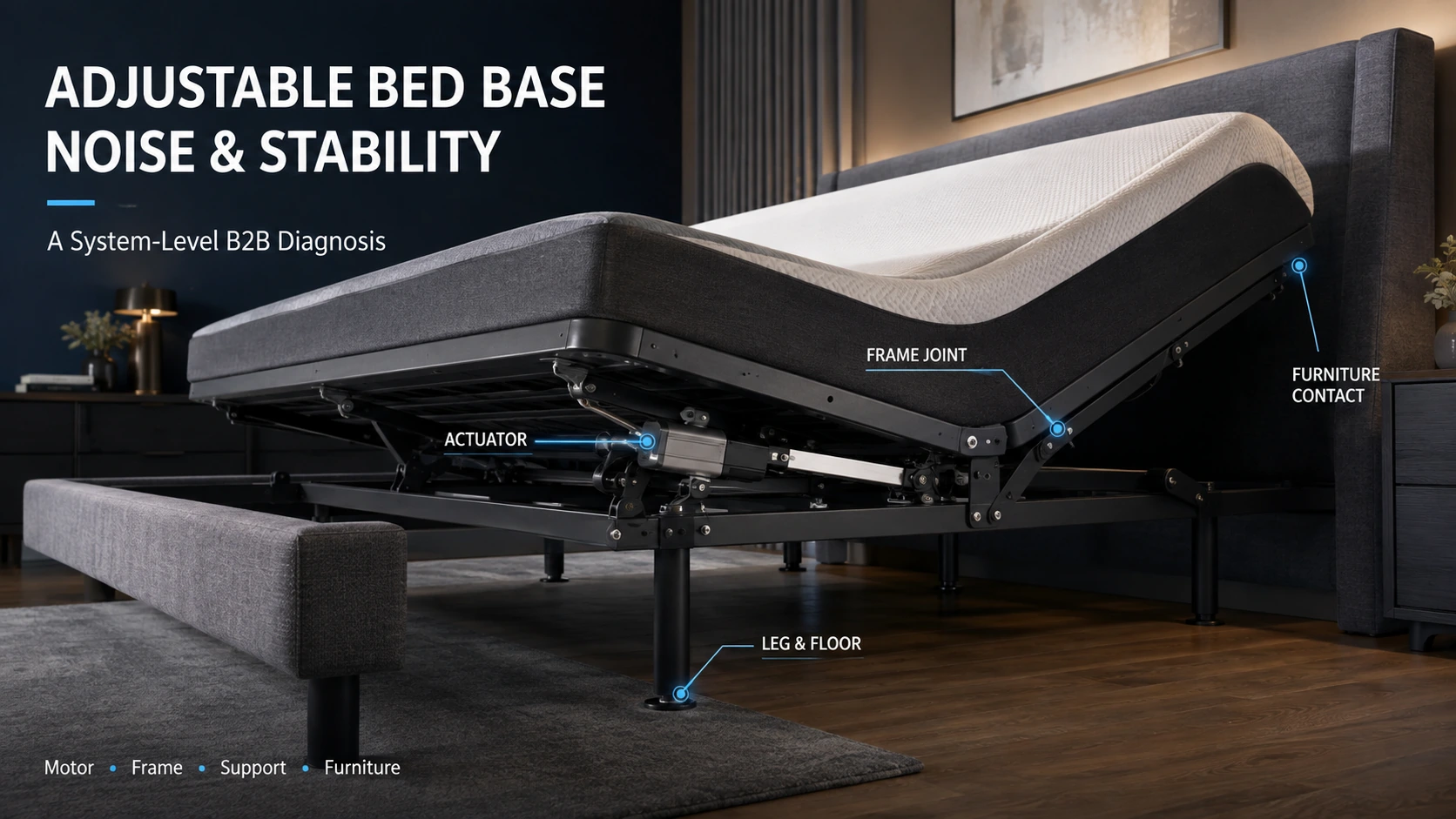
A quiet motor does not automatically make a quiet adjustable bed.
For mattress brands, furniture companies, retailers, distributors, hotels and senior-care projects, adjustable-bed noise is better understood as a complete-system performance issue rather than simply a motor specification.
An adjustable bed base combines moving mechanical components with a mattress, supporting structure, floor and—very often—surrounding furniture.
That means a squeak, click, rattle, vibration or wobble may originate from several different interfaces:
Motor / Actuator
+ Frame & Joints
+ Fasteners
+ Legs & Floor
+ Mattress
+ Furniture
+ Installation
The important sourcing question is therefore not simply:
“Is the motor quiet?”
A better question is:
“How does the complete adjustable-bed system behave under load, during articulation and inside the intended installation environment?”
Quick Answer: Why Does an Adjustable Bed Base Make Noise?
An adjustable bed base may make noise because of normal actuator operation, relay engagement, frame joints, loose hardware, uneven support, vibration transmission, contact with surrounding furniture or component wear.
Some operating sound is normal.
For example, TEMPUR-Pedic states that clicking from lift-motor relays during engagement can be normal, while Reverie advises checking physical obstructions, loose hardware, hinge points and uneven floor support when unusual grinding, clicking or squeaking occurs.
For B2B buyers, this distinction matters because:
Motor noise is a component characteristic. Finished-bed noise is a system-performance result.
The two should not be treated as the same specification.
Is Some Adjustable Bed Noise Normal?
Yes.
Adjustable bed bases contain actuators, control systems, pivots and other moving components. Mechanical and electrical movement will normally create some operating sound.
The presence of sound alone does not automatically indicate a defect.
For example, certain adjustable bases can produce a brief click when a lift command engages. TEMPUR-Pedic specifically identifies relay clicking during raising or lowering on some models as normal operation.
Likewise, an actuator may produce a light mechanical operating sound while moving the platform. Reverie product documentation also notes that light actuator noise during operation does not necessarily indicate a defect.
The more useful distinction is between:
- predictable operating sound;
- intermittent clicking;
- repetitive squeaking;
- grinding;
- rattling;
- vibration;
- furniture resonance;
- rocking or wobbling.
These symptoms can come from very different parts of the finished bed.
That is why an OEM or ODM evaluation should diagnose where and when a sound occurs, rather than simply labeling the entire product “quiet” or “noisy.”
Where Does Adjustable Bed Base Noise Come From?
Several interfaces can contribute to the acoustic performance of an adjustable base.
1. Motor and Actuator
The actuator provides the force required to raise or lower the articulated sections of the base.
Its perceived sound can vary depending on:
- applied load;
- articulation direction;
- operating angle;
- actuator mounting;
- surrounding frame structure;
- component condition.
This is the most obvious source of operating sound, but it should not automatically be treated as the source of every noise complaint.
When unusual grinding or inconsistent movement occurs, the actuator may need further inspection. However, manufacturer troubleshooting guidance normally recommends eliminating simpler structural and installation causes first.
2. Frame Joints and Mechanical Interfaces
Adjustable bases repeatedly change geometry.
During head or foot articulation, loads move through:
- hinges;
- brackets;
- pivots;
- cross members;
- linkage points;
- actuator mounts;
- fasteners.
If hardware becomes loose or two surfaces move against each other, the result may be a squeak, click or rattle.
Reverie troubleshooting guidance specifically identifies loose bolts or hardware around hinge points as possible causes of adjustable-bed squeaking.
For B2B buyers, hardware and joint design therefore influence both structural performance and perceived acoustic quality.
3. Legs and Floor Contact
A stable adjustable base depends on consistent support.
If the floor is uneven or one support point carries load differently from the others, movement can be introduced into the complete frame.
That movement may be perceived as:
- rocking;
- wobble;
- frame squeaking;
- mattress movement;
- vibration.
Reverie troubleshooting guidance recommends confirming that all legs or casters make solid contact with the floor when investigating unusual noise.
This matters particularly when a product moves from a factory test area to real homes, hotels or apartments where flooring conditions may differ.
4. Surrounding Furniture
Furniture interaction is one of the easiest noise sources to overlook.
An adjustable base may operate quietly as a standalone product but sound different after being installed inside:
- an upholstered bed frame;
- a timber bed surround;
- a headboard system;
- a platform bed;
- a storage bed;
- a project-specific furniture structure.
Possible interaction points include side rails, headboards, footboards, center supports, cross members and storage mechanisms.
Even without direct collision, vibration can travel from the moving base into surrounding furniture.
The furniture can then behave as an additional resonating structure.
Manufacturer troubleshooting documentation recommends checking whether an adjustable base is contacting a wall, nightstand or surrounding object and whether vibration is being transmitted into a bed frame or headboard.
For furniture brands, this creates an important sourcing principle:
Mechanical clearance and acoustic isolation are related, but they are not identical.
A base can avoid physical interference and still transfer vibration into the furniture.
Quiet Motor ≠ Quiet Finished Bed
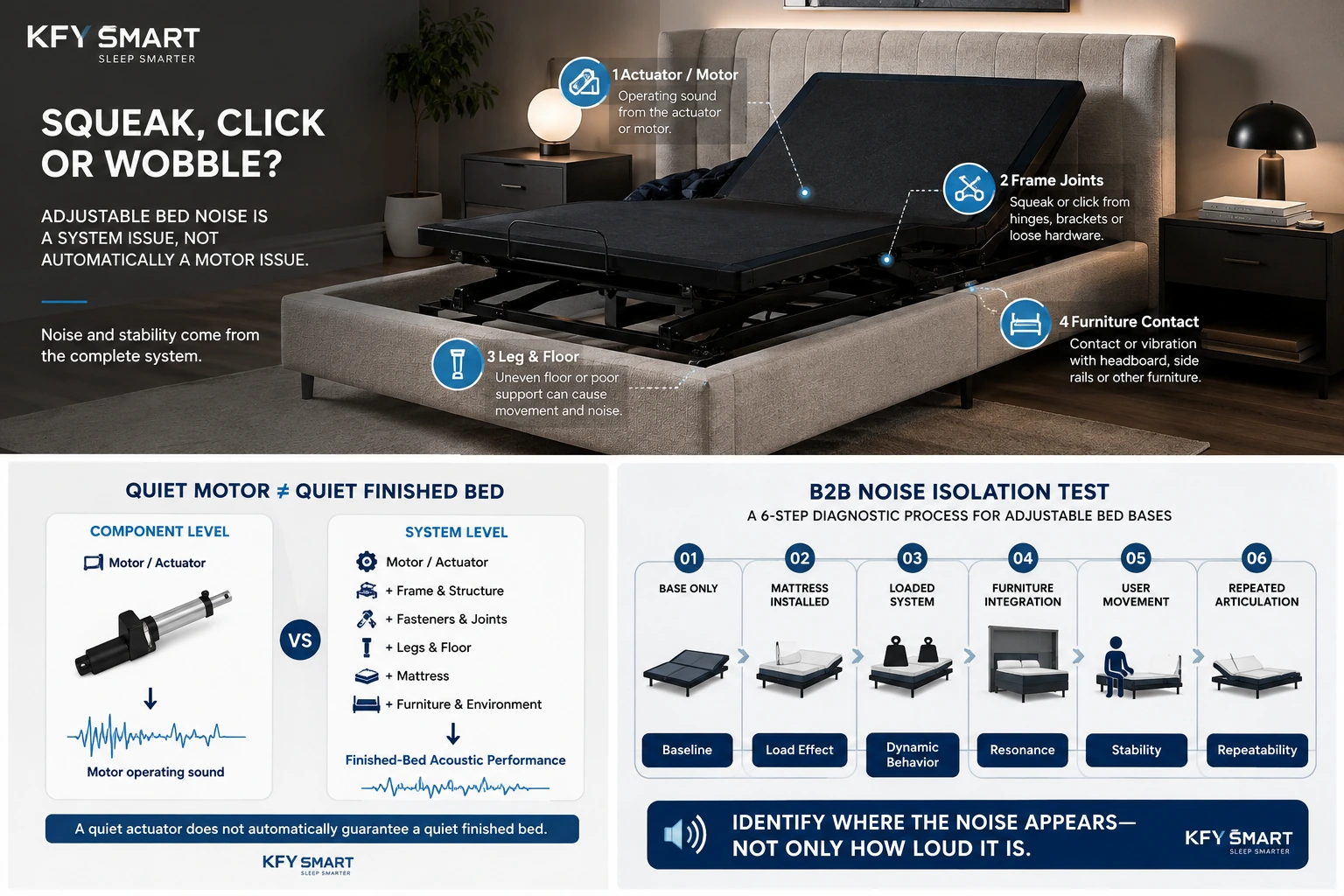
A motor supplier may provide an acoustic specification for the actuator.
That specification can be useful when comparing components.
But the number alone does not describe the final product experience.
The finished acoustic result can be influenced by:
Actuator
+ Frame
+ Fasteners
+ Joints
+ Legs
+ Floor
+ Mattress
+ Furniture
This leads to an important B2B distinction:
Component-Level Acoustic Performance
This evaluates a specific part, such as an actuator or massage motor.
System-Level Acoustic Performance
This evaluates what the customer actually experiences after the adjustable base, mattress, supporting structure and furniture are combined.
A relatively quiet actuator can still become noticeable if vibration is efficiently transferred into a large furniture panel.
Conversely, a sound that appears concerning during diagnosis may sometimes be a normal mechanical operating sound rather than a product failure.
For brands developing private-label programs, the system-level result is therefore often more commercially meaningful than the motor specification viewed alone.
Why Does an Adjustable Bed Base Wobble?
Noise and stability are closely connected.
A structure that moves slightly when its load changes can create contact or vibration even when every major component is still functioning.
Possible contributors to adjustable-bed wobble include:
- uneven floor support;
- inconsistent leg contact;
- loose hardware;
- support geometry;
- frame stiffness;
- surrounding furniture;
- split-base configuration;
- mattress movement;
- dynamic user loading.
A 2026 consumer discussion provides a useful example of why this matters: an adjustable setup was reported to become highly squeaky when elevated, with the sound occurring during entry and normal movement as well as articulation. Attempts to isolate the interface between the base and frame changed the behavior, illustrating how perceived bed noise can involve more than the actuator alone.
For B2B product validation, stability should therefore be considered independently from basic motor operation.
Static Load Capacity Is Not the Same as Dynamic Stability
This distinction is especially important for sourcing teams.
A static load rating tells a buyer how much load a product is designed to support under specified test conditions.
It does not, by itself, describe how the finished bed feels when the load moves.
Real users introduce changing forces when they:
- sit on the edge;
- enter the bed;
- leave the bed;
- turn over;
- reposition;
- raise the head section;
- raise the foot section.
This creates a second useful B2B distinction:
Static Load Capacity ≠ Dynamic Stability
Both need to be considered.
A product may meet its specified load requirement yet still need optimization around support geometry, furniture integration or movement behavior for a particular project.
This is particularly relevant for:
- premium mattress programs;
- furniture-integrated adjustable beds;
- split configurations;
- hospitality installations;
- senior-care and home-care projects.
A Practical B2B Noise Isolation Test
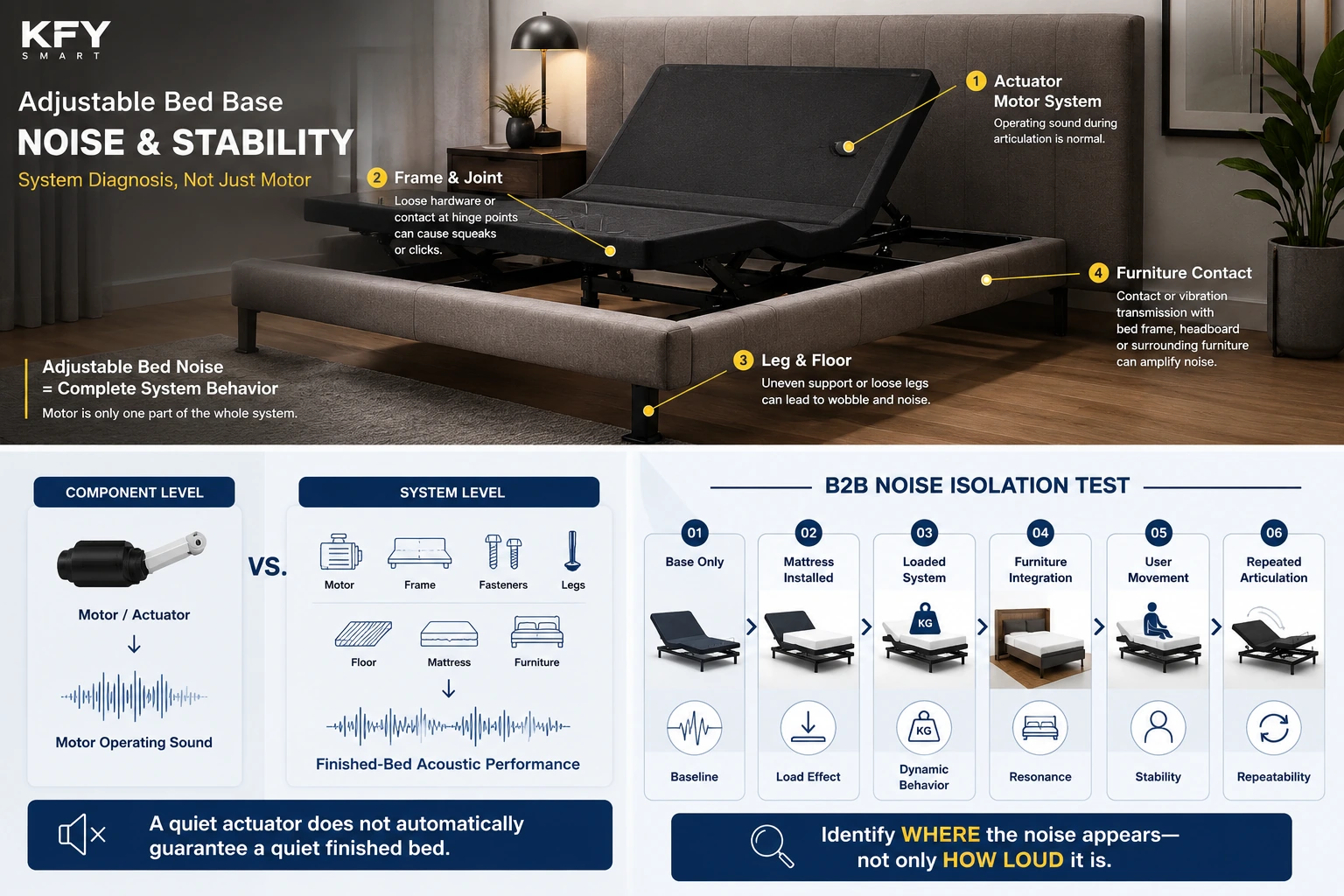
Instead of recording only:
Noise — PASS / FAIL
a more useful approach is to identify the condition in which the sound appears.
A staged test can help separate component noise from system interaction.
Stage 1 — Base Only
Operate the adjustable base in the approved test configuration before surrounding furniture is introduced.
The objective is to establish a baseline.
Observe:
- head articulation;
- foot articulation;
- return to flat;
- motor sound;
- mechanical clicks;
- frame sound.
This becomes the reference condition.
Stage 2 — Mattress Installed
Install the mattress intended for the program.
Repeat the same movement sequence.
Mattress construction, weight and flexibility alter the load carried by the moving platform, so the actual production mattress should be evaluated whenever possible.
Stage 3 — Loaded System
Evaluate the base under representative loads according to the project's approved test procedure.
Compare the result with the unloaded condition.
Look for changes in:
- actuator sound;
- movement smoothness;
- structural noise;
- frame movement;
- support stability.
The objective is not to invent one universal load test for every adjustable base.
The correct load and procedure should follow the specification of the selected product and project.
Stage 4 — Furniture Integration
Install the base inside the intended furniture configuration.
Repeat the same articulation sequence.
Check for newly introduced:
- squeaks;
- rattles;
- vibration;
- contact points;
- resonating panels.
This stage is particularly important for furniture brands because a product that performs well independently may behave differently inside an upholstered or timber frame.
Stage 5 — User Movement
With the bed stationary, evaluate normal movement according to the project's validation procedure.
The objective is to distinguish movement-related stability noise from articulation noise.
Stage 6 — Repeated Articulation
Repeat the approved movement sequence.
Some sounds appear only after mechanical interfaces have moved repeatedly.
The important question is not simply:
“How loud is the bed?”
It is:
“Where does the noise appear, and under what condition?”
Create a Noise Map Instead of One Noise Number
For OEM and ODM projects, a useful approach is to create a condition-based noise map instead of recording only one overall acoustic result.
For example:
| Test Condition | What to Observe |
|---|---|
| Head lift — unloaded | Baseline actuator and linkage sound |
| Head lift — loaded | Changes caused by operating load |
| Foot lift | Actuator, hinge and joint behavior |
| Return to flat | Contact or settling noise |
| User entry / exit | Frame and support stability |
| Mattress repositioning | Mattress/base interaction |
| Massage function | Vibration transmission where applicable |
| Furniture installation | Rails, headboard and surrounding resonance |
| Split configuration | Independent and synchronized behavior |
The value of this approach is diagnostic.
Instead of knowing only that a finished unit “made noise,” the engineering or sourcing team knows which condition introduced the noise.
That makes corrective action more targeted.
Why Split Adjustable Bases Need Separate Stability Checks
Split adjustable beds introduce additional interfaces.
Two separate bases may sit next to each other while supporting two mattresses or a coordinated sleep system.
Depending on the design, the bases may operate:
- independently;
- simultaneously;
- through a synchronized control configuration.
This introduces additional variables:
- relative movement between both bases;
- support conditions on each side;
- center spacing;
- mattress interaction;
- furniture clearance;
- sync cable or control routing;
- independent loading.
A stable single adjustable base does not automatically prove that the complete split configuration will behave identically.
For a Split King or similar program, buyers should validate the final two-base system.
Furniture Brands Should Test the Complete Furniture System
Furniture brands should not approve an adjustable base from external dimensions alone.
Useful project information includes:
- clear internal width;
- clear internal length;
- headboard geometry;
- side-rail position;
- footboard position;
- center supports;
- cross members;
- slat or deck layout;
- storage mechanisms;
- cable routes.
The objective is to evaluate two separate issues.
Movement Envelope
Can the base move through its approved articulation range without contacting surrounding structures?
Vibration Path
Can normal actuator or frame vibration transfer into furniture and become amplified?
The current KFY SMART bed-frame compatibility guide already emphasizes that adjustable-base, mattress and furniture geometry need to be treated as one mechanical system and recommends noise/interference checks as part of prototype validation.
That same principle applies directly to acoustic performance.
Mattress Brands Should Test Their Actual Mattress
Mattress specifications can also change how the complete system behaves.
Two mattresses with the same nominal size can differ significantly in:
- weight;
- thickness;
- flexibility;
- edge construction;
- internal materials.
A lightweight foam mattress and a heavier hybrid mattress do not necessarily apply identical loads to the articulation system.
For this reason, mattress brands developing adjustable-base programs should provide the intended mattress specification during sample evaluation.
Useful information includes:
- mattress dimensions;
- finished thickness;
- mattress weight;
- construction type;
- flexibility;
- edge-support structure.
The objective is to validate the actual product combination, rather than assuming a generic factory mattress represents every future SKU.
Retailers and Distributors Need Better Noise-Diagnosis Language
After-sales teams often receive descriptions such as:
“The motor is noisy.”
But that phrase does not identify the source.
A more useful service record asks:
- What type of sound is occurring?
- Does it happen during head lift, foot lift or both?
- Does it occur while the bed is stationary?
- Does it happen when a sleeper enters or moves?
- Is the base installed inside furniture?
- What flooring supports the base?
- Does the noise change when the base is moved away from surrounding furniture?
- Does the symptom affect both sides of a split system?
This creates better information for technical support.
It can also help avoid replacing a complete adjustable base before the actual source of the problem has been isolated.
Hotels Should Evaluate Adjustable-Bed Noise at Room Level
Hospitality projects introduce another acoustic environment.
A base that appears acceptably quiet in a factory, warehouse or busy showroom may be perceived differently inside a quiet hotel room.
Room-level validation may need to consider:
- flooring;
- headboard construction;
- wall proximity;
- surrounding furniture;
- mattress specification;
- repeated installation layout;
- maintenance access;
- housekeeping movement.
Furniture vibration can also matter.
Reverie documentation, for example, recommends checking whether vibration from massage systems is being transmitted into surrounding bed-frame components and whether nearby objects contribute to noise.
For hotel projects, the room—not only the adjustable base—is therefore part of the acoustic system.
Senior-Care and Home-Care Projects Should Prioritize Predictable Stability
For senior-care and home-care programs, procurement teams may place additional importance on predictable installation, stability and service access.
Relevant evaluation points can include:
- support configuration;
- level floor contact;
- frame stability;
- cable management;
- service access;
- component replacement strategy;
- repeatable installation.
These are product-development and procurement considerations.
They should be defined during sourcing rather than left entirely to after-sales troubleshooting.
KFY SMART does not position an adjustable bed as a medical device unless a specific product has been designed, certified and marketed for that purpose.
What Should B2B Buyers Include in an Adjustable-Bed RFQ?
When noise and stability are relevant to a project, the RFQ should describe more than motor functions.
Useful information includes:
Market
- Target country or region
- Sales channel
- Retail, e-commerce or project application
Mattress
- Size
- Dimensions
- Thickness
- Weight
- Construction
Adjustable Base
- Required sizes
- Single or split configuration
- Articulation functions
- Motor configuration
- Load requirements
- Leg/support structure
- Massage function where applicable
Furniture
- Furniture type
- Internal dimensions
- Platform/slat structure
- Headboard and side-rail geometry
- Storage mechanisms
- Technical drawings where available
Installation Environment
- Free-standing or furniture-integrated
- Typical floor/support conditions
- Finished bed-height requirements
- Service-access requirements
Commercial Requirements
- OEM or ODM scope
- Private-label requirements
- Packaging
- Plug and voltage
- Expected order volume
- Target market positioning
The more accurately the final installation is described, the more meaningful the sample evaluation can become.
What Should Buyers Check Before Approving an OEM Adjustable Bed Base?
A practical sample-approval checklist should include more than functions on the remote.
- Baseline articulation
Does the base move correctly through the required functions? - Operating sound
Are observed sounds consistent and explainable? - Joint and hardware behavior
Are there repetitive squeaks, rattles or abnormal movement? - Support stability
Do all intended support points remain stable? - Mattress integration
Does the actual mattress articulate appropriately with the base? - Furniture compatibility
Does surrounding furniture introduce contact or resonance? - Dynamic behavior
How does the complete structure respond to representative movement? - Repeated movement
Does acoustic behavior remain consistent after repeated approved articulation? - Serviceability
Can motors, controls, cables and relevant components be accessed when required? - Final installation
Does the product behave correctly in the configuration in which the customer will actually use it?
This converts “quiet adjustable bed base” from a general marketing phrase into a more useful product-development discussion.
KFY SMART's B2B Approach: Evaluate the Complete Sleep System
KFY SMART supplies adjustable bed bases and smart sleep solutions for international B2B programs.
The current adjustable-base product line is positioned for mattress brands, furniture companies, hospitality projects and global distributors, with configurable product and private-label options depending on the selected model and project.
For OEM and ODM development, acoustic and stability considerations can be reviewed together with:
- frame structure;
- motor and actuator configuration;
- mattress specification;
- furniture integration;
- installation method;
- packaging;
- service requirements;
- target-market configuration.
Available structures, components and functions vary by product.
For that reason, buyers should evaluate the selected model and intended system rather than assuming that one motor specification describes every finished installation.
The Core B2B Principle
Test the system, not only the motor.
A good adjustable-bed program should consider the relationship between the base, mattress, furniture and installation environment before mass production.
That approach gives mattress brands, furniture companies, retailers, distributors and project buyers a better opportunity to identify potential noise or stability issues while the product can still be optimized.
FAQ
Why does an adjustable bed base squeak?
Possible causes include loose hardware, movement around frame joints, uneven support, furniture interaction or other mechanical interfaces. The source should be isolated before assuming the actuator is defective. Reverie troubleshooting guidance specifically recommends checking obstructions, hardware, hinge points and floor support when investigating unusual noise.
Is clicking normal on an adjustable bed?
Some clicking can be normal. For example, TEMPUR-Pedic states that lift-motor relays on certain adjustable bases can click when engaged during raising or lowering. The correct interpretation depends on the product and the type of sound.
Does a quiet motor guarantee a quiet adjustable bed base?
No. The actuator is only one part of the finished system. Frame joints, hardware, flooring, mattresses and surrounding furniture can all influence perceived noise.
Why does an adjustable bed wobble?
Possible contributors include uneven support, inconsistent leg contact, loose hardware, structural movement, furniture interaction or the configuration of the complete sleep system.
Can a bed frame make an adjustable base louder?
Yes. Surrounding furniture can contact the adjustable base or receive transmitted vibration. Manufacturer troubleshooting materials recommend checking nearby objects, bed-frame components and headboard hardware when investigating vibration or excessive noise.
Should adjustable-bed noise be tested with the mattress installed?
For a B2B product program, testing the intended production mattress can provide a more representative evaluation because mattress construction and weight affect the load applied to the adjustable base.
What should B2B buyers test before approving an adjustable bed base?
Buyers should evaluate articulation, operating sound, frame and joint behavior, support stability, mattress integration, furniture interaction, dynamic movement, repeated operation and serviceability according to the selected product specification.
How should hotels evaluate adjustable-bed noise?
Hotels should consider the finished room configuration, including flooring, mattress, headboard, surrounding furniture and wall proximity, because these can influence perceived vibration and sound.
Is adjustable bed motor noise always a sign of a defective motor?
No. Some operating sound is expected, and unusual noise can also originate from obstructions, loose hardware, uneven support or surrounding furniture. The source should be diagnosed before the complete motor or base is assumed to have failed.
Sources
- Reverie Sleep — Adjustable Bed Troubleshooting: Easy Fixes for Bases That Won’t Move
- Reverie — Adjustable Power Base Manual / Troubleshooting Guidance
- TEMPUR-Pedic — A clicking noise is heard under the TEMPUR-Ergo Plus when raising or lowering. What should I do?
- Reddit — Anecdotal Demand Signal: Looking for Stable Mattress and Frame Recommendations
- KFY SMART — Adjustable Bed Base & Bed Frame Compatibility Guide
- KFY SMART — Adjustable Bed Bases for B2B Programs
Develop a Quieter, More Stable Adjustable Bed Program
Planning an adjustable-bed program for your mattress, furniture, retail, distribution or project business?
Send KFY SMART your:
- target market;
- mattress specification;
- furniture drawings;
- required size;
- target load;
- installation configuration;
- required functions;
- OEM / private-label requirements.
Our B2B team can review the selected adjustable-base configuration together with the intended mattress and furniture system before sampling and mass production.