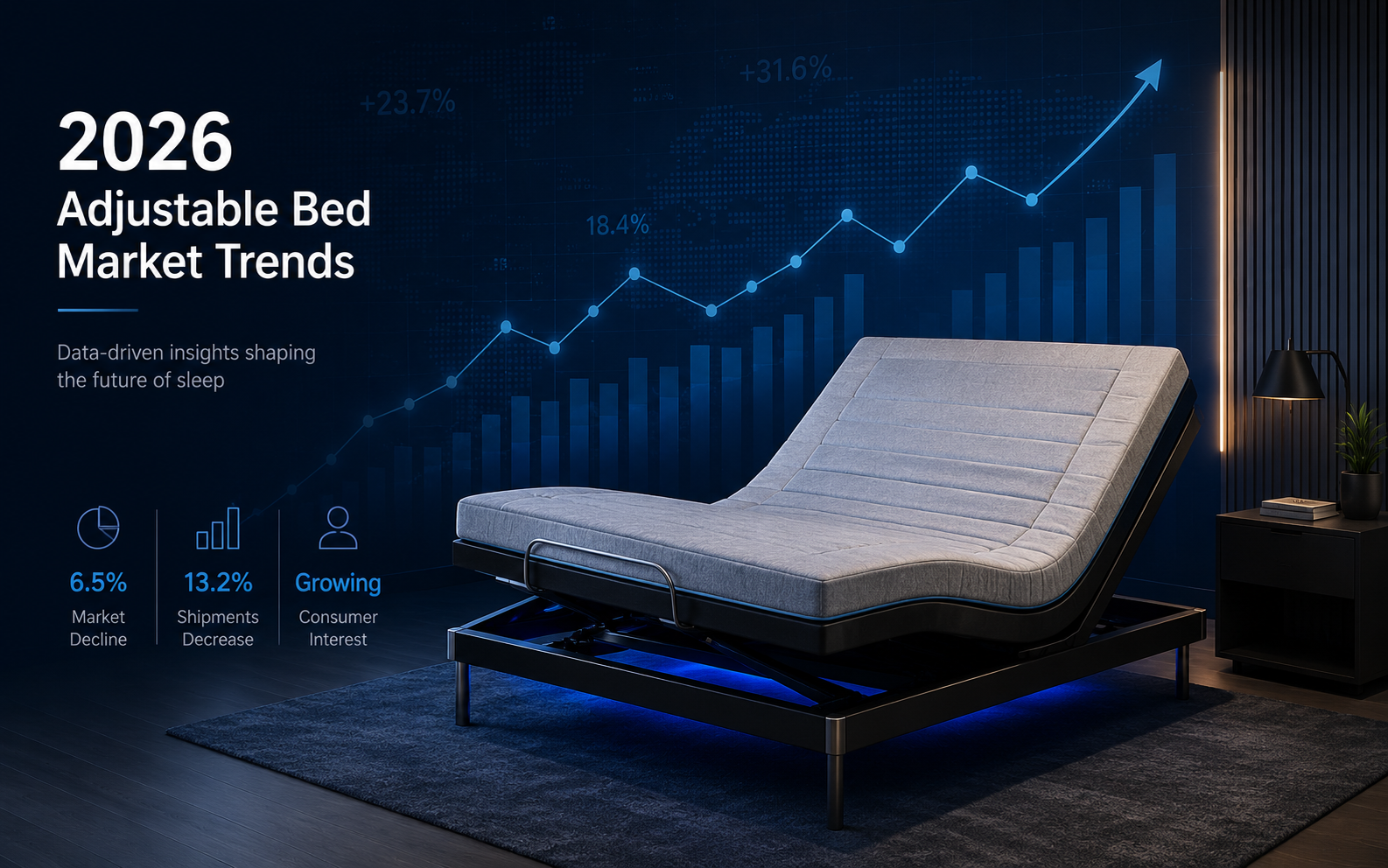
The latest U.S. mattress industry data points to a challenging but increasingly segmented market. According to the International Sleep Products Association’s 2026 Mattress Industry Trends Report overview, the total value of the U.S. mattress market declined by 6.5% in 2025, while unit shipments fell by 13.2%.
The difference between value and volume is important. It suggests that average selling prices and product mix held up better than shipment demand. In other words, the market did not simply move toward the lowest-priced products. Buyers continued to show interest in products that offered a clearer comfort story, stronger differentiation or additional functionality.
One of the most relevant findings for bedding brands is that adjustable bases remained comparatively resilient, even as several traditional foundation categories experienced sharper declines.
What does “comparatively resilient” mean?
It does not mean that every adjustable bed program grew or that the category is unaffected by economic pressure. It means adjustable bases performed more steadily than some surrounding bedding categories in a market where overall demand remained soft.
For B2B buyers, this points to a practical conclusion: motion products are increasingly treated as a distinct value category rather than only as an accessory beneath a mattress.
An adjustable base can help a brand add visible functions such as head lift, foot lift, one-touch flat positions and selected preset options. Depending on the model and confirmed configuration, it can also support different control systems, upholstery choices, packaging plans and private-label requirements.
These features give retailers and distributors more ways to explain the product, segment the collection and create a step-up purchase path. For a related view of connected smart sleep technology trends, see the CES 2026 analysis.
Why motion bases can support product-line differentiation
In a conventional mattress program, differences between models may be difficult for buyers to understand quickly. Materials, foam density, cover construction and firmness are important, but they are not always immediately visible in a showroom or online listing.
Adjustable bases create a more demonstrable product experience.
A buyer can see the platform move. A retailer can present reading, relaxation or zero-gravity-style positions where available. A mattress brand can combine an existing mattress range with several base levels rather than redesigning the entire mattress line.
This makes motion foundations useful for building a “good, better, best” assortment:
- A value-focused base can provide essential head and foot adjustment.
- A mainstream model can add a fuller frame, easier installation or additional presets.
- A premium model can focus on folding, logistics efficiency, memory positions or selected control upgrades.
- A flagship model can support more advanced structures or project-specific customization.
The exact feature set should always be confirmed by model. Not every function is standard across every adjustable base.
Four B2B questions for 2026 sourcing decisions
1. Is the product designed for the target sales channel?
A mattress retailer, furniture chain, hotel project and e-commerce distributor may need different structures. Retail programs may prioritize easy demonstrations and clear feature tiers. E-commerce programs may place more emphasis on folding design, carton dimensions and installation. Project buyers may focus on durability, electrical standards and after-sales coordination.
2. Does the mattress work correctly with the motion platform?
The mattress must be suitable for repeated articulation. Thickness, flexibility, internal construction and anti-slip performance can all affect the final user experience. Buyers should evaluate the mattress and base as a system rather than treating them as unrelated products.
3. Are logistics and packaging included in product planning?
Adjustable bases contain steel structures, motors, controls and moving components. Packaging design affects freight efficiency, warehouse handling, damage risk and installation. A lower factory price does not always create a lower total landed cost.
4. Can the supplier support a structured product range?
Many B2B customers need more than one model. A coordinated range with budget, mid-range, high-end and flagship positions can be easier to sell than a collection of unrelated products. Size options, fabrics, controls, plugs, voltage, packaging and private-label details should be planned together.
What this means for mattress and furniture brands
The 2026 market data does not remove the need for careful purchasing. It reinforces it.
When volume is under pressure, products need a clear commercial role. Adjustable bases can help brands move beyond price-only competition by creating visible comfort functions, stronger product segmentation and additional attachment opportunities.
For mattress companies, a motion-base program can extend an existing portfolio. For furniture businesses, it can add a functional sleep category. For distributors, it can create several price levels for different customer groups.
The strongest programs are usually not built around the longest feature list. They are built around the right combination of structure, functions, packaging, target price and market positioning.
Building a practical adjustable base program
KFY SMART offers four adjustable bed base levels for global B2B programs, covering value-focused distribution, mainstream retail, space-saving logistics and premium product positioning.
Buyers can review the Adjustable Bed Bases collection and discuss sizes, materials, controls, electrical standards, packaging and private-label requirements through the Contact page.
Product specifications and optional functions vary by model and confirmed order requirements.