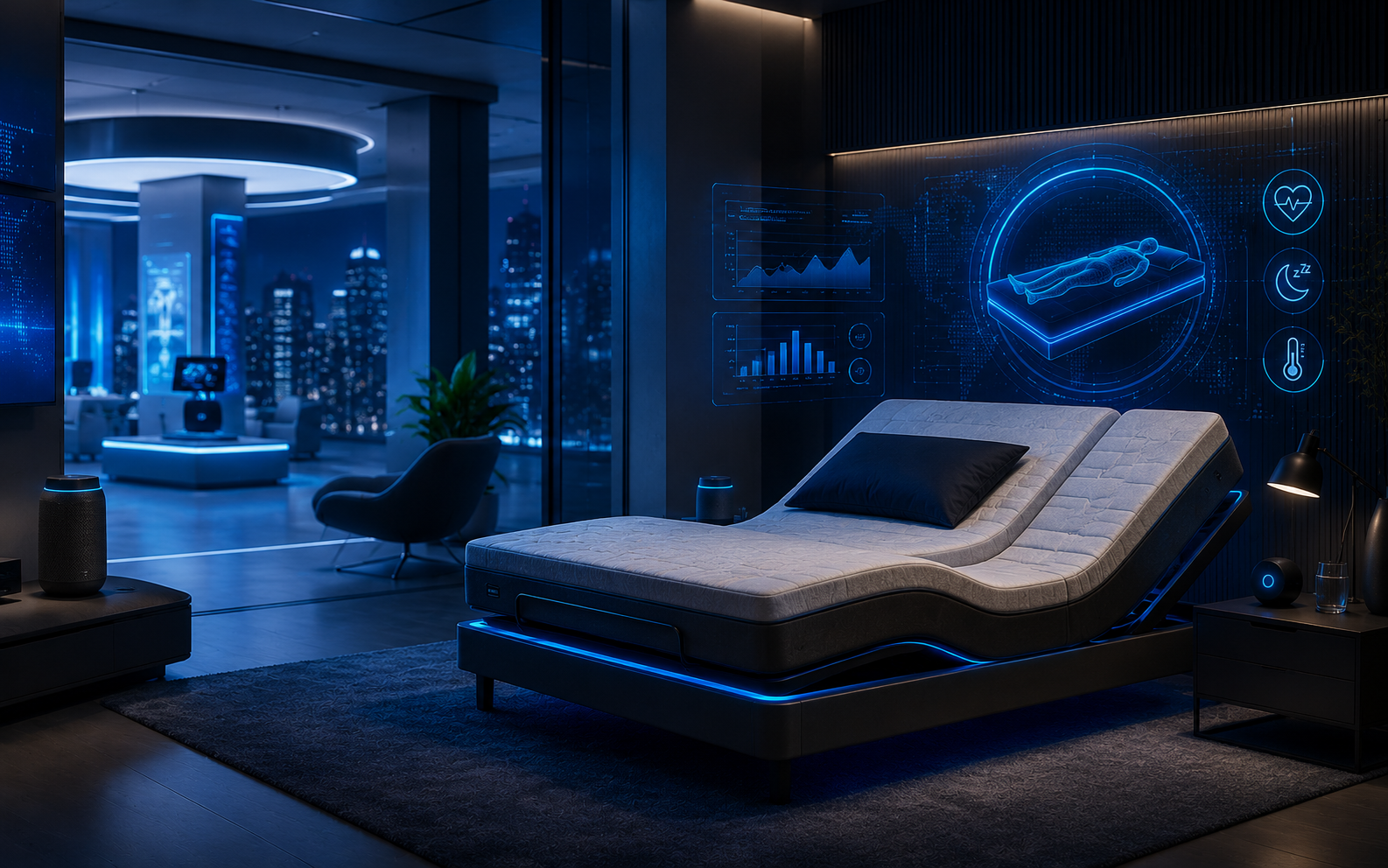
CES 2026 reinforced a major change in the sleep-products industry: the category is moving beyond individual hardware features and toward complete, connected sleep experiences.
Adjustable motion remains central. However, the wider smart-sleep conversation now includes software integration, environmental control, personalized routines, sustainable materials and more coordinated interaction between the mattress, base and surrounding bedroom.
For B2B buyers, this does not mean every product must include sensors, artificial intelligence or a mobile application. It means product planning increasingly needs to consider how hardware, controls, comfort functions and future connectivity may fit together.
Trend 1: The adjustable base is becoming a platform
For many years, adjustable bases were primarily described by their mechanical functions: head lift, foot lift, flat position, massage and preset positions.
Those functions remain important, but leading industry presentations are increasingly positioning the base as a platform that can connect with other components.
At CES 2026, Ergomotion introduced its Sleep Assist platform for compatible smart and adjustable beds. The company described an ecosystem combining a connected application, bed controls, sleep-related insights and automated routines. It also presented an environmentally focused adjustable base using recycled materials.
The broader industry message is clear: the value of an adjustable platform may increasingly depend on how well it supports controls, software, product upgrades and coordinated sleep experiences.
Trend 2: Smart mattresses are expanding beyond a single function
The CES 2026 Innovation Awards also highlighted smart mattress concepts that combine several environmental and comfort elements.
The SomaNest Mattress, a CES 2026 honoree, presented a system involving light, temperature, firmness and angle adjustment. Other CES exhibitors described integrated combinations of mattress support, adjustable bases and bedroom ambience.
These examples represent advanced technology concepts, not a standard specification for every commercial mattress. Many markets still need simpler and more affordable products.
However, they show where the category is heading: instead of asking whether a mattress is “smart,” buyers may increasingly ask which parts of the sleep environment it can control and how those functions create a useful customer experience.
Trend 3: Software experience matters more
A connected feature has limited value if setup is difficult, controls are confusing or the application is not supported in the destination market.
For private-label buyers, software creates additional sourcing questions:
- Who owns and maintains the application?
- Which operating systems and languages are supported?
- Does the product require an account, subscription or cloud service?
- How are firmware updates handled?
- What happens if the application is discontinued?
- Can the bed still perform essential functions with a physical remote?
- What data is collected, and which privacy requirements apply?
These questions are especially important when selling into multiple countries. A product may be mechanically reliable but commercially difficult if the software experience is not localized or supported.
For many B2B programs, a dependable remote-controlled product remains the correct starting point. Connectivity should be selected because it solves a market need, not simply because it is available.
Trend 4: Sustainability is entering the smart-bed conversation
CES presentations also showed that technology and sustainability are no longer separate product stories.
Ergomotion’s CES announcement described an adjustable base using recycled fabric and a high proportion of recycled frame material. This reflects a broader movement toward material documentation, product life-cycle planning and more responsible component sourcing.
For manufacturers and buyers, sustainability planning may involve:
- Steel and fabric material documentation
- Packaging reduction and recyclable packaging
- Replaceable motors and controls
- Product designs that support repair
- Clear separation of electronic and structural components
- Supplier information for destination-market compliance
Not every market requires the same evidence. However, brands that plan international distribution should expect more questions about materials, packaging and end-of-life responsibility.
Trend 5: Product portfolios still need clear levels
CES naturally emphasizes advanced innovation, but most B2B product lines need a balanced range.
A useful portfolio may include:
- Entry-level adjustable comfort with simple controls
- Mainstream models with key presets and practical packaging
- Higher-end products with selected control or comfort upgrades
- Flagship systems designed for integrated smart-sleep programs
This approach allows brands to participate in technology trends without forcing every buyer into the highest-cost configuration.
It also reduces the risk of presenting optional features as standard across an entire collection.
What B2B buyers should take from CES 2026
The most important lesson is not that every bed needs AI. It is that the sleep product is becoming part of a wider system.
A future-ready B2B program should therefore consider:
- Mechanical reliability first. Motion, frame stability, noise and repeated-use performance remain fundamental.
- Controls matched to the market. Physical remotes, applications and connectivity should be selected by channel and user need.
- Clear optional-function management. Sensors, massage, lighting and connected functions must be confirmed by model.
- Upgradeable product architecture. Replaceable or configurable controls can help a program evolve.
- Responsible claims. Products should not make medical, health-monitoring or AI claims unless the relevant functions, evidence and compliance requirements are confirmed.
For the broader commercial context, see 2026 adjustable bed market trends.
Planning smart-sleep products with KFY SMART
KFY SMART develops B2B product programs across Adjustable Bed Bases, Smart Beds and Smart Mattresses.
The available structure, controls and optional features differ by model. Buyers can discuss target price, market positioning, electrical standards, packaging and private-label requirements through the Contact page.