The aging-in-place market is expanding, but older consumers are not asking for technology simply because it is new.
They are looking for products that are understandable, reliable and useful in everyday life.
AARP’s 2026 technology research found that 66% of adults age 50 and older agreed that technology enriches life and makes aging easier. At the same time, three in five said technology is not designed with their age in mind. Two in five older adults were already planning a technology purchase in 2026.
This creates a clear design challenge for sleep-product brands: the opportunity is significant, but complicated features, unclear controls and weak support can quickly reduce trust.
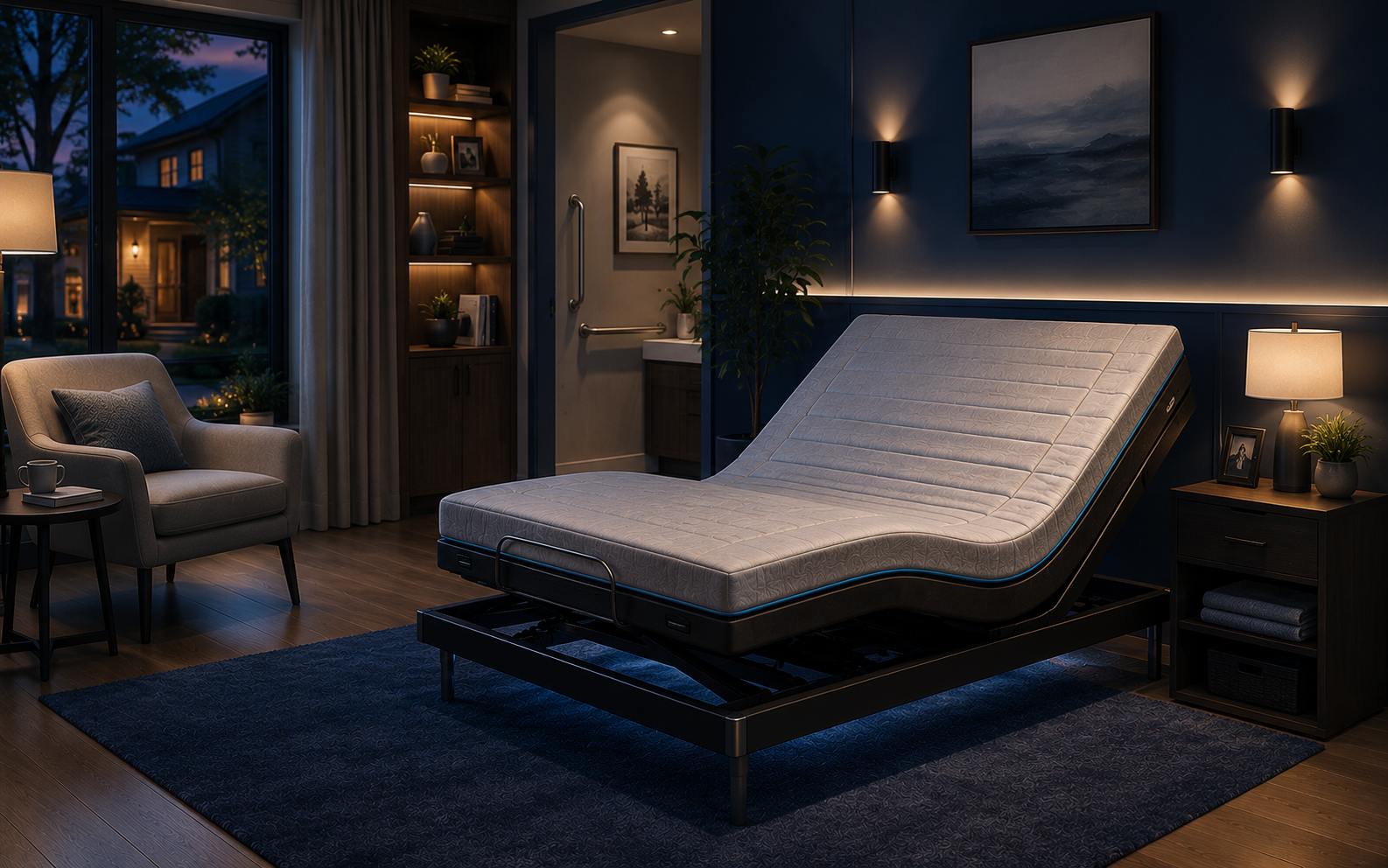
For adjustable beds and integrated smart mattresses, age-friendly design should begin with physical usability and simple comfort functions.
Aging in place is not the same as medical care
An adjustable bed for an older adult is not automatically a medical device.
Many products are designed for residential comfort, easier position changes, reading, relaxation and more flexible bedroom use. Medical claims, clinical functions and patient-monitoring features involve different evidence and compliance requirements.
B2B buyers should therefore define the application clearly:
- Residential aging-in-place product
- Senior-living apartment product
- Assisted-living furniture program
- Home-care-friendly product
- Medical or clinical product
The design, documentation, claims and required certifications may be different for each category.
KFY SMART products discussed for senior-friendly applications should not be represented as medical monitoring or treatment products unless a separately confirmed product and compliance scope supports those claims.
What age-friendly buyers may value most
Simple position adjustment
Head and foot movement can support reading, television viewing and relaxed resting positions. The controls should be easy to identify and operate.
A physical remote may be more appropriate than an application-only system for many users. Buttons should be limited, logically arranged and visually clear.
Practical bed height
The height of the sleep surface affects how easily a user can sit down, stand up and transfer beside the bed. Product planning should consider the mattress thickness, adjustable structure, legs and overall frame.
An integrated lift function may be relevant for selected projects, but it should be confirmed by model rather than assumed across the product line.
Stable entry and exit space
The bed should have predictable edges, sufficient floor clearance and practical access on the intended side. Optional removable side supports or rails may be useful in some residential or care-oriented configurations.
These components must be securely attached and should not obstruct the user, caregiver or housekeeping process.
Quiet, smooth movement
Sudden movement or excessive motor noise can reduce user confidence. The bed should move steadily and return to a flat position in a clear, controlled way.
Easy-to-clean materials
Senior living and home-care projects may prioritize upholstery that is durable, comfortable and practical to maintain. Fabric or PU material selection should match the project’s cleaning plan and local requirements.
Reliable manual operation
Essential functions should remain usable without requiring complicated software. Buyers should consider what happens if a mobile application, wireless connection or account is unavailable.
Usability and trust are part of the product
AARP’s research highlights a persistent gap between technology adoption and age-friendly design.
That gap matters for adjustable sleep products. Even a mechanically capable bed may perform poorly in the market if users do not understand the controls or fear damaging the system.
Brands can reduce this problem through:
- Clear product instructions
- Large, readable remote-control symbols
- Consistent button layouts across models
- One-touch flat return
- Simple installation guidance
- Customer-service documentation
- Spare remote and control-box planning
- Realistic product claims
For distributors and private-label brands, support materials are part of the product experience.
B2B product planning for senior-living channels
A complete senior-friendly program should evaluate more than the bed itself.
Residential retail
Products should fit normal bedrooms, standard delivery routes and household electrical systems. Appearance matters because many customers want supportive functions without a hospital-style design.
Senior-living apartments
Operators may need coordinated room dimensions, durable materials, simplified controls and replacement-part planning. The bed should support a warm residential environment.
Home-care distribution
Distributors may prioritize ease of assembly, packaging, clear user instructions and optional support accessories. Claims should remain within the confirmed residential product scope.
Project-based procurement
Project buyers should confirm quantities, installation responsibility, destination standards, spare parts, control systems and after-sales arrangements before finalizing specifications.
A better design principle: useful before “smart”
For aging-in-place markets, the most successful product may not be the one with the most functions.
It may be the one that:
- Moves smoothly
- Feels stable
- Is easy to control
- Fits the room
- Looks residential
- Can be maintained
- Provides clear value at the target price
Connected controls, sensors or advanced software can be considered where they have a defined user benefit and the relevant compliance requirements are addressed. They should not replace basic usability.
Exploring age-friendly smart sleep products
KFY SMART’s Smart Beds collection includes several structures for different B2B positions. The W4 integrated smart mattress concept may also be discussed for selected residential and care-friendly projects, subject to confirmed specifications and destination requirements.
Buyers can review Smart Mattresses and contact the KFY SMART team through the Contact page to discuss bed height, structure, removable support options, controls, materials, packaging and project needs.
Product features vary by model. Final suitability must be evaluated for the intended market and application.